
Related videos:
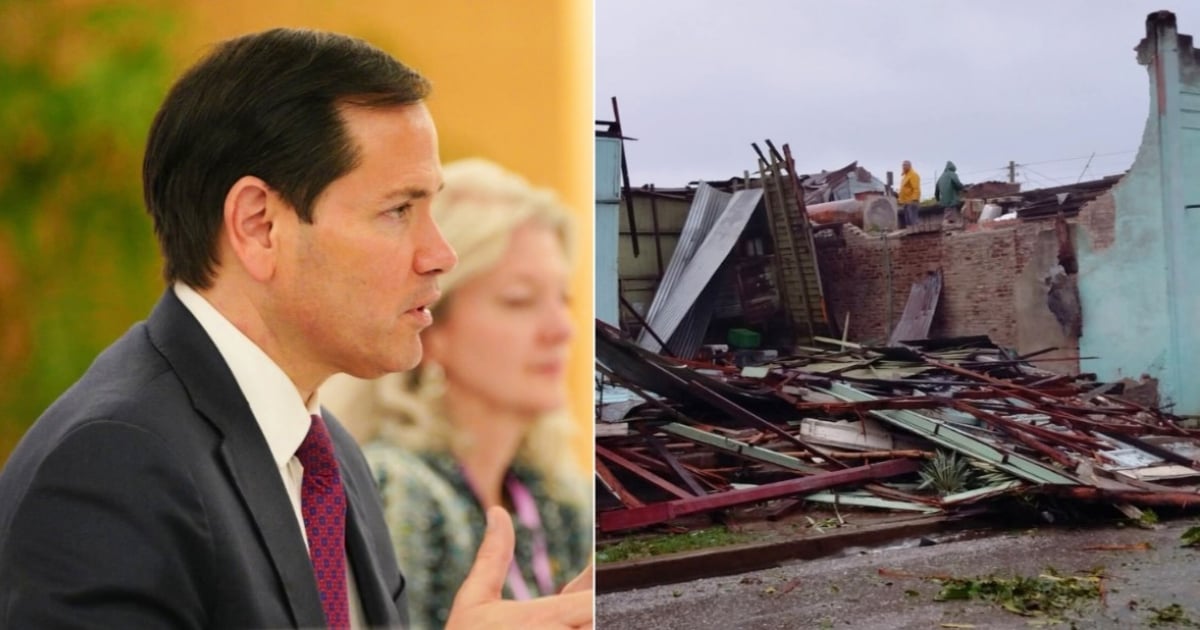
In an unexpected turn amid the humanitarian crisis caused by Hurricane Melissa, the U.S. Secretary of State, Marco Rubio, announced this Thursday the willingness of the U.S. government to provide "immediate" humanitarian assistance to Cubans affected by the weather event.
The statement was made through his account on the social media platform X, where the Republican official avoided going into details but made it clear that the island is joining the group of countries that will be able to receive assistance from Washington.
“We are ready to provide immediate humanitarian aid to the Cuban people affected by the hurricane,” Rubio stated succinctly.
The message—later reproduced by the U.S. Embassy in Havana—comes just one day after Rubio himself made public the active coordination with the governments of Jamaica, Haiti, the Dominican Republic, and the Bahamas to respond to the emergency.
At that moment, however, Cuba was not included among the countries with which the United States maintained contact to coordinate joint actions in response to the natural disaster.
A source from the Embassy told CiberCuba that "more things are coming", and they are waiting to see what they will be told after Rubio's announcement.
Rubio then added a second post in which he stated that the Trump administration "stands in solidarity with the brave Cuban people."
"Following the devastation caused by Hurricane Melissa in eastern Cuba, the Trump administration stands in solidarity with the brave Cuban people, who continue to struggle to meet their basic needs," he wrote.
The Secretary of State added that "the United States is ready to provide immediate humanitarian assistance, both directly and through local partners who can distribute it more effectively to those in need."
The statement from the U.S. Secretary of State comes in a political context characterized by sanctions against the Havana regime and the systematic rejection of any attempts at rapprochement by the Donald Trump administration.
The official policy toward Cuba, upheld by Rubio as a key figure in the hardline of the Republican Party, has emphasized pressure and isolation, dismissing significant concessions or bilateral dialogues.
Precedents of aid and historical tensions
Recent history has shown that humanitarian aid offers between the United States and Cuba during times of natural disaster have been exceptional and politically delicate.
In 2022, following the devastating Hurricane Ian, the government of Havana requested emergency assistance from the Biden administration.
That request generated a limited response but demonstrated an unusual openness amid the diplomatic confrontation.
A few months earlier, following the fire at the Supertanker Base in Matanzas, Cuba had requested technical assistance from Washington.
Nevertheless, on other previous occasions, when humanitarian aid has been offered by the U.S., it has been rejected by the Cuban government, on the grounds that it is not provided in conditions that respect national sovereignty.
In this context, the arrangement now announced by Rubio falls within a tradition of occasional and limited assistance.
So far, the Cuban government has not issued any official response to Rubio's message. State media and institutional channels have not reported any statements regarding the American offer.
What is clear is that the emergency in eastern Cuba demands significant resources.
Torrential rains, flooding, and damage to critical infrastructure in provinces such as Santiago de Cuba, Holguín, and Granma have left communities cut off and entire areas without access to electricity or drinking water.
Filed under: