
Related videos:
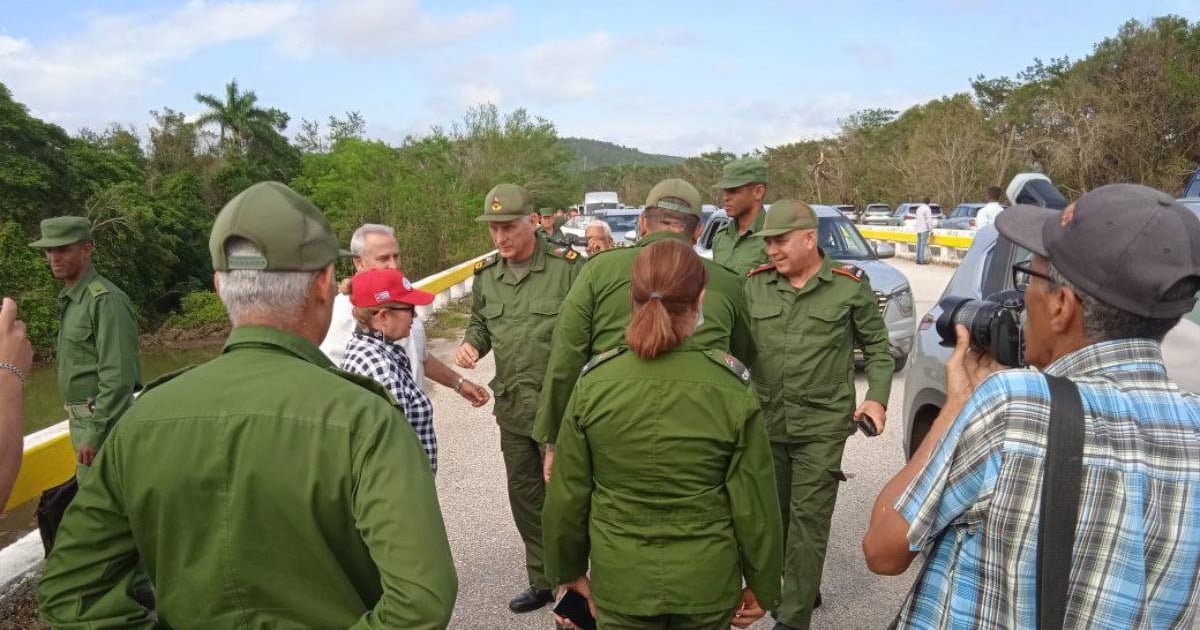
Cuban President Miguel Díaz-Canel began this Friday assessing the damage caused by Hurricane Melissa in Santiago de Cuba and traveled to Guantánamo to continue his visit to the eastern part of the country, where isolated communities, destroyed homes, and severe agricultural impacts persist.
The hurricane Melissa left flooding, landslides, and severe damage to crops and infrastructure in its wake. The official Presidential account shared images of Díaz-Canel in conversation with the secretary of the Communist Party, Beatriz Johnson Urrutia, who stated on Facebook that "Santiago de Cuba is rising and starting the recovery efforts."
On Thursday, Díaz-Canel visited San Luis, Guamá, and Contramaestre, where he witnessed the devastation caused by the winds and rains. In areas like Chivirico, on the western coast of the province, homes, banana crops, and a significant portion of the infrastructure were destroyed, although authorities repeat as a mantra: “We are alive!”
The official report itself acknowledges that several municipalities remain cut off by road, especially Segundo Frente and Guamá, which can only be accessed by air.
In light of that situation, the regime announced emergency measures, such as deploying buses to cover the disrupted routes, repairing damaged bridges, and mobilizing construction forces.
In Santiago de Cuba, dozens of communities remain isolated, without communication or basic services.
Guantánamo: more damage, fewer answers
In Guantánamo, the official newspaper Venceremos reported that Díaz-Canel arrived accompanied by Politburo member Roberto Morales Ojeda and several ministers. The group visited critical points such as the La Yaya dam, the Valvo Company, the Río Frío Bridge, and the affected areas in Yateras and Manuel Tames.
The rains from Melissa increased the level of the La Yaya dam to 165 million cubic meters, releasing water at a rate of 200 cubic meters per second, something that hadn’t happened since 2012. The rise in water levels caused the Cabaña bridge to become submerged and disrupted the fiber optic network, leaving a large part of the province without communication.
The regime claims that communication has been partially restored and that work is underway to repair the damaged roads, especially the one in Yateras, where a landslide has left several communities isolated.
In terms of electricity, an isolated system was implemented to supply the provincial hospital and other essential services, with plans to incorporate four solar parks. Numerous homes are also reported to be affected or collapsed, for which the government intends to use containers as a temporary solution.
In the agricultural sector, the most significant damages are concentrated in coffee, bananas, and corn.
The First Secretary of the Party in Guantánamo, Yoel Pérez García, stated that they will "make use of the water to plant more rice" and that "the wood from fallen trees will be utilized."
Díaz-Canel, for his part, called to "engage the producers" to increase food production in the territory.
The president's tour of the affected areas combines close-up images and triumphant messages, while the real needs of the people far exceed the official promises.
In eastern Cuba, thousands of families remain without shelter, electricity, and basic food supplies, and recovery will depend—more on community solidarity and the individual efforts of the affected than on the Party's rhetoric.
Filed under: