
Related videos:
After the devastating passage of Hurricane Melissa through eastern Cuba, Miguel Díaz-Canel traveled to Holguín on Thursday to assess the damages and "drive the recovery," according to official media reports.
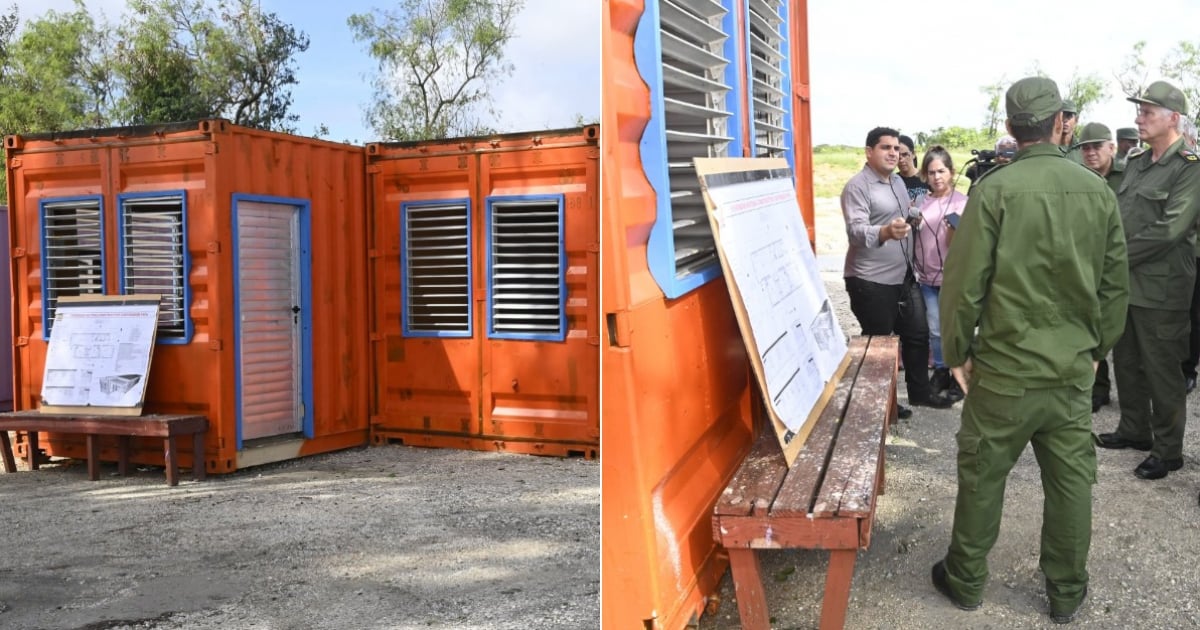
The Presidency of Cuba released images of the leader touring the Military Construction Unit in Perdenales, where shipping containers are being converted into housing for those affected.
The project, presented as an "agile and comfortable alternative," has been advertised by the regime as a demonstration of creativity and efficiency amidst the crisis.
However, this supposed solution does not escape the triumphalist tone that the government uses to mask widespread precariousness.
In a country where hundreds of families have still not recovered from the devastation caused by previous hurricanes, Díaz-Canel's visit comes amid an unprecedented housing emergency, exacerbated by a lack of materials, low wages, and institutional neglect.
During his visit, the leader also toured the José Martí Vocational Pre-University Institute of Exact Sciences, which has been set up as an evacuation center for more than 300 people from the municipalities of Cacocún and Urbano Noris.
There, according to the official note, he inquired about the conditions of the evacuees and received reports on the "good food" and "health and psychological care" they are being provided. The Presidency stated that "the families said they feel protected."
As is customary on these types of tours, the leader stated that he was taking away "a good impression" of the work done.
However, the scene carefully depicted by the official communication contrasts with the reality reported by the residents of Holguín themselves: thousands of victims continue to lack state assistance, food, shelter, and hope.
Container homes: an improvised solution for a chronic crisis
The conversion of shipping containers into homes has become one of the most supported projects by the Cuban regime in recent months.
Presented as an "efficient and sustainable" option, these metal structures aim to alleviate the housing deficit that the country has been experiencing for decades.
However, more than an architectural innovation, the project reflects the profound inability of the State to maintain a construction system that has been in ruins for years.
Unlike other countries where container houses are built with thermal insulation, proper ventilation, high ceilings, and protective materials, the Cuban versions lack these basic conditions.
The images broadcast by national television show stacked containers, without visible insulation, lacking climate control systems, and with simple aluminum shutter windows, inadequate for the extreme heat of eastern Cuba.
Specialists and citizens warn that, instead of providing comfort, these "metal homes" could turn into heat traps during the day and uninhabitable spaces during the frequent nighttime blackouts.
On social media, many have mocked the project, nicknaming the new communities "the microwave houses".
The Ministry of Construction itself acknowledged that the initiative is "a temporary variant" to expedite the delivery of housing.
However, in Cuba, temporary situations tend to become permanent, and those affected fear being trapped in a makeshift solution that does not address the underlying issue.
An inadequate model for a country in ruins
In developed countries, container houses can be an eco-friendly and functional alternative thanks to private investment and access to specialized materials.
In Cuba, on the other hand, they are implemented in a context of economic collapse, uncontrolled inflation, and a complete lack of basic resources, making it impossible to replicate those standards.
The official images show structures without thermal bases or visible reinforcements, raising concerns about their safety in the event of future storms or hurricanes.
There is also no information about the electrical and sanitary systems, in a country where power outages are frequent and water supply is inconsistent.
The official discourse insists that this is a "rapid response" and a "demonstration of the country's ability to overcome difficulties," but the reality is different: Cuba continues to rely on political will and propaganda to conceal the collapse of its infrastructure and the lack of real housing policies.
In Holguín, as in so many other provinces, the victims of Hurricane Melissa are not only facing the loss of their homes but also the burden of a system that fails to—nor seems willing to—ensure them a dignified life.
Filed under: