
Related videos:
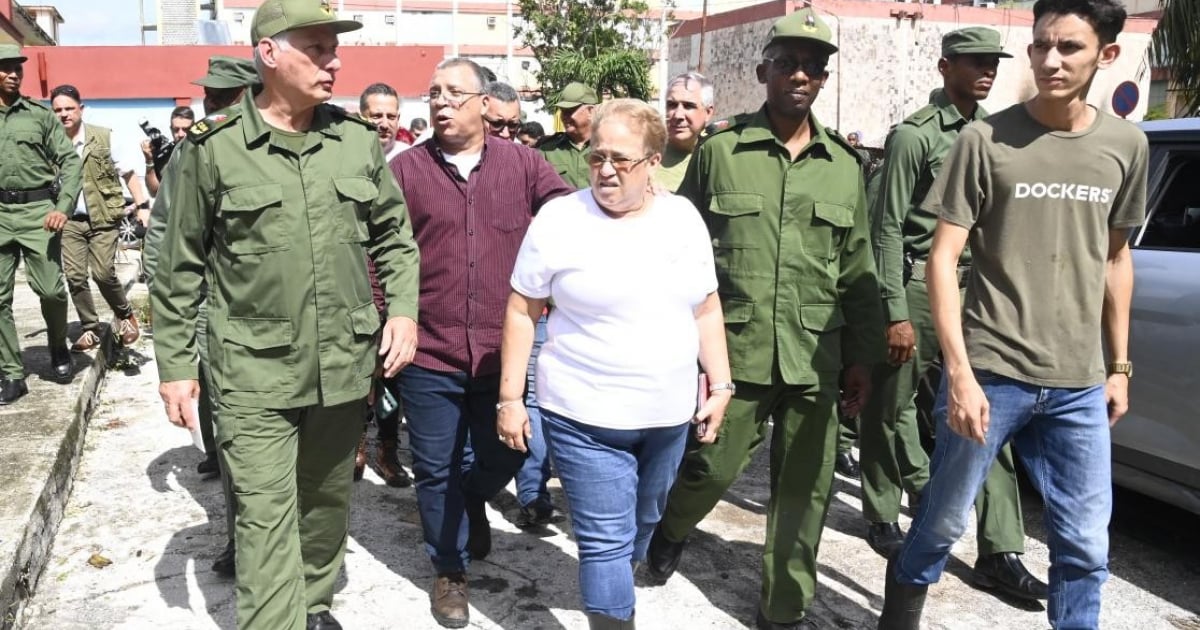
The leader Miguel Díaz-Canel visited the Vladimir Ilich Lenin Provincial Hospital in Holguín this Thursday, one of the most important medical institutions in eastern Cuba and also one of the hardest hit by the hurricane Melissa.
According to information from the Presidency of Cuba on its X account, the president toured the area alongside local authorities.
The institutional message states that, despite the flooding and the damage to the generator, "the hospital remains operational, just like the other health facilities in Holguín."
At the end of the visit, Díaz-Canel expressed that he had a "good impression" of how work is being conducted in the province and conveyed greetings from Raúl Castro, who stated that he is "aware of the entire situation."
Between the official discourse and the reality of overwhelmed hospitals
The triumphalist narrative contrasts sharply with the images broadcast just hours earlier by Cuban television and shared on social media, which showed flooded wards, inundated hallways, fallen trees, and medical equipment covered with makeshift tarps to protect them from the water.
The official reporter admitted that the situation at the center was "extremely precarious," while medical personnel and workers were trying to evacuate the accumulated water.
According to local testimonies, the hospital lost part of its operational capacity after the collapse of the emergency electrical system.
"There is no electricity, no water, and the generators are barely holding up. We are doing what we can," stated a healthcare worker, who requested anonymity, on social media.
Holguín is one of the provinces most affected by Melissa, whose torrential rains caused river overflows, the collapse of urban drainage, and the isolation of entire communities.
While Díaz-Canel speaks of "immediate recovery" and "vitality," the reality in hospitals tells a different story: buildings without maintenance for years, roofs with leaks, a lack of medicines, minimal surgical supplies, and exhausted staff.
Another devastated hospital in Santiago de Cuba
More than a hundred kilometers to the southeast, the Dr. Juan Bruno Zayas Alfonso General Hospital in Santiago de Cuba suffered significant structural damage following the hurricane.
Photos published by the institution itself on Facebook showed a scene of torn roofs, shattered windows, hallways flooded with water and debris, and fallen trees within the hospital grounds.
"Melissa, as if sent from the underworld, has wreaked havoc in our hospital," acknowledged the center's management, which, despite the magnitude of the disaster, closed its statement with the usual tone of "unity and victory."
Two days before the cyclone hit, the Ministry of Public Health had assured that the hospitals in the region were prepared to face the hurricane, with checked generators and guaranteed supplies.
Reality disproved that narrative: years of neglect and deficiencies turned hospitals into fragile structures, incapable of withstanding a major weather event.
A healthcare system on the brink of collapse
Melissa's passage not only caused material damage; it exposed the collapse of a healthcare system that the regime continues to present as a model of humanity and efficiency.
Before the hurricane, reports of infectious outbreaks, lack of hygiene, shortages of essential medications, and power outages that paralyzed operating rooms were already being made.
Today, Cuban hospitals survive with the same precariousness as the rest of the country: lacking resources, maintenance, and official responses beyond triumphant rhetoric.
While Díaz-Canel tours flooded rooms claiming that "vitality is maintained," the population confronts the tragedy with resignation and without real assistance, trapped in a crumbling system that long ago ceased to guarantee even the basics: health and dignity.
Filed under: