
Related videos:
The Cuban economist Pedro Monreal warned that the lack of financial resilience and the accumulated impoverishment following the "economic reordering" are turning the aftermath of Hurricane Melissa into a long-term disaster for thousands of Cuban families, beyond the immediate material damage.
Through a series of posts on his X account (formerly Twitter), Monreal argued that the most critical factor in the recovery of Caribbean countries after hurricanes is not the magnitude of the meteorological event, but rather the level of poverty and access to preexisting financial resources.
In his analysis, he cited regional studies that show how the lack of insurance, savings, or rapid transfer mechanisms exacerbates socioeconomic effects and prolongs the recovery time.
"The level of socioeconomic resilience —measured by the poverty index and access to financial resources— has been crucial in the Caribbean," she wrote.
According to Monreal, empirical evidence shows that “for every 10% decrease in the poverty index, the delay in the recovery of per capita GDP after a natural disaster was reduced by one year,” based on a World Bank study (2024).
The economist compared the situation in Cuba with that of Puerto Rico and the Dominican Republic after hurricanes María (2017) and David (2017). In the case of the Dominican Republic, he recalled that 90% of the damaged homes were not insured and 70% of the population fell below the poverty line after the disaster.
In Cuba —he emphasized— the situation is even more precarious. The so-called monetary ordering, which eliminated subsidies and partially dollarized the economy, has left households without a financial cushion or real access to credit or insurance.
"The worsening impoverishment due to regulation and financial disempowerment is likely to exacerbate the economic and social situation of Cuban households in the aftermath of the disaster," Monreal warned.
Furthermore, the economist criticized the new Council of Ministers Agreement 10/247, approved after Hurricane Melissa, which proposes supposed subsidies and soft loans for those affected.
"It is not clear how subsidizing and offering loans could be translated into real resources," he stated, noting that Cuba has an outdated post-disaster protection scheme compared to other Caribbean countries.
Monreal mentioned two mechanisms used in the region that could be implemented on the island: parametric microinsurance, which automatically releases funds in the event of a natural disaster, and direct cash transfers, whether conditional or not, to vulnerable households.
"Early warning and evacuation save lives, but they do not necessarily restore the level of life prior to the disaster," he concluded.
A disaster that amplifies the structural crisis
Monreal's analysis aligns with the reports published in recent days regarding the extent of the damage caused by Hurricane Melissa.
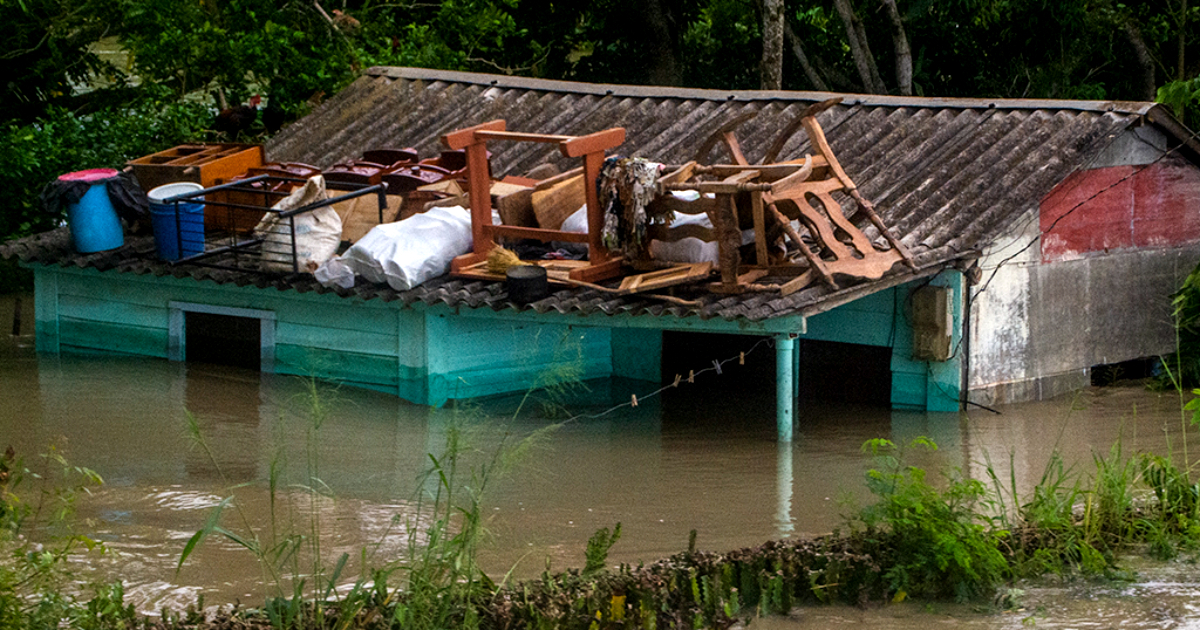
According to official data cited by this outlet, over 46,000 homes have been affected in the eastern and central regions of the country, while dozens of communities remain cut off or lack stable access to electricity and potable water.
The Cuban government has opened bank accounts to receive donations, but citizen criticism persists due to a lack of transparency in the management of resources.
CiberCuba has documented multiple cases of corruption and misappropriation of humanitarian aid, ranging from the sale of oil donated by the World Food Programme to the resale of construction materials intended for victims in Pinar del Río and Havana.
This distrust is compounded by the structural housing crisis: 35% of the housing stock in the country is in poor technical condition, according to official data. Hurricanes, far from being exceptional events, thus become triggers of poverty that has accumulated over the years.
After decades of hurricanes, landslides, and unfulfilled promises, shelters for disaster victims have become an extension of the housing crisis in Cuba, rather than a temporary solution.
Thousands of people survive for years—and in many cases, for decades— in makeshift accommodations, old schools, or state-owned warehouses, without privacy, overcrowded, and with no guarantee of receiving permanent housing.
The State considers them "resolved cases," but in reality, they remain trapped in a bureaucratic limbo, amid lost files and official promises that are renewed with each government visit.
The lack of resources, administrative corruption, and the absence of a sustainable housing plan have made the figure of the "sheltered" a lasting symbol of the system's failure to care for the most vulnerable.
Meanwhile, the victims of Melissa are facing the same vicious cycle that has characterized previous disasters: delayed aid, promises of loans without real backing, supplies that vanish, and a government unable to ensure transparency or accountability.
Monreal's warning summarizes the root of the problem: without economic resilience, without access to financial mechanisms, and without institutions that respond effectively, each new hurricane in Cuba not only destroys roofs but also the few certainties of economic survival for millions of Cubans.
Filed under: