
Related videos:
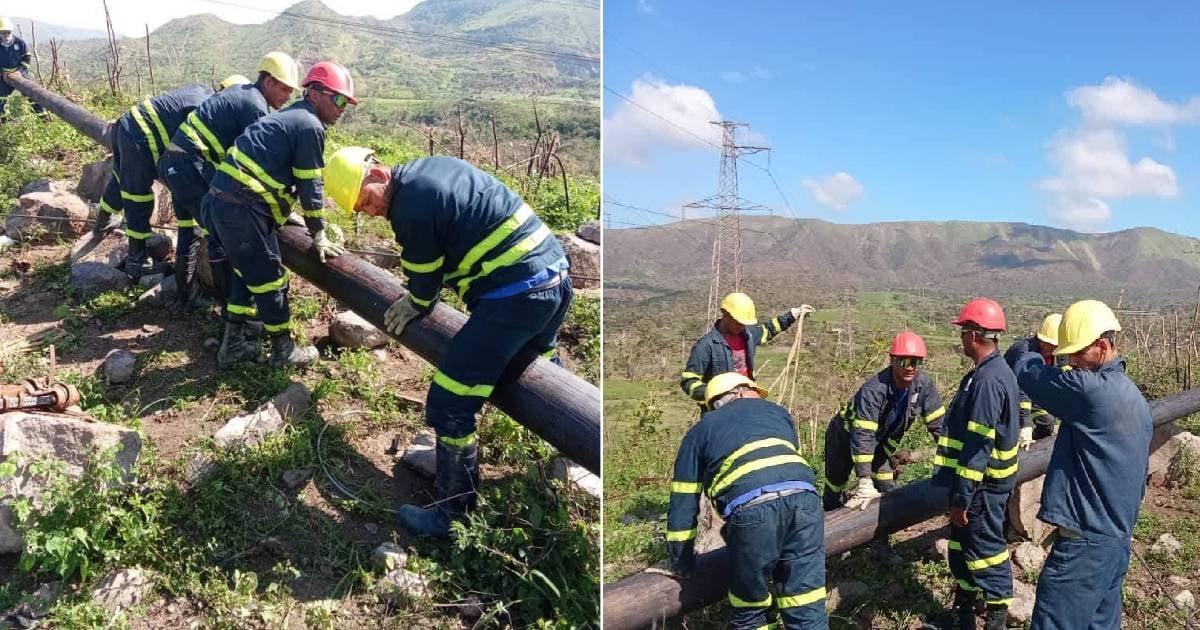
The Cuban Electric Union (UNE) reported that 54.02% of the service in the eastern region of the country has been restored following the severe damage caused by Hurricane Melissa, which left large areas without power for several days.
According to the state company on the social network Facebook, the result is due to the "relentless effort" of the linemen and teams mobilized to the most affected provinces.
"Every advancement is the result of the commitment, discipline, and dedication of those who work tirelessly to restore the stability of the national electrical system," noted the UNE in a statement released this Tuesday.
Recovery efforts continue in the provinces of Granma, Santiago de Cuba, Holguín, Guantánamo, and Las Tunas, where outages in transmission networks and substations persist.
Although the figure represents a significant advance, hundreds of thousands of households still remain without electricity, which continues to put pressure on the national electrical system, already affected by structural failures and a lack of generation capacity.
Blackouts continue throughout Cuba
Cuba woke up this Thursday engulfed in a new day of blackouts.
According to the report from UNE in its daily report, the national electrical system remains in collapse, with a deficit exceeding 1,100 megawatts (MW) during peak hours.
This means that more than 40% of the country's demand cannot be met, which will leave millions of Cubans without electricity for much of the day and night.
UNE itself acknowledged that the disruptions lasted for 24 hours on Wednesday and that Thursday morning began with power outages.
The highest reported outage was 1,311 MW at 6:10 PM, a figure that highlights the magnitude of the collapse.
This situation is compounded by another 414 MW out of service in the eastern part of the country, between Las Tunas and Guantánamo, due to the destruction caused by Hurricane Melissa, which left significant damage to lines and substations.
A broken system
At 6:00 am, the total availability of the system was only 1,720 MW, compared to a demand of 2,100 MW, indicating a deficit of 380 MW.
At peak time, an impact of 500 MW is estimated.
The situation will worsen as evening falls: during peak hours, the UNE estimates a demand of 2,850 MW and a supply that will not exceed 1,760 MW, resulting in a deficit of at least 1,090 MW, with an impact of 1,160 MW.
The regime tries to attribute the collapse to malfunctions and scheduled maintenance, but the situation reflects a structural deterioration of the electricity system, lacking real investments and long-term planning.
Currently, Unit 2 of the Felton thermoelectric plant is out of service due to a breakdown, in addition to two other units in Santa Cruz del Norte and Cienfuegos that are undergoing maintenance.
In total, 653 MW remain unavailable due to technical limitations at the thermal power plants, a constant issue in recent months.
Lack of fuel and abandonment
The crisis is worsened by the chronic shortage of fuel, which paralyzes a significant portion of distributed generation.
The UNE reports 60 power plants out of service due to a lack of diesel, which translates to 519 MW less, and another 131 MW unavailable due to a shortage of lubricants. In total, 650 MW are lost due to the lack of basic energy resources, reflecting the logistic and financial collapse of the country.
Although the government insists on promoting the "advancements" in renewable energy, the results are negligible in light of the magnitude of the crisis.
The 22 new photovoltaic solar parks in the west and center of the Island only contributed 420 MW at their peak, an amount that fails to compensate even a fraction of the losses from the thermal system.
Endless blackouts and empty promises
In Havana, the provincial Electric Company reported that the capital experienced power outages for nearly 11 hours on Wednesday, with a maximum impact of 174 MW at 7:00 PM.
The service was restored just before 9:00 PM.
"It was not necessary to affect the planned blocks (4 and 6) at 10:00 PM. In the early morning, there was no impact due to a deficit," the note published on Facebook specifies.
The reality in Havana's neighborhoods remains the same: intermittent outages, overloaded circuits, and an exasperated population.
While the UNE publishes daily reports filled with technical jargon, the population remains in the dark, without refrigeration for food, without ventilation in the heat, and without electricity to sustain work or study.
More than a decade of unfulfilled promises, lack of maintenance, corruption, and diversion of resources have resulted in an energy system in ruins, unable to sustain the minimum demands of the population.
Cubans no longer anticipate solutions, only the next blackout.
Filed under: