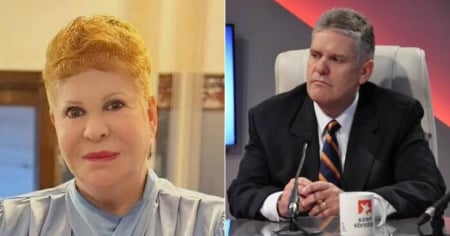
“This is a difficult moment, but it is also an opportunity to demonstrate that the Revolution is still alive,” declared Yudelkis Ortiz Barceló, the first secretary of the Communist Party of Cuba in Granma, during a meeting of the National Defense Council broadcast on the program Desde la Presidencia this Thursday.
In a triumphalist tone, the leader asserted that the damage caused by Hurricane Melissa, which struck eastern Cuba on October 29, will allow for “the legacy of Fidel to be demonstrated” and to show that “the Revolution does not leave any of its children abandoned.”
According to Ortiz, the disaster represents an “uplifting moment” and an “opportunity to do more for the people,” a phrase that attempts to obscure the extent of the damage suffered by one of the country's most affected and impoverished provinces.
"The Revolution is still alive," but in misery, as behind the rhetoric, the data reveal a very different reality.
The leader herself admitted that only 64% of the electrical service has been restored in Granma, a province where 50 primary circuits still remain without power.
It also acknowledged that more than 5,000 people remain sheltered in state centers and that agricultural losses amount to 47,833 hectares of devastated crops—including coffee, rice, tobacco, and vegetables.
The municipality of Río Cauto, which Ortiz described as the "epicenter of the greatest complications," continues to have flooded communities ten days after the cyclone’s passage.
The Defense Council itself keeps that area and Cauto Cristo on alert due to the water levels and the lack of access to basic services.
Ortiz stated that the province is "working diligently" with brigades and commissions to assist those affected, but he acknowledged that only 79% of fixed-line telephone services have been restored and that the recovery is progressing "gradually."
Even in the education sector, Ortiz attempted to present the partial reopening of 200 schools as a sign of recovery, when in reality, most municipalities in eastern Cuba are still struggling with a lack of electricity, drinking water, and transportation, in addition to a health crisis that is decimating the population.
The official emphasized that "the Revolution does not leave any of its children abandoned because we are here and we support them," but she omitted the most serious issues: the shortage of construction materials, the slow distribution of humanitarian aid, and the lack of state capacity to respond to emergencies that recur year after year.
During the broadcast of the program Desde la Presidencia, the Minister of Economy and Planning, Joaquín Alonso Vázquez, stated that “we have not had to mourn a single death or injury, due to the passage of the hurricane,” despite Melissa being considered one of the most disastrous cyclones to have hit Cuban soil.
According to Alonso, the “determined and commendable action” of both organizations allowed for the “protection of life” of the residents in the affected areas, even in cases where evacuations took place after the impact of the meteorological phenomenon.
The minister's statements contrast sharply with the scene of destruction that Melissa left in the eastern part of the country.
Reports from the United Nations and humanitarian organizations describe severe damage to over 60,000 homes, 1,500 schools, and hundreds of medical centers, as well as millions of people affected by crop loss, service interruptions, and communication breakdowns.
Similarly, the leader Miguel Díaz-Canel stated that there are no deaths following Hurricane Melissa in Cuba, while significant material damages are reported and testimonies of two fatalities in Santiago de Cuba.
Filed under: