
Related videos:
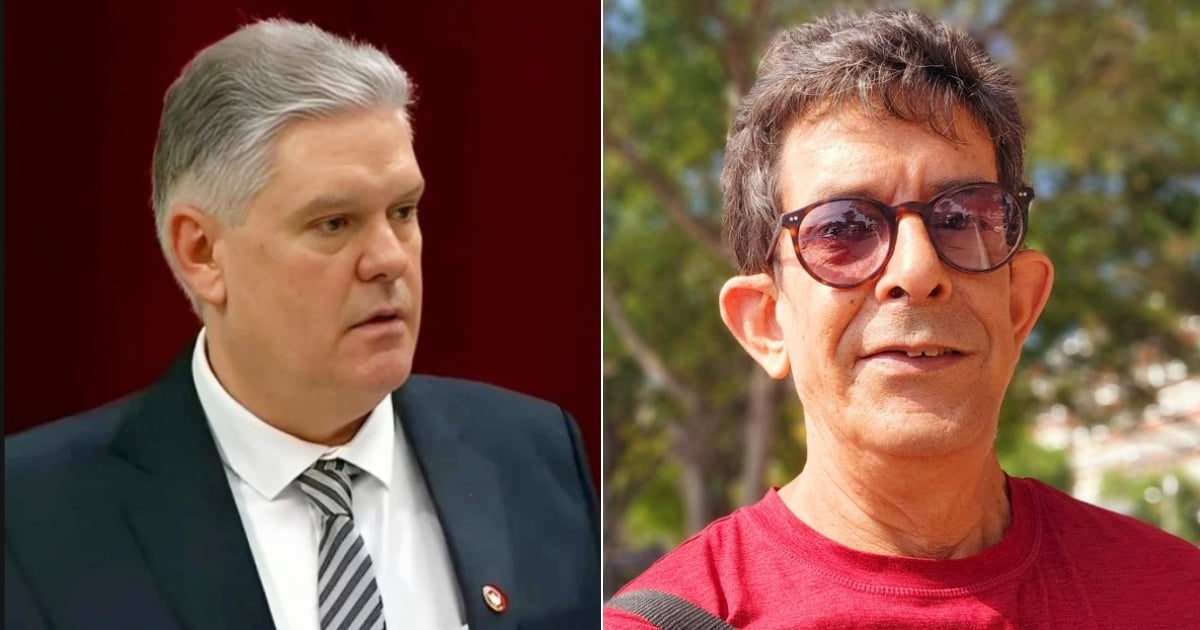
The comedian Ulises Toirac has described the case of the former Cuban Minister of Economy, Alejandro Gil Fernández, as “a puzzle with missing pieces.”
His analysis, shared on social media, has not been limited to the judicial process but has instead focused on the political context and the way information is handled by those in power.
In the midst of the media and political storm sparked by Gil's arrest and prosecution, Toirac acknowledges that until now he had avoided delving into the subject, but he does so with a clear warning: the case seems incomplete to him, shrouded in silence and calculated timing.
His reflection has highlighted not only the lack of transparency but also the political use of the “informational timing”, the selection and manipulation of the moments when those in power decide what to disclose and what to keep silent.
His statement thus becomes a broader critique of the power structures in Cuba and its institutional control system.
In his words, these episodes reflect a pattern of systemic immunity: "There are very few truly important things that can be audited and held accountable. The audit office cannot reach the higher branches. No one is held accountable."
The comedian alluded to an old official strategy that justified secrecy in the name of national security: "Once we were told that discretion was necessary because the enemy could interfere with the plans."
That argument, according to him, became institutionalized to the point of being used as an excuse for the lack of control and oversight over the highest levels of power.
Structural immunity and absence of accountability
Toirac's reflection has gone beyond Gil's figure and has highlighted a structural problem in the Cuban system: the absence of real accountability mechanisms.
According to him, the dismissal of officials in Cuba only happens when "a hare jumps" that cannot be hidden, usually because it "leaps beyond borders".
In her view, justice is applied selectively and reactively, not as a result of transparent policy or rigorous journalism.
"Investigative journalism? Not at all. Not a word should be said about that. They just take dictation… In the Middle Ages, this is how books and edicts were copied. They were called scribes, not journalists," he scoffs.
A scandal that breeds not trust, but cynicism
Toirac also assesses the social impact of the Gil case and concludes that instead of fostering trust in the judicial system, it has reinforced widespread skepticism.
"The case of Gil has provoked (and it was predictable)… the popular sentiment of 'everyone does the same thing'," warns the comedian.
Critique that the official narrative fails to distinguish between isolated corruption and structural impunity: “no one can claim otherwise because there is neither oversight nor shared responsibility.”
In other words, the trial against Gil does not dispel doubts but rather confirms suspicions: that corruption is the norm and not the exception.
The "timing" of politics: Why now?
One of the most revealing aspects of Toirac's analysis is his interpretation of the moment when the Prosecutor's conclusion about Gil is made public.
It questions why this news—along with the announcement of new economic measures and the post-cyclone situation in the East—has been released right now, amid the crisis triggered by Hurricane Melissa.
“A few days ago, I spoke about the ‘timing’ in politics... And regarding the contentious document, two or three days before Melissa... The Gil case two or three days later... Either the timing is very messed up, or something is happening around Melissa,” he warns, suggesting that the government might be using the Gil scandal as a smokescreen to divert attention from its disastrous handling of the emergency.
For Toirac, the focus should have been on the victims of the cyclone, on prevention measures, and on the structural deficiencies in Eastern Cuba. "THE WHOLE COUNTRY SHOULD HAVE BEEN DEVOTED TO MELISSA AND THE EAST," he emphasizes in capital letters.
Justice or show?
The comedian concludes with a breathtaking reflection on the manipulation of political time and public perception.
It criticizes the fact that it took nearly two years from Gil's arrest to the official publication of the case, relating this to the regime's ability to control social memory: "If people forgot about the Saratoga and the rate hike... Gil? He could have stayed there quietly for another two months."
"A couple more months, it wouldn’t be noticeable. For all the years they seem to be adding... I don’t know. Just saying,” he concluded.
Ulises Toirac's statement not only reflects his keen insight as a political and social observer but also his commitment to a critique that goes beyond sarcasm.
His analysis of Alejandro Gil's case is a veiled, yet clear, condemnation of a system where secrecy, impunity, and discourse manipulation combine to maintain the status quo.
Through his direct, irreverent, and deeply human style, Toirac succeeds in articulating what many think but few dare to say: that the problem is not a rotten apple, but the whole tree.
Other critical voices: Luis Alberto García and the shared indignation
Ulises Toirac's statement has not been an isolated one.
Also, the actor Luis Alberto García reacted harshly and with irony to the list of crimes attributed to Gil Fernández, recalling that the former minister was for years one of the most visible figures of the regime's economic apparatus.
Her post, which went viral within hours, dismantled the official narrative that seeks to reduce the case to an individual deviation rather than a structural failure of power.
"The man would have to be very foolish to have tried to present himself as the only rotten potato in that sack," the actor quipped, pointing to the chain of political responsibilities that allowed for his rise and continued tenure in the position.
In his most severe criticism, García concluded with a quote from Hamlet—"Something is rotten in the state of Denmark"—to emphasize that the issue is not a corrupt official, but a system that is decaying from within.
Charged with a lengthy list of offenses
The Attorney General's Office of the Republic announced on Friday that it has initiated public legal action against Alejandro Miguel Gil Fernández —who served as Deputy Prime Minister and Minister of Economy and Planning— and other defendants, following the completion of the criminal investigation conducted by the Ministry of the Interior (MININT).
The charges against the former Vice Prime Minister and former Minister of Economy and Planning were submitted to the appropriate court, and imprisonment penalties were requested “in accordance with the committed offenses.”
The Public Ministry specified that the request for criminal responsibility includes a wide range of offenses: espionage; acts detrimental to economic activity or contracting; embezzlement; bribery; forgery of public documents; tax evasion; influence peddling; money laundering; violations of classified document protection regulations; and theft and damage of documents or other objects in official custody.
Filed under: