
Related videos:
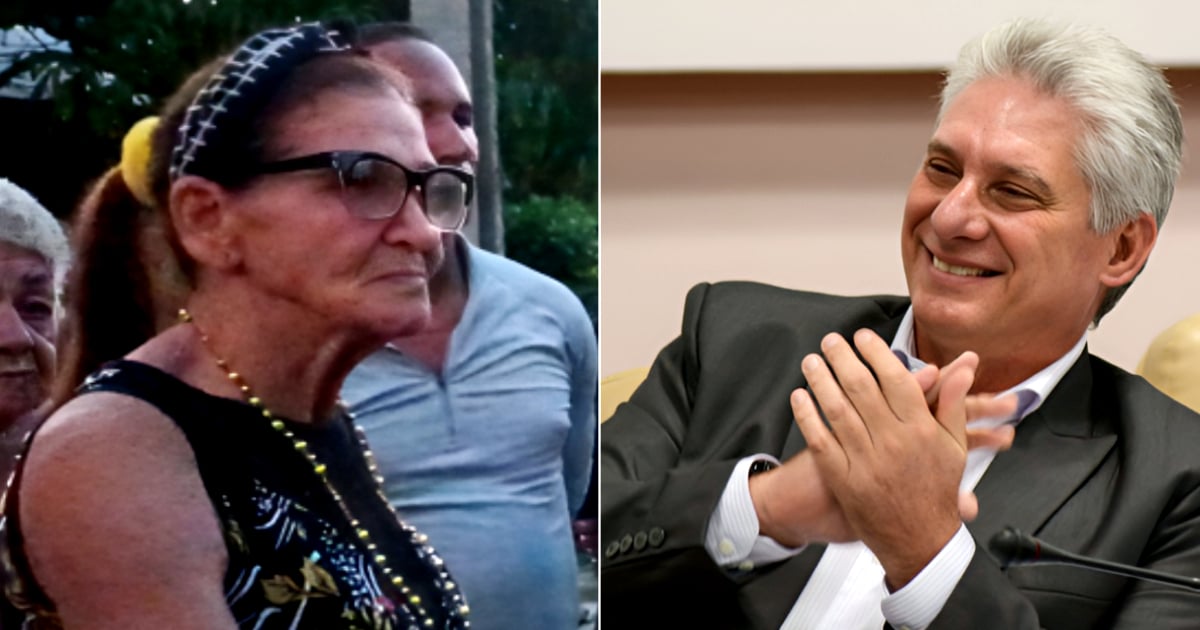
The post on Facebook by CiberCuba regarding the forced retraction of Francisca, the elderly woman who confronted Miguel Díaz-Canel in El Cobre after Hurricane Melissa passed, sparked a wave of outrage and solidarity that quickly turned into a public opinion phenomenon.
Thousands of comments agreed on a simple and powerful idea: “What is said is said. And the whole world saw it.”
The Cuban regime's attempt to rectify the incident with a video in which the elderly woman appears "grateful" and praising the so-called "revolution" was interpreted by users as a coercive maneuver.
"Surely they threatened her or told her to say that", wrote one of the internet users. Another summed up the collective sentiment with a striking phrase: "Pure theater, she was forced to declare the opposite".
A Cross-Sectional Indignation
The comment thread quickly transformed into a mosaic of emotions: anger, shame, compassion, helplessness.
“No matter how much they want to correct it, what’s been said is said and the whole world saw it”, said one user. “The one who should retract is the president, not her”, added another.
The tone was unanimous: the elderly woman did nothing wrong; it was the authorities who lost moral control of the situation. “I don’t understand why all the fuss. She simply spoke the truth: she had no bed. Is that now a crime?”, they wrote.
The outrage was further fueled by the contrast between the humility of Francisca —a 71-year-old retired teacher who lost everything in the hurricane— and the disheveled attitude of the ruling palace occupant, who responded to her: “And I don’t have anything to give you right now either!”.
“A person who has lost everything asks for a bed, and the president of the country responds with arrogance. And she should be the one to apologize? She should be ashamed”, commented another reader.
"The script no longer works."
Dozens of comments highlighted the repetitive nature of the propaganda method: the use of "edited" videos to mask social discontent.
"It's always the same script", wrote a user. "First they humiliate, then they pressure, then they release a video for the people to say it was a misunderstanding".
The perception of the assembly was complete. “You can tell when the ‘leader’ is whispering the answers to the poor woman,” said another. “The lady doesn’t even know what she’s saying. She’s tired, confused, surrounded by green uniforms. It’s sad.”
For many, the video was new evidence of the fear of power: “They try to cover up what we all saw. But it no longer works for them. No editing can erase that woman’s face when she said she didn’t have a bed.”
Compassion and symbol
In the midst of fury, a tone of tenderness emerged. Francisca became a symbol of the people who suffer and still dare to speak.
"God willing, may nothing happen to her for speaking the truth", someone wrote. "She spoke for millions who sleep on the ground, without a mattress or hope", another added.
The religious echo was recurring. “The children of God are praying for Cuba”, several messages stated, interpreting the episode as an act of revelation: “God allows these things to show the misery of the government and the nobility of the people”.
The elderly woman, who appears in the "retraction" video thanking the "revolution" and invoking Fidel Castro, was perceived by many as a victim of emotional manipulation. “She is not repentant; she is scared. It shows in her eyes, in her voice. They are dictating what she must say,” stated a commentator.
From individual acts to systemic repudiation
The case quickly went beyond the specific incident and turned into a collective denunciation of the Cuban repressive model.
“This is the same thing they do with prisoners, with doctors, with the youth: forcing them to recant. It’s the same old method”, noted a comment that received dozens of reactions.
Others were more blunt: “It’s the dictatorship showing its true face. There is no longer any respect for the elderly. They intimidate them to the point of making them apologize for speaking the truth.”
A user summed up the mood of discontent: “They try to fix what can't be fixed. What’s said is said. We all saw it, and that can't be erased.”
The power of networks and the failure of fear
The avalanche of reactions also reveals an underlying fact: the erosion of the totalitarian state's narrative monopoly.
For decades, the regime was able to impose its version without resistance. But this time, the official narrative encountered an empowered audience that contrasts versions, records, shares, and expresses opinions.
“Before they could lie, now they can't. Social media are the eyes of the people”, wrote an internet user. Others pointed out that, for the first time, “the shame is collective, but the fear is changing sides”.
“The people are no longer silent. Neither with threats nor with cameras. What they did to that elderly woman only demonstrates that they fear the truth.”
"Let him retract."
The phrase appears in dozens of messages: “The one who should retract is Díaz-Canel”.
That idea encapsulates the sense of inverted justice that prevails in the comments. “She did not offend anyone. She only expressed her need. He was the rude one.” This is read over and over again.
Others mocked: “And have they given her the bed? Because if that's the case, all this circus didn't even bring her a mattress”. One message summarized it harshly: “The president responded with despotism to a woman who lost everything, and now they make her apologize. It's like a father hitting his son and then forbidding him to cry”.
"Nobody believes them anymore."
The digital conversation reaches a unanimous conclusion: manipulation has lost its effectiveness.
“No one believes them anymore”, says a comment with over a hundred reactions. “Every attempt to clean up their image makes them look worse”.
And another voice, among hundreds, summarized it with the weariness of someone who has seen it all: “This is not a communication error. It is the essence of the system: to intimidate, correct, control. But this time, it didn't work for them. What’s done is done.”
Filed under: