
Related videos:
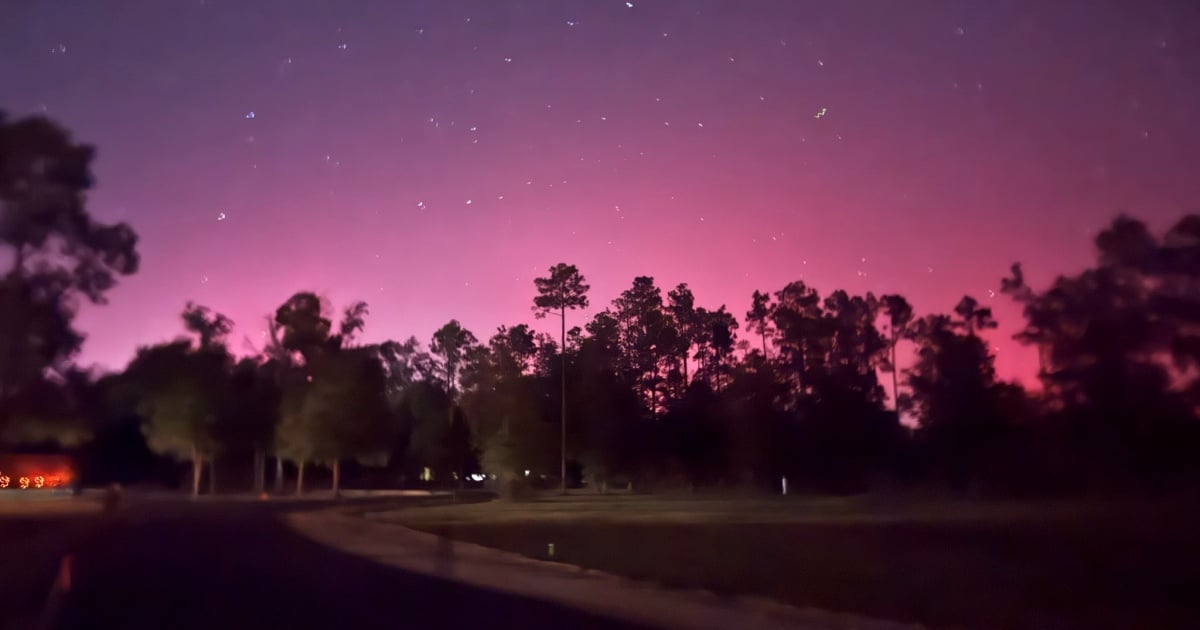
In an unusual astronomical event that captured the nation's attention, the aurora borealis was visible on the night of this Tuesday in unexpected locations such as northern and central Florida, painting the skies in shades of purple, green, and red.
The scene, more typical of polar latitudes, astonished the residents of the Sunshine State who were able to witness the phenomenon.
“I didn't expect to see the northern lights from north Tallahassee tonight”, wrote Wright Dobbs, a meteorologist with the National Weather Service, on X.
He accompanied his post with a long-exposure image where the reddish glow was clearly visible.
The Meteorological Service office in Tallahassee shared several photographs sent in by users.
In the images, the light display could be seen from places such as Marianna, Crawfordville, Bryceville, Pensacola, Titusville, and as far south as Orlando.
The intensity of the aurora surprised even the experts.
The NOAA Space Weather Prediction Center issued a G4 geomagnetic storm alert, the second highest level on the scale, which explained the unusual expansion of the phenomenon toward the south.
The optimal conditions— a powerful coronal mass ejection, clear skies, and low light pollution—aligned to allow for a rare visibility of this phenomenon in unusual areas.
The spectacle is expanding: auroras visible in over 20 states
The same geomagnetic storm caused widespread sightings from Kentucky and Indiana to Utah, Wyoming, Wisconsin, and Colorado, and even as far south as Texas, Alabama, and Georgia.
Social media was flooded with images of skies dyed in magenta and emerald.
NBC Miami described the phenomenon as an "uncommon spectacle in mid-latitudes"; while CNN noted that the auroras "painted the night skies with stunning displays."
These types of auroras are caused by coronal mass ejections (CMEs), large eruptions of plasma and charged particles from the Sun.
Upon reaching the Earth's magnetosphere, these particles interact with gases such as oxygen and nitrogen, creating the characteristic moving curtains of light.
Why it happened now: Maximum solar activity and changing polarity
Astronomers explain that the Sun is currently at the peak phase of its 11-year cycle, a period of high activity during which solar eruptions are more frequently observed.
This cycle reaches its peak when the Sun's magnetic poles reverse, causing significant geomagnetic disturbances on Earth.
"The increase in solar activity is causing auroras borealis to appear more frequently and further south than usual," noted NOAA, which anticipates that the current solar intensity will last until the end of this year.
Additionally, this series of auroras was associated with a series of solar eruptions from an active group of sunspots.
Although it was expected that the intensity would decrease slightly, experts maintained the alert until November 12.
Consequences on Earth: beauty and vulnerability
While the phenomenon offers a majestic view, it is not without risks.
A G4 geomagnetic storm can impact electrical grids, radio communications, GPS navigation, and satellites.
History recalls extreme events such as the solar storm of 1859, which set telegraph lines on fire, or that of 1972, which is said to have detonated underwater mines off the coast of Vietnam.
Nevertheless, on this occasion, the consequences were minimal.
“For most people, the impact was limited to spectacular skies,” commented a spokesperson for NOAA.
How to see and photograph the Northern Lights
Experts recommend several tips to enhance the experience:
-Seek dark skies: move away from cities and choose rural parks or agricultural areas.
-Look to the north: the aurora does not appear directly overhead, but low on the horizon.
-Stay awake between 10 p.m. and 2 a.m., although there may be peaks earlier or later.
Use cameras with long exposures, or take advantage of the night mode on modern phones to capture colors that are invisible to the naked eye.
Since the solar cycle has not yet reached its peak, new solar storms could lead to more visible auroras in unusual areas.
Filed under: