
Related videos:
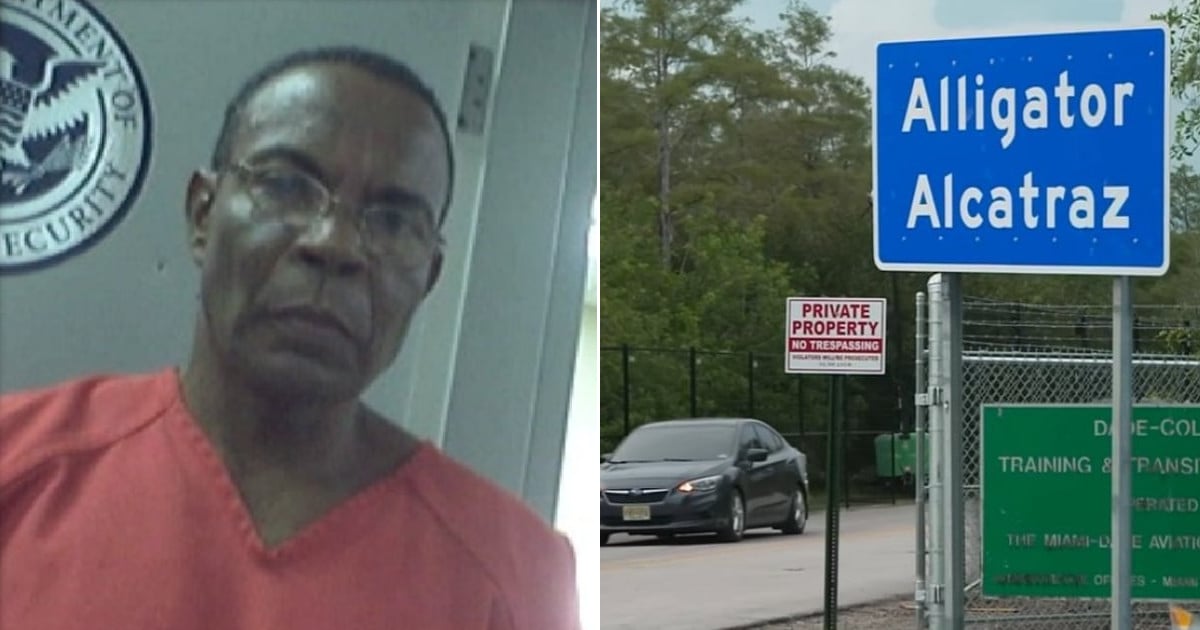
A Cuban who arrived in the United States in 1980, during the Mariel exodus, is detained at the Alligator Alcatraz migrant detention center in the Florida Everglades, awaiting his deportation.
Four and a half decades after emigrating to the U.S., Félix Arrebato Blanco is about to be deported due to his criminal record, even though he has permanent residency, as revealed by the Immigration and Customs Enforcement (ICE) in a statement.
His criminal record includes child sexual abuse, concealed carry of weapons, and failure to register as a sex offender, the agency specified on the social network X.
He pointed out that Arrebato Blanco "was welcomed in the United States in 1980, during a massive migration of Cuban dissidents fleeing communist Cuba and the authoritarian regime of Fidel Castro."
During six months, from April to October of that year, more than 125,000 Cubans left their country through the port of Mariel and arrived on the shores of Florida. The government of President Jimmy Carter "provided safe haven" in the U.S., ICE recalled.
Many of the emigrated Cubans at that time, such as Arrebato Blanco, even obtained permanent residency, but “he wasted his opportunity”, he claimed.
According to the information, Arrebato Blanco has been detained in Alligator Alcatraz since November 2, awaiting deportation.
ICE presented him as "the worst of the worst" in Miami, a classification that groups immigrants with serious criminal backgrounds, who -authorities argue- pose a threat to public safety and are captured with the intention of deporting them permanently from the country.
The Mariel exodus marked one of the largest migration waves in recent Cuban history. Thousands of Cubans sought refuge in Florida, fleeing from poverty and repression under the regime of Fidel Castro, although among them were also common prisoners and individuals released from penitentiary and psychiatric institutions, used by the Castro government to rid itself of groups deemed “undesirable.”
Recently, ICE arrested another Cuban refugee from Mariel, with an extensive criminal record that includes charges of drug possession and aggravated assault with injury.
The arrests of numerous Cuban citizens who have been convicted or accused of serious crimes in the U.S. are part of the strict immigration policy of the Donald Trump administration, which aims to
Backed by a Supreme Court ruling, the current U.S. administration has deported migrants with prior convictions for violent crimes to third countries, in cases where their home nations have not accepted them.
Washington's decision to send them to countries in conflict with which they have no personal ties has been harshly criticized by human rights organizations and legal experts.
At least four Cubans with extensive criminal records and final deportation orders issued by ICE have been sent to African countries, such as South Sudan, the Kingdom of Eswatini, and Rwanda, while others were transferred to Mexico.
The government of Havana refuses to accept individuals with criminal records in the U.S. or those who have been outside the country since before the migration agreements of January 2017, which has led to the deportation of Cubans to third countries, including some where they face the risk of torture or death.
According to official records from the Department of Homeland Security (DHS), more than 42,000 Cubans have final deportation orders, but the regime's reluctance to accept them back has complicated the expulsion processes.
Meanwhile, deportation flights from the U.S. to Cuba continue on a monthly basis, in accordance with existing migration agreements between the governments of both countries.
Last Thursday, 232 people were returned to the island in the tenth air operation since Trump took office. In total, 1,231 Cuban migrants have been deported from the U.S. to Cuba by air, from January 23 to November 6, 2025.
Filed under: