
Related videos:
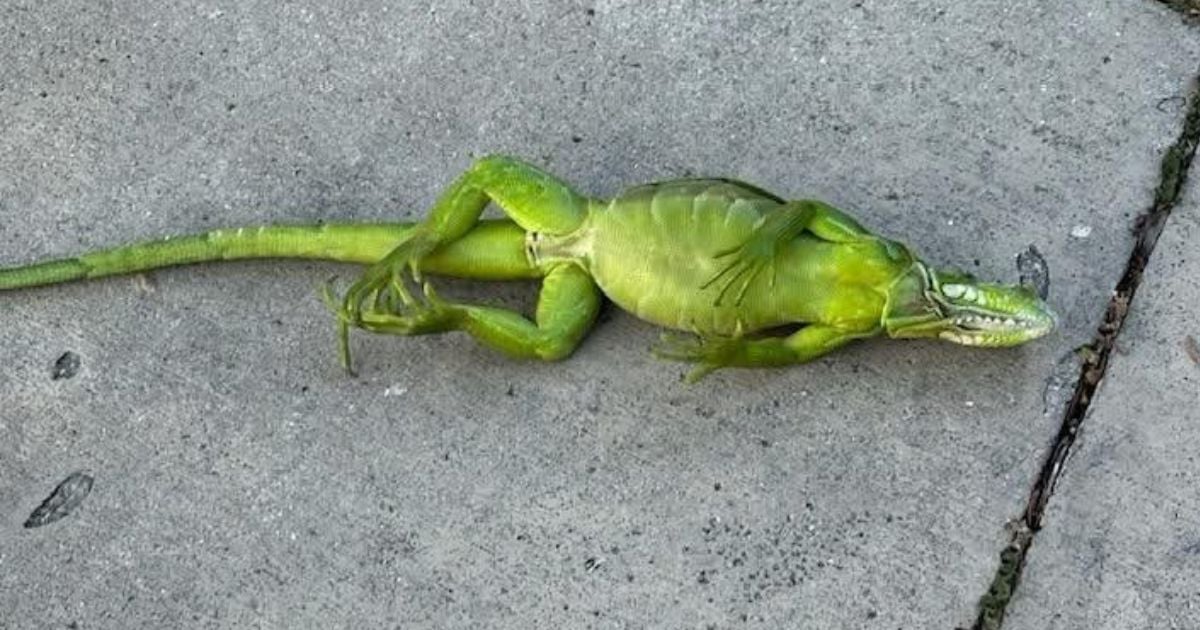
The marked drop in temperatures in South Florida, with values close to three degrees Celsius (38 degrees Fahrenheit), has caused dozens of iguanas to fall from trees as they become immobilized by the cold, a phenomenon that occurs every extreme winter in the state.
Meteorologist Matt Devitt reported this Tuesday on his Facebook profile that a large iguana fell from a tree in Port Charlotte, north of Fort Myers, when the temperature dropped to about three degrees Celsius.
"She is not dead, just stunned by the cold," explained the specialist in his post.
Several residents of Florida also shared images of the phenomenon. On the social network X, the user @Vic1972 sarcastically commented that while other states receive snow alerts, Florida issues warnings about iguanas falling from trees.
The user @LauraJ posted a photo of an immobile reptile on the pavement and wrote: “A typical cold morning in Florida.”
According to a report by the agency EFE, the National Weather Service of the United States warned on Monday about a cold wave affecting two-thirds of the country, with record low temperatures in Florida.
Authorities issued freeze warnings in several counties and warned that the temperature drop could immobilize iguanas.
The agency explained that the lows, which range from six to one degree below zero, are due to a polar air mass that has moved down from the north of the country.
In Florida, the counties of Brevard, Lake, Orange, Volusia, Levy, and Hernando are under a cold air advisory, as historic records are reported in Orlando, Lakeland, and Brooksville, where temperatures are nearing their lowest levels since 1894.
According to EFE, the Southern Florida Wild Lands Association reminded that when temperatures drop to around four degrees Celsius (40 degrees Fahrenheit), iguanas—cold-blooded reptiles native to Central and South America—lose mobility and fall from trees or rooftops, although they remain alive.
The meteorological service MyRadar Weather also issued a warning for "falling iguanas" for early Tuesday in the central and southern parts of the state, alerting that the animals may remain motionless for several hours before regaining movement.
The portal Weather.com explained that this phenomenon occurs when the air temperature drops below ten degrees Celsius, which slows down the iguanas' metabolism and prevents them from gripping the branches. When the weather warms up, the animals regain their mobility and return to their natural habitat.
Experts recommend not touching them or trying to help them, as they may suddenly react upon regaining warmth and cause injuries.
Temperatures are expected to begin rising by midweek, allowing iguanas to return to the trees and southern Florida to regain its normal climate.
Although this phenomenon is always surprising, it is not something unusual. In 2021, the Miami Weather Service (NWS) announced the falling of iguanas in Florida due to the drop in temperatures.
Filed under: