
Related videos:
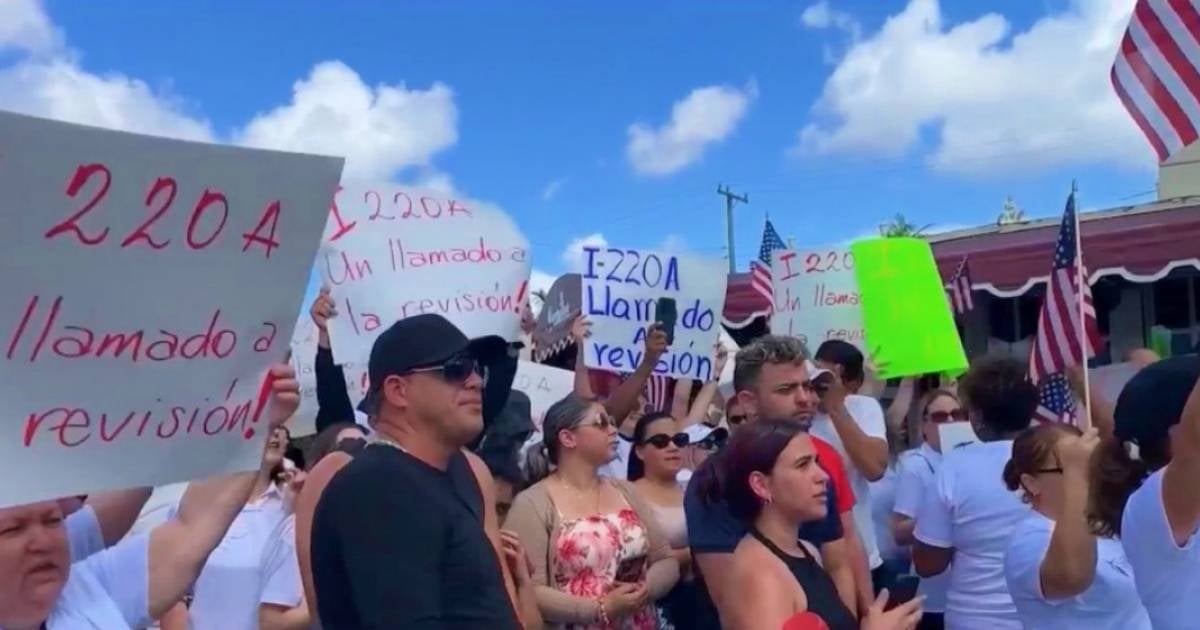
The struggle of thousands of Cuban migrants to regularize their status in the United States has received crucial support.
The American Civil Liberties Union (ACLU), one of the most influential organizations in the defense of civil rights in the country, has decided to intervene in the legal case seeking the recognition of parole for Cubans released under the I-220A form.
Although this participation does not imply an immediate victory, it does represent a breath of hope for a community that has lived in legal uncertainty since its arrival in the United States.
An anticipated intervention: the ACLU's "Amicus Brief"
The support from the ACLU was formalized through an "Amicus Brief", a legal document that allows third parties to present relevant arguments without being direct participants in the case, as reported in recent hours by journalist Daniel Benítez.
This legal action reinforces the stance of the lawyers representing Cubans with I-220A, led by Cuban-American attorney Mark A. Prada, who has brought the litigation before the Eleventh Circuit Court of Appeals, based in Atlanta.
The heart of the case is an appeal against the decision of the Board of Immigration Appeals (BIA) in the well-known “Matter of Cabrera,” which determined that Cubans with I-220A do not qualify for parole, thus blocking their path to permanent residency under the Cuban Adjustment Act.
The ACLU, in its brief, requests that the case be returned to the BIA for reconsideration, citing the precedent of the "Matter of Q-Li" case, which establishes that the release of detained immigrants must be granted under parole if certain conditions are met.
The legal and human impact of parole
Parole is a special entry permission that, in the case of Cubans, is a critical step to benefit from the Cuban Adjustment Act.
This legislation allows citizens of the island who have been legally admitted to the U.S. to apply for permanent residency after one year and one day.
However, those who possess an I-220A —a document for supervised release issued by ICE— have been excluded from this process as it is considered they did not enter under parole.
“The inclusion of the ACLU is not merely a symbolic matter”, stated Mark Prada.
"It is a clear message: the conditions under which the Cubans with I-220A were released are erroneous, and their right to parole, a key step to access status adjustment, must be recognized," he added.
More than 50,000 signatures: Pressure from the migrant community
The intervention by the ACLU comes after an intense campaign of social pressure that gathered over 50,000 online signatures, along with a letter supported by activists and Cuban migrants.
Platforms like TikTok and other social media have been crucial in amplifying the cause and bringing visibility to the situation of thousands of Cubans who, having not received parole, have remained in a legal limbo.
Yariel, one of the main activists of the movement, shared his excitement in a video about the ACLU's decision: “This support is not just a legal act, but a step towards bringing visibility to an issue that affects thousands of Cubans who, for various reasons, arrived in the U.S. under vulnerable conditions.”
What’s at stake: a precedent for thousands
Lawyer José Guerrero, cited by journalist Daniel Benítez, warned that if the court rules in favor of the plaintiffs, the implications could extend well beyond the group of Cubans with I-220A.
“This ruling could pave the way for the regularization of hundreds of thousands of people under the Cuban Adjustment Act,” he affirmed, emphasizing the transformative potential of this process.
The ACLU, with its track record of success in federal courts and even the Supreme Court, has the power to profoundly influence the development of this cause.
Although its current participation is partial and limited to the Amicus Brief, activists hope that in the future it will take on a more prominent role in defending the rights of these migrants.
A long road still to travel
Despite the symbolic victory that this endorsement represents, the legal process continues.
The appeals court will hear the arguments from both parties at a hearing scheduled for December.
A final decision is not expected immediately, which means that the path to regularization remains fraught with uncertainty.
However, the support of the ACLU has injected renewed optimism in those who have fought for years to assert their rights.
"The backing of an entity with the power and resources of the ACLU represents a crucial boost," is stated in one of the press releases circulated among the support groups for the I-220A.
The ACLU's involvement in defending Cubans with I-220A not only adds legitimacy and legal weight to the cause, but also reflects an evolution in public awareness regarding the shortcomings of the U.S. immigration system.
For thousands of Cubans living between legality and uncertainty, this support represents more than a legal gesture: it is a tangible hope for justice.
In recent days, a growing number of Cubans with I-220A have been detained by ICE, facing the crossroads of imminent deportation.
Filed under: