
Related videos:
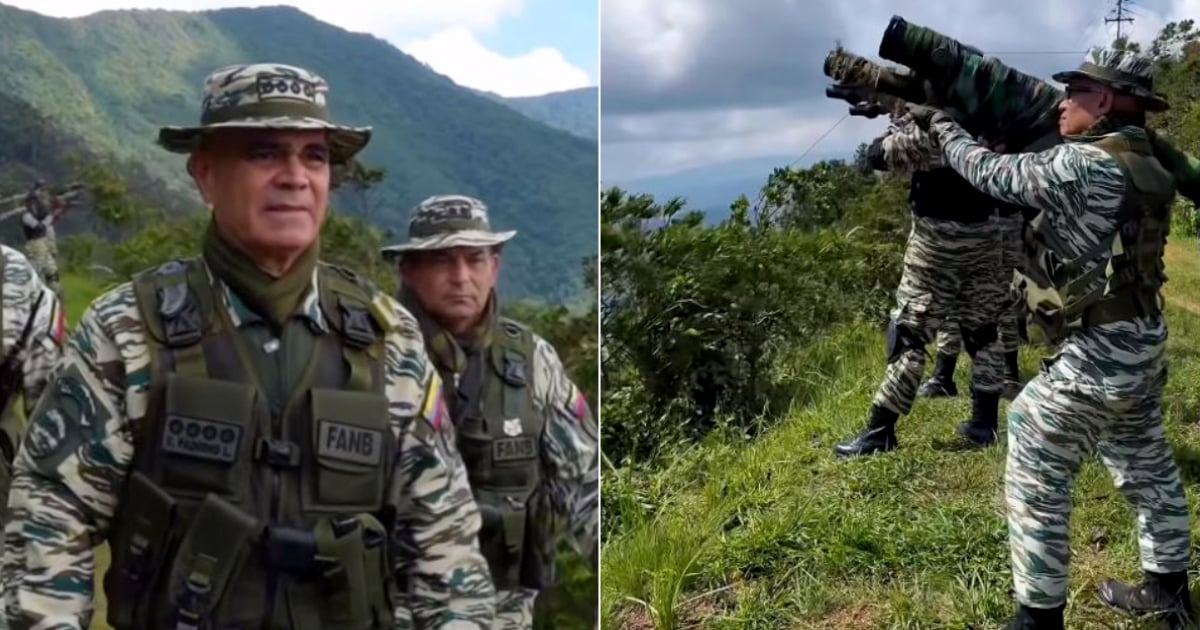
Military tension in the Caribbean continues to escalate. While the United States maintains its naval deployment off the coast of Venezuela, the regime of Nicolás Maduro mobilized 200,000 troops across the country this Tuesday, as announced by Defense Minister Vladimir Padrino López in a message broadcast on state television.
The exercise, which began at four in the morning, includes land, air, naval, riverine, and missile operations, with the participation of the Bolivarian Militia, police forces, and territorial commands.
"Almost 200,000 personnel have been deployed, and this does not detract from the daily operations carried out by the Operational Strategic Command in combating other threats," affirmed Padrino López, without providing details on the material resources used.
The maneuver aims to demonstrate military strength in response to what Caracas describes as "imperial threats" from Washington. At the same time, the chavista National Assembly approved a new Law for the Command of Integrated National Defense, intended to coordinate civil and military responses to a potential foreign attack.
A "prolonged" defense with a flavor of desperation
Military sources consulted by Reuters and internal documents from the Venezuelan army reveal that the government is planning a guerrilla-type response if the United States launches an offensive.
The doctrine, dubbed "prolonged resistance" – and borrowed from the Cuban regime's "war of the entire people" – instructs small units to disperse, hide, and carry out sabotage at over 280 points across the country.
The plan also includes a second strategy called "anarchization," through which intelligence services and armed groups loyal to chavismo would incite disturbances in Caracas to make the country ungovernable in the eyes of any invading force.
An official quoted by Reuters summarized it bluntly: “We wouldn’t last two hours in a conventional war. We have no way to confront one of the most powerful armies in the world.”
Army in ruins
The internal situation of the Venezuelan armed forces contradicts Maduro's rhetoric. Soldiers earn less than 100 dollars a month, which is a fifth of the cost of the basic food basket, and many commanders have been forced to negotiate with farmers to feed their troops.
The military park—mostly of Russian origin—is outdated and poorly maintained. Of the 20 Sukhoi fighters purchased in the 2000s, barely four or five are operational. The helicopters, tanks, and portable missiles are also over two decades old.
Despite this, Maduro has ordered the deployment of 5,000 Igla-S missiles throughout the national territory and has instructed units to withdraw or hide "after the first strike from the Americans."
"Any military force in the world knows the power of the Igla-S," the leader proclaimed on television, asserting that its operators are deployed "to the last mountain and the last city."
Propaganda and weakness
The massive deployment announced by Padrino López is as much a military operation as it is a political maneuver.
Internationally, it seeks to send a signal of resistance against American advances. However, within the country, the exercises serve to maintain cohesion in the military power structure, which remains the primary support of the regime.
The warmongering rhetoric also aims to mobilize the Chavista base with the discourse of external siege. “The aggression will be met with national unity,” said the minister, while Maduro reiterated his call for the “defense of the Bolivarian homeland.”
However, analysts point out that the so-called “people's army” lacks the real capacity to sustain a prolonged conflict. Corruption, desertion, and hunger undermine troop morale. “We are dealing with an army that is hungry and without fuel,” commented a former officer cited by independent media.
Washington observes
The administration of Donald Trump continues its military deployment with more than 10,000 personnel, seven warships, and the aircraft carrier USS Gerald Ford on its way to the region.
Washington insists that its operation aims to combat drug trafficking, but diplomatic sources do not rule out the possibility of it evolving into direct action if the situation worsens.
Meanwhile, Maduro seems to trust more in propaganda than in his rifles. He organizes guerrillas without being able to sustain them, proclaims independence while depending on Moscow, and waves the flag of patriotism in a country where most people only think about surviving.
Filed under: