
Related videos:
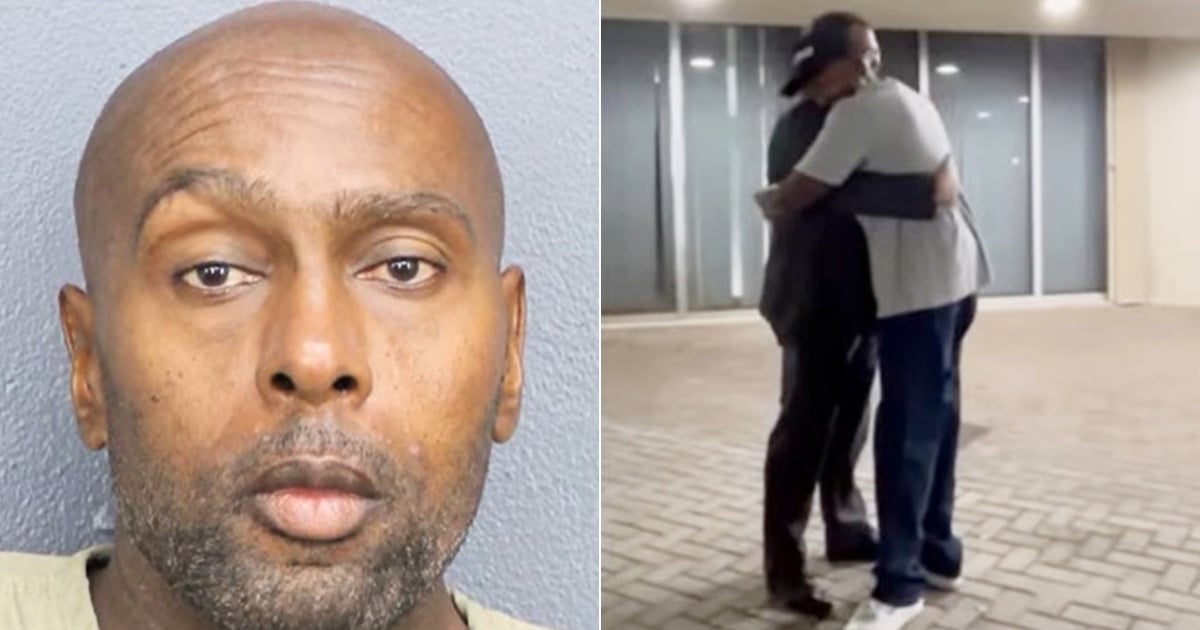
Tavares Hutchinson, a man who spent 26 and a half years incarcerated in Florida, regained his freedom on Friday after it was proven that he was wrongfully convicted in a case of armed robbery that occurred in 1999.
The original sentence against Hutchinson dates back to June 1999, when he was arrested by the Broward County police.
The victim, a man who reported being assaulted by an armed individual who stole his wedding ring and a 14-karat gold Gucci-style chain, identified him as the perpetrator.
The evidence was weak from the beginning: Hutchinson was stopped in a car for erratic driving hours after the alleged theft, and inside the vehicle, the police found a chain that did not match the description given by the victim.
Despite Hutchinson denying the facts and asserting that he had purchased the necklace, he was the only person included in a lineup and subsequently identified.
In January 2000, he was found guilty of armed robbery and resisting arrest without violence. He was sentenced to life in prison.
A process flawed from the beginning
The subsequent review of the case reveals a long list of shortcomings.
In 2024, Hutchinson requested the Conviction Review Unit (CRU) of the Broward County Prosecutor's Office to reexamine his conviction.
With the support of the Innocence Project of Florida (IPF), and aided by funding from the Department of Justice, an investigation was launched that lasted two years and uncovered serious irregularities.
Among the most significant findings are:
The seized chain did not match the stolen one: it was not 14-karat gold nor the same Gucci style design.
The victim retracted her initial identification and admitted to having mistakenly pointed out Hutchinson.
The description of the attacker did not match Hutchinson in age, height, weight, dental appearance, or manner of speaking. He also did not dress as indicated in the initial report.
-Hutchinson had visible physical deformities, such as scars and bodily peculiarities that were not mentioned by the victim.
The only substantial "evidence" was the identification of a person in a police lineup that included only Hutchinson, violating basic procedural standards.
Dr. Lora Levett, an expert in forensic psychology and former president of the American Psychology and Law Society, reviewed the identification in this case and found 12 flaws in how it was conducted, which, in her opinion, completely undermined its reliability.
Moreover, serious doubts about the very existence of the crime have arisen. The victim, who was struggling with addictions at the time, provided contradictory testimonies.
Some witnesses suggested that he might have voluntarily sold his belongings to buy drugs and fabricated a story about being assaulted.
"My innocence has been proven, and I am free."
On November 14, after more than 26 years in prison, Tavares Hutchinson was finally released from the Broward County jail.
It was a moment filled with emotion.
“It’s just relief that, you know, finally, um, um, my innocence has been proven and I am free,” he told the local press after breathing free air for the first time in over two decades.
"Every day was an internal battle. I visualized myself leaving, time and time again; I imagined walking out of the county jail," he confessed.
At nearly 50 years old, all he wanted to do was walk, breathe fresh air, and start over.
The Prosecutor's Office: it was not an exoneration
The Broward State Attorney's Office has been clear in its statement: "This was not an exoneration."
Although Hutchinson's sentence was modified to time served—26 years, five months, and 24 days—his criminal record still identifies him as a convicted felon.
After his release, he was transferred to a social reintegration center.
Hutchinson's lawyer, Brandon Scheck, legal director of the IPF, acknowledged that "the process was emotionally challenging, but Tavares never lost faith."
He added, “I don't think they were wrong [at the time], I believe they followed the tests as they were in 1999; the tests have evolved over time.”
Still, Scheck and his legal team are already exploring legal mechanisms to completely overturn Hutchinson's conviction.
The power of the Innocence Project
The Innocence Project of Florida has been crucial in this and other similar cases. Founded in 2003, the IPF works to free individuals wrongfully convicted through new evidence, legal reviews, and comprehensive legal support.
Hutchinson is the 37th person to regain freedom thanks to the efforts of this organization. Together, their cases amount to more than 864 years of unjust imprisonment endured by innocent people.
The story of Hutchinson is no exception: it reflects how the combination of poor police practices, identification errors, racial biases, and lack of evidentiary rigor can ruin the life of an innocent person.
After his release, Hutchinson has expressed his desire to help others who are still struggling to prove their innocence: "I hope to see that what happened to me doesn't happen to other young people."
Although the damage inflicted is irreparable, her resilience now transforms into a mission: to prevent others from experiencing the same hell.
Filed under: