
Related videos:
The death this Sunday of a woman and her son in a collapse of their home in Old Havana has sparked a wave of grief, helplessness, and outrage on social media, where hundreds of Cubans have expressed their sorrow and frustration over a tragedy that once again highlights the deterioration of the capital.
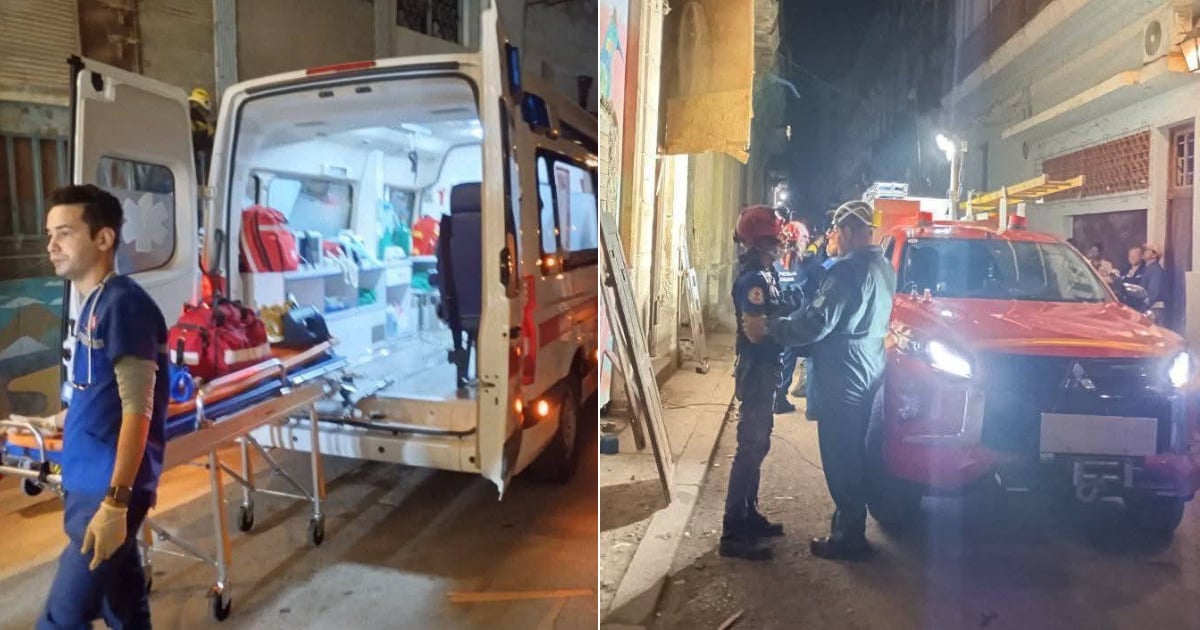
The collapse occurred in the early morning of November 16 on Compostela Street, between Muralla and Sol, in the Belén popular council. The second floor of the building collapsed and two people died : Sara Paula Díaz, 64 years old, and her son Carlos Fidel Sánchez Díaz, 38. Other families were also living in the residence, including a woman with four children and an elderly person.
The news generated a flood of comments on social media. On the official page of Cubadebate, numerous users expressed their sorrow over what happened and criticized the lack of maintenance of Havana's housing. “What a sad and ironic way to celebrate an anniversary,” wrote one user, referring to Havana's 506th birthday. “Everything is crumbling to pieces, and the leaders are only traveling and buying luxury watches and shoes,” another person remarked, while someone else commented: “506 years of a ‘smart’ city that has nothing to celebrate.”
In that same post, there were many criticisms of the government's priorities. "If they truly regretted it, they would fix the houses instead of building hotels for tourists," one user pointed out, while another noted, "With the materials they used to build the K Tower, they could have fixed half of Havana." Irony also seeped through the sadness: "Collapses are another great achievement of the Cuban revolution," someone wrote, while another added, "Before the triumph of the 'robolution,' the rich lived in Miramar; afterwards, the rich still live in Miramar."
On the Facebook profile of journalist Lázaro Manuel Alonso, who confirmed the identity of the victims, a tone of mourning and criticism was repeated. "A regrettable tribute for the 506th anniversary of Havana," wrote one internet user, while another warned, "The country is falling apart." Some comments called for a deeper analysis of the structural situation of the old neighborhoods, where "Old Havana and Centro Habana are on the brink of collapse from any angle you look." "Cuba is falling apart and it hurts so much, especially on the day the capital reaches its 506th anniversary," lamented another user.
In the post shared on Facebook by CiberCuba Noticias, the reactions were even more numerous and emotional. Hundreds of Cubans inside and outside the country left messages filled with grief and anger. “God have mercy on the Cuban people. Rest in peace to the deceased,” wrote one of the most repeated comments. “What sadness, for God’s sake, my condolences to the family,” said another. The phrase “Cuba hurts” was echoed time and again, accompanied by expressions of faith and resignation: “Lord, place your hand over Cuba,” “No longer enough with the diseases, now we must also fear collapses.”
But there was also anger. "While they build luxury hotels, Cubans are buried under rubble," wrote one person. "They have money for hotels and propaganda, but not to repair homes," said another. "This is how Cuba falls apart while they raise empty hotels that no one visits," read among dozens of similar comments. Several opinions denounced the inequality between leaders and citizens: "The families of the bosses never live in danger of collapse; they always have new and safe houses," wrote a user; another added, "The poor lose their homes and their lives, while the children of ministers study abroad."
Among the reactions, there were also messages that reflected the helplessness of many Cubans in the face of an apparently inevitable tragedy: “People don’t want to rebel out of fear of dying, yet they are dying just the same, if not worse, without rebelling,” wrote one person. “The country is falling apart, and no one is held accountable for that,” said another. And a third summed it up: “How long will people continue to die due to the regime's neglect and indifference?”
The mixture of sadness, resignation, and anger was evident throughout the hundreds of comments. “Lord, have mercy on my people,” “God save Cuba,” “Only a miracle can save us from so much abandonment,” some wrote, while others left more hopeless messages: “Cuba is collapsing little by little, along with our people,” “Cuba is dying without a present or future.”
The collapse of Compostela Street did not only leave two victims. It also left the certainty, expressed by dozens of Cubans on social media, that living under a roof in Cuba continues to be, for many, living under threat.
Filed under: