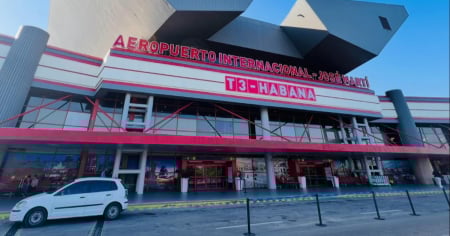
The TikToker Ainara Quesada sparked a stir on social media after posting a short video in which she highlights the conditions at José Martí International Airport in Havana.
The clip, shared on her account and quickly going viral, has garnered thousands of likes and a wave of comments that confirm the content creator’s version: the main access point to the Cuban capital has become synonymous with disorder, theft, and unbearable procedures.
In her post, Ainara only shared images of the terminal, but that was enough to generate an avalanche of criticism from her followers.
Cubans who have been able to travel report the discomfort of arriving in a space where bureaucracy, slowness, and technical shortcomings are compounded by corrupt practices.
What should be the first welcome to the country—the first impression a tourist gets upon descending from the plane—is a traumatic experience.
The testimonies and complaints that followed their video paint a picture of ongoing issues: missing or delayed luggage, employees demanding payment to expedite departures, long lines at immigration, power outages, and an overwhelming atmosphere due to the heat.
Among the reactions to Ainara's video, many users shared that losing a suitcase at Havana airport is almost routine, and that there are employees who wait for "incentives" in dollars to expedite the process.
Some confessed that they feel genuine panic before traveling.
"Literally, 'the trauma of my life,' but being with family is worth everything," expressed a young woman.
Others asked the influencer if something had been stolen this time. "Last time, they stole my tuna," revealed another.
There were those who reported waiting for two hours to collect their luggage, followed by an unnecessary delay at the exit control. Anxiety, they said, is increasingly growing, because rather than improving, the processes have become slower over time.
There were those who pointed out to Ainara that, at least in her case, there was electricity and the conveyor belts were working, because when they passed through, everything was malfunctioning.
The comments range from personal anecdotes to more serious complaints, which for many are symptoms of an institution that neither controls nor addresses its failures.
A Spaniard with Cuban blood
Ainara shared other experiences in Havana, already at her family's home, where she ate the Cuban food she loves and took a stroll around the city.
He also had the chance to visit the place where his paternal family lived decades ago, in a now-gone lot where 14 people resided in a very small space without a private bathroom.
"What a different way of growing up my family and I have had," he stated.
The young woman, who leads an active life on social media where she combines personal stories with entertainment content, has explained in previous posts her experience of having two nationalities.
Daughter of a Spanish mother and a Cuban father, she has shared with her followers about what it means to belong to two different cultures and how this has influenced her identity.
"The truth is that you never feel like you're from anywhere, you never feel enough from any place," he assured.
However, after 12 years without visiting Cuba, his return in 2024 made him feel for the first time an intense sense of belonging to the Cuban part of his life.
"The connection I felt had never happened to me before in my life; for the first time, I felt like I belonged somewhere," she confessed.
In addition to sharing her personal story, Ainara has won over her fans with videos dancing with her Cuban grandmother.
Filed under: