
Related videos:
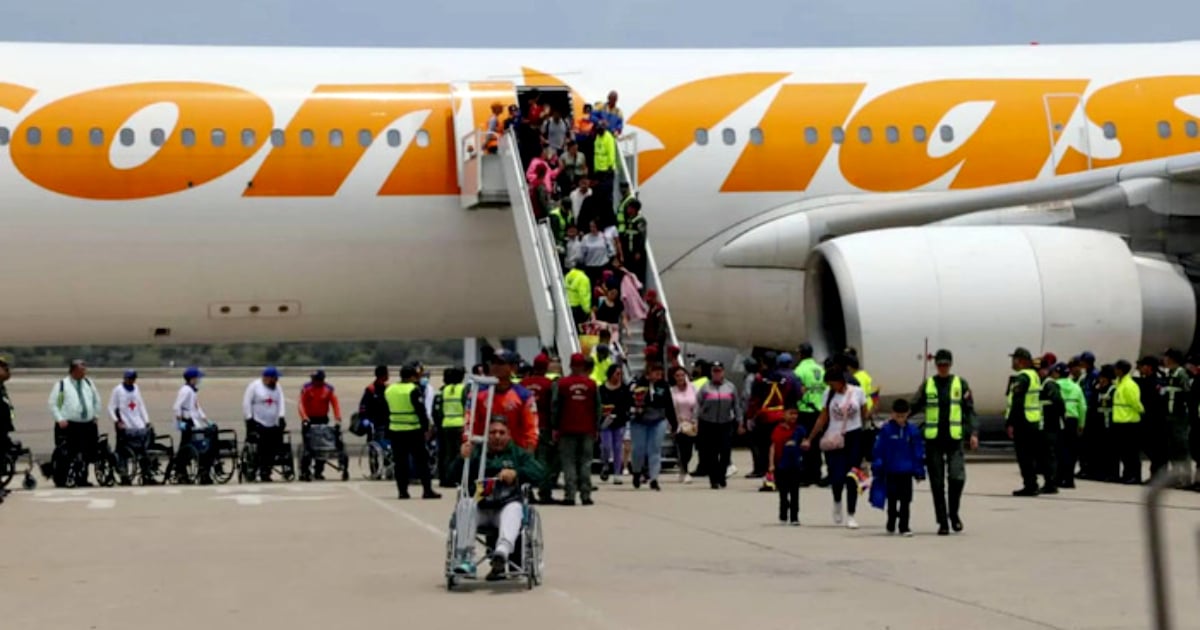
The government of Nicolás Maduro announced this Saturday the immediate suspension of flights carrying migrants deported from the United States, in response to the complete closure of Venezuelan airspace ordered by President Donald Trump, an action that Caracas described as "arbitrary, hostile, and a violation of national sovereignty."
In a statement released by the Venezuelan Foreign Ministry, the Chavista regime condemned what it described as an "unprecedented measure in decades in Latin America and the Caribbean," and accused Washington of "attempting to exert extraterritorial jurisdiction over Venezuelan airspace."
“The government of the Bolivarian Republic of Venezuela categorically condemns this threat to national sovereignty and unilaterally suspends repatriation flights for migrants coming from the United States,” the text stated, according to the agency ANSA.
As of now, 75 deportation flights have returned nearly 14,000 Venezuelans from U.S. territory in 2025, according to official figures. The last flight, with 175 migrants, arrived in Maiquetía last Wednesday from Arizona.
Caracas accuses Trump of "imperialist" aggression
The message from the U.S. president, published on his social media platform Truth, urged “airlines, pilots, drug traffickers, and human traffickers” to consider the airspace over and around Venezuela “completely closed.”
The lack of operational details generated confusion among international airlines and governments in the region.
The vice president Delcy Rodríguez accused Trump of acting in coordination with the opposition leader María Corina Machado, whom she held responsible for having "requested the air blockade" against Venezuela.
“The Government of the United States has granted María Machado's request to try to block Venezuelan airspace,” Rodríguez stated, describing the decision as “unprecedented imperialist aggression.”
Special repatriation plan and new air restrictions
At the same time, Rodríguez announced the creation of a special repatriation plan for Venezuelans stranded in third countries, particularly in Latin America, due to the cancellation of international routes. The program will include humanitarian flights and coordination with partner airlines.
The air crisis worsened after U.S. aviation authorities advised airlines to avoid Venezuelan airspace due to the increase in military flights in the Caribbean. Following this, Caracas revoked the licenses of six international companies, including Iberia, TAP, Turkish Airlines, Avianca, Gol, and Latam, which had suspended their operations.
The Panamanian airline Copa Airlines continues to operate flights between Panama and Caracas, but only during daytime hours and under "maximum alert levels." The rise in prices for alternative routes has skyrocketed ticket costs to as much as 1,000 dollars, reflecting an unprecedented aviation crisis in the region.
Filed under: