
Related videos:
The leader Nicolás Maduro claims that Venezuela is prepared to withstand any external aggression; however, the actual capabilities of his army are far below those of the United States Armed Forces.
According to military sources and planning documents consulted by the agency Reuters, the South American country, ravaged by the economic crisis, faces a weakened, poorly trained army equipped with outdated gear.
For this reason, its strategy in the face of a potential U.S. offensive would focus less on a direct confrontation and more on guerrilla-style resistance and internal destabilization.
The context became tense after the then-President of the United States Donald Trump declared that the airspace over Venezuela and its surroundings should be considered “completely closed”, while warning that operations against alleged drug-laden boats in the Caribbean and the Pacific, which resulted in the deaths of more than 80 people, could escalate into ground actions within Venezuelan territory.
Although it was also reported that Trump spoke with Maduro about a possible visit to the United States, the overall tone from Washington has been one of increasing political and military pressure.
Six sources familiar with Venezuela's military capabilities agree that the military power of the U.S. eclipses that of Venezuela, which faces serious issues such as lack of training, low salaries, and deteriorating military equipment.
Low wages and obsolete weaponry
Under Maduro's command since 2013, the military leadership has enjoyed privileges and access to government positions, ensuring their loyalty; however, the situation for enlisted soldiers is very different: they earn about 100 dollars a month in local currency, roughly one-fifth of what an average family needs to meet its basic needs. This has fueled discontent within the ranks.
Sources indicate that dissensions are already occurring in numerous units, and that in the event of a U.S. military attack, this trend could significantly increase, further undermining the regular army's response capacity.
The recent primary experience of Venezuelan troops has not been conventional combat, but rather confrontations with unarmed civilians during street protests, highlighting their lack of training for high-intensity warfare.
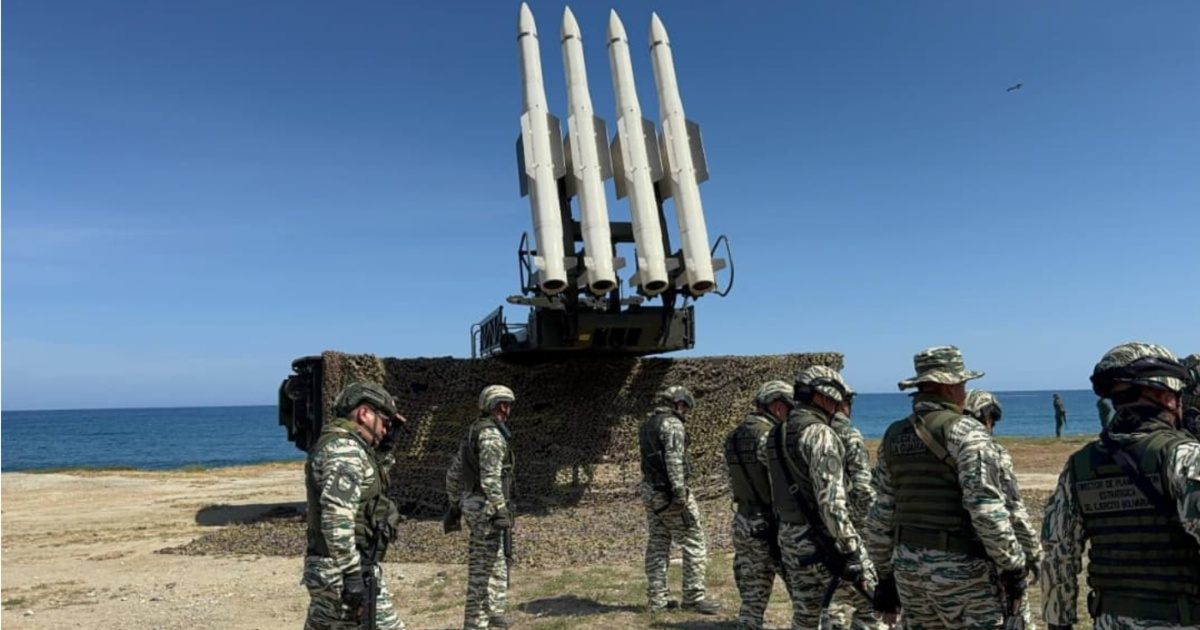
Military equipment is also a weak point. A large part of the arsenal is of Russian manufacture and is several decades old. Caracas acquired about 20 Sukhoi fighter jets in the 2000s, but they are considered significantly inferior to platforms like the American B-2 bombers.
The same applies to helicopters, tanks, and portable Igla missiles, all of which have outdated technology compared to the air and technological power of the United States.
Maduro has stated that eight million civilians are training in militias to defend the country against an external attack.
However, one of the cited sources drastically reduces that operational figure and estimates that, when the time comes, only thousands of intelligence agents, armed supporters of the ruling party, and militia members would actually participate in defensive actions.
Internal planning documents and consulted sources indicate that, rather than sustaining a conventional war, Venezuela would prepare a “prolonged resistance” in a guerrilla style in the event of an air or ground attack.
The plan outlines that small military units, distributed across more than 280 locations in the country, will carry out acts of sabotage, ambushes, and wear-down tactics, avoiding direct confrontation with a militarily superior enemy.
Part of this strategy relies on the deployment of approximately 5,000 Igla missiles, which Maduro claims have already been positioned; the orders specify that these units will be dispersed and concealed at the onset of any offensive, aiming to complicate enemy air and helicopter operations.
Additionally, there is a second response line internally referred to as “anarchization,” which has not been publicly acknowledged by the authorities, but which, according to sources, would employ intelligence services and armed supporters of the party to create chaos in Caracas and render the country ungovernable in the event of foreign intervention.
The idea would be to combine military sabotage with political violence and urban chaos, raising the costs of any occupation or regime change operation.
In this framework, the so-called "collectives" play a role; these are government supporters who often mobilize in motorcycle caravans to confront opposition demonstrations and, at times, have acted armed.
This is coupled with the presence of Colombian guerrilla groups in border areas of western Venezuela, regions that are also a significant hub for coca cultivation, the main ingredient in cocaine.
Drug trafficking accusations
Opposition groups, NGOs, the U.S. government itself, and several Latin American countries have repeatedly accused Maduro and the Venezuelan military of maintaining ties to drug trafficking organizations, which are also attributed with a significant level of violence.
The Venezuelan government denies these accusations and claims that Washington seeks a regime change to take control of the country's vast oil reserves.
In the official narrative, any escalation of military pressure or sanctions is portrayed as part of a “political and economic war” driven by the United States.
However, in light of the comparative military capabilities and the actual state of the Venezuelan armed forces, the government seems to rely less on the possibility of a successful conventional defense and more on its ability to prolong the conflict, intensify the internal violence, and raise the political and human costs of any potential foreign intervention.
Filed under: