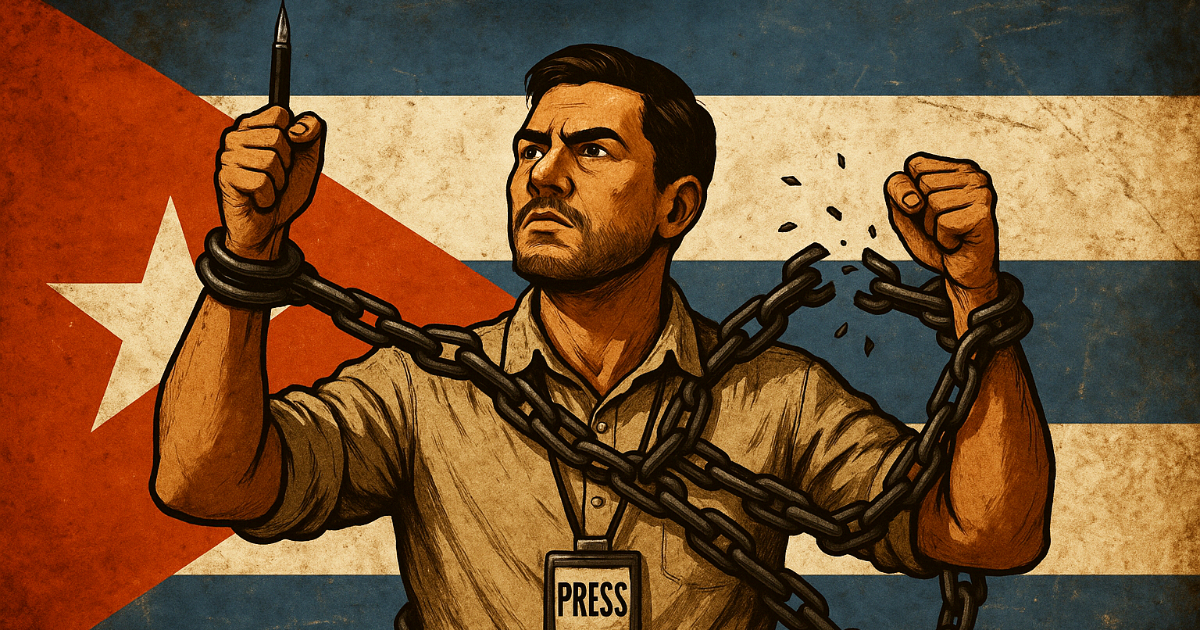
In Cuba, informing has always been an act of resistance. For over six decades, the regime has turned the practice of free journalism into a suspicious, if not criminal, activity.
Today, in the 21st century, the mechanisms have changed, but the objective remains the same: to silence the truth, intimidate those who speak it, and create enemies to justify censorship.
The current campaigns against elTOQUE, CiberCuba, CubaNet, Diario de Cuba, and other independent media are not isolated or spontaneous events. They are part of a coordinated offensive orchestrated from the ideological and repressive apparatus of the State, which has found in the digital environment a new way to pursue critical thought.
An old strategy with a new face
On November 26, 2025, Cubadebate published an article titled “Radiography of the far-right accounts operating against Cuba on X,” produced by their so-called ‘Media Observatory’.
Beneath the guise of a technical analysis, the text listed around thirty social media accounts—including those of journalists, economists, and activists—that were accused of leading an "organized cognitive war" from abroad to "promote hatred against Cuba."
Two days later, Foreign Minister Bruno Rodríguez Parrilla amplified the accusation on his official X account, turning what was a propaganda text into state doctrine.
Immediately, Razones de Cuba, Granma, Prensa Latina, and the television spokesperson Humberto López resumed the narrative, particularly targeting the outlet elTOQUE, which they accused of “economic terrorism” and “mercenarism.”
The sequence is well-known: first the media demonization, then the judicial threat. The cards featuring photographs and personal information of 18 supposed “executives of elTOQUE” — published by Cubadebate — confirm the pattern.
The accusations are serious: currency trafficking, tax evasion, conspiracy... The evidence is nonexistent. The method is the same as always: lynch first, justify later.
But the case of elTOQUE is merely the most visible manifestation of a broader strategy: to criminalize free journalism in order to deter, ridicule, or destroy it.
Six decades of institutional censorship
The repression of press freedom is not a temporary error, but a foundational policy of the regime established in 1959.
As soon as the so-called "revolution" triumphed, the new power shut down the newspapers Prensa Libre and Diario de la Marina, confiscated the printing presses, and established the state media apparatus led by Granma and the ICRT.
Since then, the Communist Party has monopolized information under the principle that "the press is a weapon of the Revolution."
During the seventies and eighties, journalists and writers such as Carlos Franqui, Marta Frayde, Guillermo Cabrera Infante, and Reinaldo Arenas were silenced or expelled for not conforming to the official narrative.
In 2003, during the 'Black Spring,' 27 independent journalists —including Raúl Rivero and Ricardo González Alfonso— were sentenced to long prison terms for “mercenarism,” a crime specifically invented to punish intellectual dissent.
The 21st century brought the internet and social networks, but it also introduced a digital version of the same control. Today, repression no longer requires visible prisons: it operates through defamation campaigns, threats on social media, interrogations, hacks, website censorship, and economic persecution. Control of the narrative remains central to the survival of power.
The crimes of those who ask and do not remain silent
The current Cuban Penal Code, approved in 2022, includes broadly formulated provisions that can affect the activities of journalists, activists, and critical citizens. Organizations that advocate for freedom of expression have warned about the intimidating effect that some of these provisions may have on independent journalism.
Article 124 (Propaganda against the constitutional order): punishes specific actions of propaganda against the established social order and the socialist State. The regulation is particularly relevant to informational activities because it increases penalties when such conduct is carried out using social communication media, both physical and digital. In those cases, penalties can reach up to ten years in prison. Its wording opens the door for critical political content to be interpreted by the authorities as propaganda against the constitutional order.
Article 135 (Mercenarism): This is the article that truly defines this offense. Unlike the political use that the regime typically makes of the term "mercenary" to discredit opponents, activists, and journalists who receive external funding, the criminal type is related to the recruitment, in exchange for remuneration or personal benefit, into military formations or private military companies under the circumstances established by law, as well as certain forms of collaboration with those acts. Therefore, working for a foreign media outlet or receiving payment for journalistic activities does not, by itself, turn a person into a "mercenary" in the technical sense of Article 135.
Article 143 (financing activities against the State and its constitutional order): this is one of the provisions that raises the greatest concern for independent journalism and civil society. It establishes penalties ranging from four to ten years for anyone who supports, promotes, finances, provides, receives, or possesses funds, material resources, or financial resources intended to cover activities against the Cuban State and its constitutional order. The broadness of the wording gives the authorities considerable latitude in determining which activities they consider directed against the State, posing risks for journalistic or civic projects that receive funding from abroad.
Article 133 (Dissemination of false news against international peace): it penalizes the dissemination of false news when carried out with the specific purposes outlined by the law, including disrupting international peace, endangering the reputation or credit of the Cuban state, or harming its good relations with another state. This offense should not be confused with Decree-Law 370, which was previously used against activists and journalists for online publications, nor with Article 370 of the current Penal Code, which does not classify the dissemination of false news.
These figures are supplemented by other offenses that may come into play depending on the specific behaviors attributed by the authorities, including contempt, incitement to crime, public disorder, or disobedience. Crimes such as assault or resistance require additional behaviors stipulated by law and should not be presented as offenses that automatically arise from the practice of journalism or the expression of critical opinions.
The problem, therefore, is not that the Penal Code includes a crime called "independent journalism," because it does not exist. The risk lies in the possibility of interpreting the publication of certain content, political or civic activities, and receiving foreign funding through criminal offenses designed to protect the state and its constitutional order.
That distinction is particularly important when the official discourse labels journalists, activists, and opponents as "mercenaries." The Penal Code distinguishes between mercenarism as outlined in article 135 and the receipt or provision of funds mentioned in article 143; in contrast, the regime's political discourse tends to blur that boundary.
In a country without a fully recognized free press in relation to the state power, and where independent journalists have reported interrogations, threats, and pressures from State Security, that rhetoric is not merely a political disqualification: it can turn into a tool of intimidation when combined with criminal laws that can lead to several years of imprisonment.
False Crimes: Unraveling the Myths of the Regime
“Mercenarism”: The government insists that independent media are "mercenaries" because some receive international funding. However, all funding for independent media is public, transparent, and audited.
Despite the regime's insistence on defaming CiberCuba as a recipient of these funds, this outlet has made it clear on multiple occasions that it does not receive any funding and operates with self-generated funds from advertising and traffic.
However, the real problem for the regime is not the source of the money, but the destination of the information: it cannot be controlled.
Additionally, state media also receive external funding, albeit disguised as cooperation or state investment from allied countries. The difference is that they serve political interests, while independent journalism is committed to the truth.
“Enemy propaganda”: If there is propaganda in Cuba, it is in the State media. Granma, Juventud Rebelde, or Cubadebate do not inform: they repeat slogans. On the other hand, free journalism contrasts, verifies, and gives a voice to those whom power silences.
The regime fears independent media because it breaks the narrative monopoly: it exposes poverty, blackouts, corruption, and human rights violations that the official press denies.
“Betrayal” and “State Security”: The loyalty of a journalist is not to the government, but to society. The regime deliberately confuses criticism of the Party with betrayal of the homeland. However, denouncing an authoritarian power is not betraying Cuba; it is defending it.
Identifying "Revolution = State = Homeland" is the greatest political subterfuge of Castroism. Under this formula, the regime appropriates the country and turns any disagreement into a crime.
“Counter-revolution”: For decades, the term has been used to exclude and demonize those who do not agree with the official discourse. But in today's Cuba, where the so-called “revolution” signifies permanence and repression, the true revolutionary is the one who demands change.
Being "counter-revolutionary" has become an honor for those who fight for rights, transparency, and freedom. Likewise, being a "hater" has become a distinction displayed by those who despise the violence, repression, ignorance, manipulation, indoctrination, and corruption of a totalitarian power.
The war of language
The regime has refined its semantic arsenal. It no longer speaks merely of "enemy propaganda" or "mercenaries," but now refers to "cognitive warfare," a concept imported from Russian military terminology.
The idea is simple and dangerous: to present public debate as a war, criticism as an attack, and free thought as a weapon. By militarizing language, the State justifies its surveillance, censorship, and repression as a form of national defense.
When power calls "war" the truth, it is because it no longer has arguments.
The role of independent journalism
Despite the persecution, free journalism in Cuba remains alive both inside and outside the country. Media outlets such as CiberCuba, elTOQUE, CubaNet, Diario de Cuba, 14ymedio, and ADN Cuba document what the State hides: poverty, mass migration, political prisons, the healthcare collapse, and the inequality generated by the "partial dollarization" of the system.
Their existence is not a crime, but a public service. They are the ones who keep Cuba connected to the truth, despite censorship, exile, and campaigns of hate.
The true crime
The regime accuses those who report of treason, but the true traitors are those who lie in the name of Cuba. Those who use the flag to conceal repression, the word "homeland" to justify poverty, and "revolution" to perpetuate the power of an elite.
In Cuba, to inform is to resist. There is no graver crime for a dictatorship than to speak the truth. Independent Cuban journalists are not enemies of the homeland, but dissidents of a dictatorship that uses state-run media as an instrument of domination. They are those who, as Martí once said, “with a little light on their foreheads cannot live where tyrants command.”
And as long as power continues to confuse its permanence with the nation, it will need to be reminded that Cuba is not the Party, nor the Revolution, nor the Government: Cuba is the current victims of a dictatorship, but also the future citizens of a rule of law, and a free and democratic homeland.
Related videos:
Filed under:
Opinion piece: Las declaraciones y opiniones expresadas en este artículo son de exclusiva responsabilidad de su autor y no representan necesariamente el punto de vista de CiberCuba.