
Related videos:
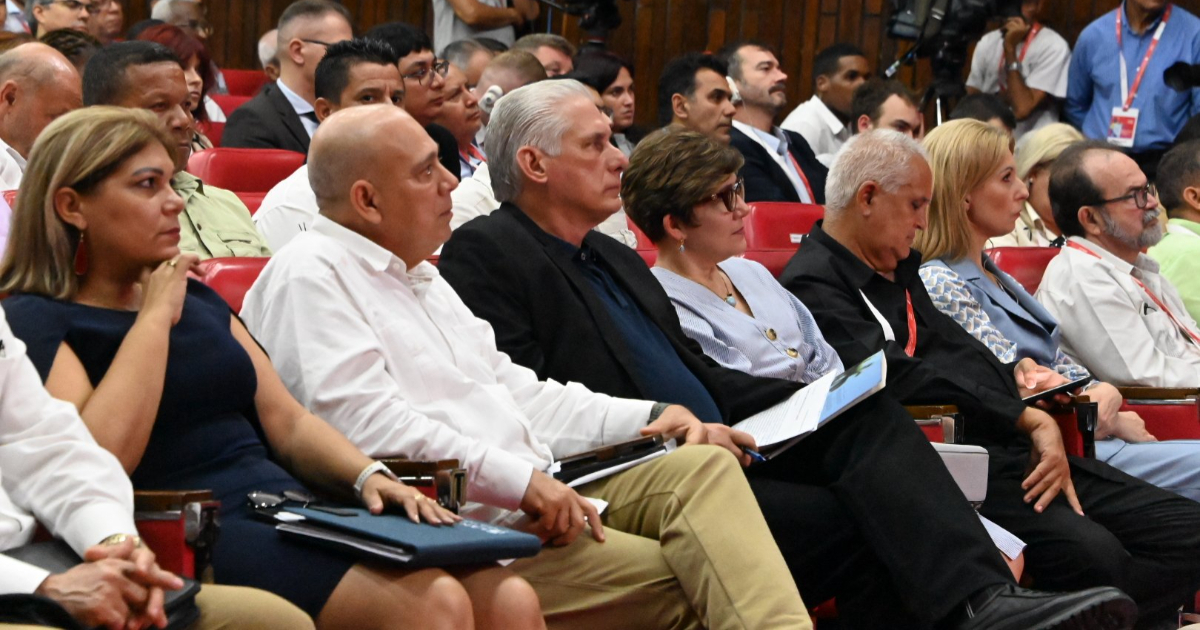
The Cuban leader Miguel Díaz-Canel proposed this Thursday the creation of an international network of leftist media during the Third International Meeting of Theoretical Publications of Leftist Parties and Movements, being held in Havana.
The call, disseminated by the official newspaper Granma, seeks —according to the leader— to bring together “critical and sovereign media” to confront “the ideological offensive of imperialism” and consolidate “cultural sovereignty and the unity of the peoples of the South.”
Díaz-Canel invited attendees to build a network that links theoretical publications, printed and digital media from Latin America, Africa, Asia, and Europe, which will promote thematic co-publications and encourage the training of "revolutionary" young communicators.
In her words, this platform should be "a political tool" that serves to "make visible the struggles of the left" and "train new generations committed to emancipatory thinking."
During his speech, the leader reiterated that “to think is to fight, to publish is to resist, and to communicate is to liberate”, and defended the need for “a sensitive and strategic political communication, capable of building consensus and fostering awareness.” He also stated that leftist publications have “a historical responsibility in the battle for truth against media manipulation.”
The speech came after journalist Ignacio Ramonet's conference on the challenges of artificial intelligence and "quantum superintelligence," during which Díaz-Canel emphasized that sovereignty is not only territorial but also "symbolic, cultural, and spiritual," and that progressive forces must "defend themselves and unite against global capitalism."
Contradictions amidst information control
While the leader calls for the creation of a global network of "critical and sovereign" media, in Cuba there is no freedom of the press and the State maintains an absolute monopoly on information.
Her proposal comes just five months after the Resolution 9/2025 of the Institute of Information and Social Communication came into effect, which allows for the closure of websites and digital publications without prior notice if they are deemed to violate "socialist principles."
This regulation also empowers the regime to severely sanction those who republish after a cancellation, requires hosting providers to work only with officially registered media, and mandates the declaration of funding sources, effectively excluding independent media.
The resolution was presented as an attempt to "organize" the national communication system, but it has been denounced as a tool of censorship and narrative control at a time of rising social discontent, marked by blackouts, protests, and the discrediting of the official media apparatus.
Censorship, self-censorship, and official discourse
In recent months, the regime has intensified its oversight of state media and the journalists working within them. In August, a televised debate in Cienfuegos revealed how official reporters admitted live to the existence of self-censorship walls and the fear of reprisals from the authorities.
Despite this reality, Díaz-Canel insists that the “revolutionary press is independent and free” because “it does not serve capitalist or foreign interests,” a statement that has been deemed cynical by international organizations such as Reporters Without Borders (RSF) and the Committee to Protect Journalists (CPJ), which rank Cuba among the most repressive countries in terms of press freedom.
The contrast between the president's rhetoric and the reality of the country is becoming increasingly evident. While he speaks of "unity of peoples" and "the battle for truth" in international forums, within Cuba journalists are monitored, censored, and threatened for deviating from the Communist Party's line.
In this context, the idea of an international network of leftist publications sounds more like an attempt to export the Cuban model of communicative control than a project of cooperation among free voices.
Filed under: