
Related videos:
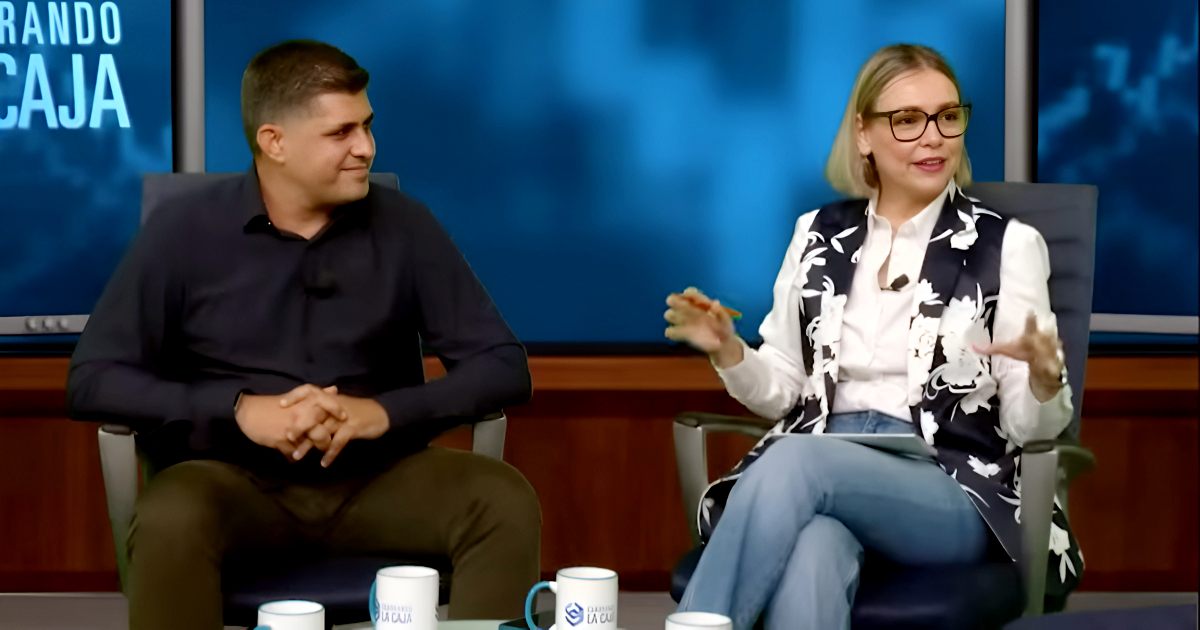
The latest television program 'Cuadrando la Caja' from state television, hosted by Marxlenin Pérez Valdés, dedicated its edition to explaining “why Cuba seeks to regain control of the currency exchange market.”
In the event, the following individuals participated: the licentiate Ian Pedro Carbonell Karell, director of macroeconomic policies at the Central Bank of Cuba (BCC); Dr. Ayuban Gutiérrez Quintanilla, vice president of the National Association of Economists and Accountants (ANEC); and deputy Carlos Miguel Pérez Reyes, private entrepreneur.
The program began with an unprecedented acknowledgment: "We know that the currency market is currently not functioning," admitted Carbonell Karell, who justified the need to "reclaim" that space to connect the national economy with the outside world.
The academic Gutiérrez Quintanilla added that the State should grant "official status" to a market that currently operates informally and illegally, in order to "regulate it" and "put it at the service of economic development."
On his part, businessman Pérez Reyes described how the volatility of the dollar and the lack of a real exchange rate impact contracts, prices, and the ability to export. “It's a vicious cycle: without foreign currency, there is no market, and without a market, no foreign currency comes in,” he said.
The program's leadership emphasized that the government's goal is to create a legal and secure market to curb the informal dollar exchange rate, which currently hovers around 450 pesos on the street, well above the official rate of 120.
"Enter the playing field"
The panel of experts agreed that the government plans to "enter the game" in the informal market with an "official" and controlled version.
"We need to reclaim that exchange market that currently exists illegally," reiterated Gutiérrez Quintanilla. "The first step is to participate, even if the conditions are not ideal."
The participants acknowledged that Cuba does not have sufficient reserves to sustain a fixed exchange rate, which is why a "flexible and gradual" model is intended to be implemented.
Carbonell Karell admitted that the Cuban economy faces a fiscal deficit, excessive issuance of pesos, partial dollarization, and productive contraction, but he maintained that the new scheme "will allow for the attraction of remittances and provide confidence to those currently operating in the black market."
The host emphasized that the government seeks to "eliminate the influence of external actors" and "end the game" of what she described as an "economic war."
El Toque, now an official enemy
In the final segment of the program, the panelists and the host spent several minutes pointing to El Toque —an independent Cuban media outlet that daily publishes the informal dollar exchange rate— as being responsible for distorting the economy.
“That rival player, El Toque, manipulates the illegal dollar rate under foreign interests,” stated the host Marxlenin Pérez, a doctor of Philosophical Sciences and professor at the University of Havana, and partner of Fidel Castro Smirnov, son of Fidel Castro Díaz-Balart and paratrooper grandson of the balloon dictator.
Carbonell Karell warned that “200, 300, 400 messages a day about buying and selling” cannot determine the real rate of an economy, and accused the platform of “creating expectations” that “threaten the stability of the country.”
The businessman and deputy Pérez Reyes went as far as to describe the dynamics of the informal market as “a mafia” and linked El Toque to “actors who launder money and charge commissions for operations between Cuba and the United States.”
The academic Gutiérrez Quintanilla concluded with a political statement: “One does not overlook the enemy; one combats them. El Toque has declared that it wants to subvert the Revolution. No patriot can side with those who attack their country.”
In this way, the television program transformed an economic discussion into a political propaganda act, reinforcing the narrative that the State must "regain control of the dollar" to defend national sovereignty.
Without the IMF and with "gradual dedollarization"
In response to the question about possible international support mechanisms, Gutiérrez Quintanilla ruled out any cooperation with the International Monetary Fund (IMF): “We do not have access to the IMF. That check comes with conditions that undermine sovereignty. Cuba will not follow that path.”
The panelist argued that the country must “rev up its economic machinery through its own efforts” and move towards a monetary and exchange unification “in the long term,” with the ultimate goal of “dedollarizing” the economy.
In summary, the program presented a rudimentary outline of recovery, without reservations, external funding, or international credibility, relying solely on the promise of "joining the game."
Critique by economist Pedro Monreal: "Without production, there is no exchange rate."
The Cuban economist Pedro Monreal responded on social media with a direct critique of the official discourse.
In a series of ten messages on X (formerly Twitter), he warned that the so-called “relaunch” of the exchange market lacks economic basis and that the government is evading its responsibility for the failure of monetary policy.
"What is being said about 'relaunching' the official exchange market is mere rumor. Two crucial issues are not mentioned: resolving the lack of productive backing for the Cuban peso and the specific type of exchange rate regime," he wrote.
Monreal stated that without productive offerings, without goods or services priced in pesos, exchange rate stability is impossible: “With battered pesos, there will be no robust currency market. It will function as a facade or a makeshift solution.”
The economist recalled that in 2020 the government promised a monetary and exchange unification that never materialized, and deemed it "absurd" that it is now said that such a measure would be "suicide," after being defended at the time as part of a process of analysis lasting over 10 years.
"It's not serious to bring that up at this point in the game," he scoffed.
For Monreal, the main issue with the new attempt is the lack of coherence and credibility: "As long as there is talk of a 'floating' exchange rate without defining what type of regime will be established, a reasoned debate cannot progress."
He added that maintaining two different exchange rates will prolong "a factory of distortions" and that the current "vagueness about the sequence of the economic program doesn't promise much."
His conclusion was striking: “A political document is maintained that advocates for monetary and exchange unification, while official channels assert that this would be suicide. A bit of coherence wouldn’t hurt.”
Conclusions
The regime's attempt to "regain control of the dollar" is not grounded in an economic strategy, but rather in a political narrative designed to simulate initiative and deflect responsibility.
"Cuadrando la Caja" was, in fact, a propaganda performance: a script filled with socialist slogans, external blame, and abstract promises, lacking any figures, timelines, or technical mechanisms to explain how a functional currency market is intended to be created in a country without liquidity, without supply, and without trust.
The official discourse, disguised as a debate, was limited to reiterating clichés: “entering the playing field,” “recuperating the market,” “taking the first step,” “doing it gradually,” or “moving the economic machinery with our own efforts.” Empty phrases that do not describe policies, but rather states of mind.
No one explained what reserves would support the exchange rate, what fiscal or productive measures would accompany the process, or how foreign currency would be attracted in a context where the state itself is unable to deliver remittances sent through official channels.
There was also no self-criticism or assessment of past failures: the "Tarea Ordenamiento," which was supposed to unify the currencies and stabilize the peso, was either omitted or treated as an unrelated experience, despite having collapsed just three years ago. When one of the guests labeled that unification as a "suicide," the host nodded in agreement, sealing the official amnesia.
The implicit message was clear: the State does not assume responsibility; it merely announces another "gradual experiment" with the same triumphal rhetoric that preceded all previous failures.
The structure of the program resembled more of a political event than an economic forum. Each intervention reinforced the idea that the issues with the Cuban peso stem from "an economic war," the "blockade," or "foreign interests."
As expected, Marxlenin Pérez transformed the technical discussion into an ideological crusade against the independent medium El Toque, which has become an official enemy for publishing the informal dollar rate.
The demonization of El Toque served as a perfect distraction to evade the central issue: the total loss of confidence in the peso and the state financial system. Instead of acknowledging this erosion, the panelists blamed "a few kids who read messages on Facebook" for manipulating the national economy, reducing a structural crisis to a battle of perceptions.
Deliberate ambiguity dominated the entire debate. There was talk of a "flexible market" without defining its regime, "monetary unification" without a timeline, "gradual dedollarization" without tools, and "recovering convertibility" without explaining where the foreign exchange will come from to support it.
Not a single figure, nor an estimate of reserves, nor an incentive plan for exporters or producers: just rhetorical appeals to "sovereignty" and "self-reliance," repeated for three decades.
In summary, 'Cuadrando la Caja' was an example of empty economic rhetoric cloaked in ideology.
Its function was not to inform or debate, but to legitimize the narrative of state control and point to external culprits — the United States, sanctions, the IMF, and independent media — while the Cuban peso continues to devalue and the government lacks a credible plan to reverse it.
The regime promises to "recover the market" without foreign currency, without transparency, and without trust. And in that contradiction —of a State that does not produce, does not pay, and does not allow anyone else to do so— lies the essence of the Cuban crisis: an economy sustained by rhetoric, not by action.
Filed under: