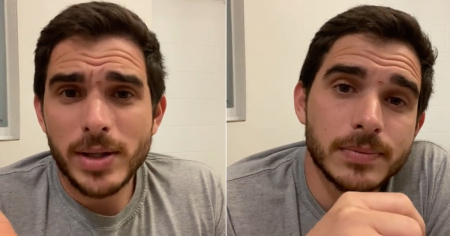
The young Cuban Leandro Hernández, known on social media as @leoibarra1112, shared an emotional video on TikTok where he recalled the first anniversary of his departure from Cuba and recounted how he experienced the most uncertain days of his life until he managed to settle in Peru, a country that offered him refuge after he was stranded at Lima airport in 2024.
“Today is November 30, marking one year since I boarded a plane to leave Cuba. I believe it was one of the hardest decisions I've ever made in my life, and one of the most uncertain moments I've experienced,” the young man began. He explained that from the moment he left, he knew he wouldn’t be able to return “unless the dictatorship fell.” He recalled that he even feared he might not be allowed to leave, and that he was held at the Havana airport for about an hour. “A rather arrogant lieutenant colonel approached me with my passport, which had already been taken away. I remember he asked me, ‘Are you sure you want to go?’ I replied that I was, and at that moment, he threw my passport to the immigration officer and said in a very dismissive manner, ‘Alright, let him go,’” he recounted.
Hernández explained that he had purchased a flight to Nicaragua, with layovers in Lima and El Salvador, but his suspicions were confirmed upon arriving at the Peruvian airport. “When I went to board the flight heading to El Salvador, the airline gave me a notification from the Managua immigration stating that I could not enter the country, that I was banned from entering Nicaragua,” he stated. “I could no longer return to Cuba, and I was left in a migratory limbo at Jorge Chávez airport,” he added. The story of his arrival in Peru became known when the young man reported on social media that he was stranded at the Lima airport and asserted that his case demonstrated “the tentacles of the Cuban regime”.
The young man spent several days in the Duty Free area, without a visa to enter Peru and with very little money. “It wasn't at all in my plans, I didn’t know anyone here in Peru, I didn’t have a visa to enter the country, I only intended to stay in the airport for four hours,” he said. “I thought about the case of a Cuban dissident woman who was also stranded at the same airport for 12 days until she was allowed to enter the country. This led me to adopt a wartime economy, as I was traveling with very little cash on hand,” he explained. “I really lived in a lot of tension those days at the airport. I remember that to save money I would go to the markets inside the Duty Free, where they displayed Peruvian products that you could sample. I would approach, try one, and sneak a few into my pocket to have something sweet to eat at night, rationing my food extremely,” he added.
Four days later, Peruvian authorities allowed him to enter the country. “The phrase I was greeted with at the entrance, ‘welcome to Peru,’ is going to be one of the sentences I carry with me for the rest of my life,” he stated. However, he admitted that upon leaving the airport, he felt a mix of relief and fear. “I was very eager to get out of the airport, but once I left, I think I wished I could go back inside. I didn't know anyone in Peru, I didn’t know anything, I didn’t know what I was going to do, I didn’t know where I was going,” he recalled.
It was then that a Peruvian journalist, who followed him on social media, reached out to him and met him at the exit. "He took me to eat my first lomo saltado, which tasted glorious; I was very hungry," he recounted. "I have to thank the Cuban community a lot, especially the exile community in Florida, who kept a close eye on my case and tagged the Ministry of Foreign Affairs of Peru in posts all the time. I believe that exerted pressure to get me out of the airport as quickly as possible," he added.
After leaving, Hernández immediately started looking for work. “I remember that same day I printed out resumes and began my job search right away, and one of my best friends in Cuba had a friend here in Peru. Ricardo reached out to connect me with Alejandro Maínegra so I could meet him and get some guidance here in the country,” he recounted. He mentioned that he met him in a café where another Cuban had been working for over three decades in Peru. “After getting to know each other and talking for a while, they offered me a job, and that’s how, by my second day in Peru, I was already starting to have some financial support,” he shared.
The young man explained that over time he achieved job stability. “I currently work as a mechanic for the Euromotors group, especially for the San Bartolomé company,” he said. “Time has flown by for me. There are times when I think about Cuba as if it happened 10 years ago, and I believe it's part of the post-traumatic shock that many of us Cubans experience when leaving the island.” In another post, he celebrated being able to practice his profession again in Peru.
In another previous testimony, Hernández reflected on his identity and his relationship with the country he left behind. "Do I miss it? I miss moments, I miss people who are still in Cuba, and people who are no longer in Cuba either, but I don't miss Cuba itself. Many times I feel that I am more Cuban outside of Cuba than I am within it. The regime destroyed us as a society; it consumed us physically and mentally. I don’t believe there is much to miss in the Cuba I grew up in, not in the Cuba of my grandparents," he said.
The video has generated a wave of reactions from Peruvian, Cuban, and Latin American users. One person commented, “You said the phrase ‘welcome to Peru’ and I couldn't help but break down; that felt so powerful, happy anniversary.” Another wrote, “You made me cry; how difficult it must be, but you know I appreciate that you came to work, not to cause harm or hurt anyone. Wishing you success.” There are also messages like “Excellent story of effort, resilience, and sacrifice. Welcome to Peru. It’s regrettable to know that there are Peruvians who believe that socialism and communism are good” and “Your story should be shared so that young people understand what hard and pure socialism is. Welcome to Peru, let’s always be free.”
Among the comments, several Cubans expressed pride in seeing him succeed. One wrote: "I followed you on X from Cuba. You are an example of a young Cuban. Keep moving forward, and you will have a bright future. You represent us. Thank you, Peru, for welcoming our best people." Another commented: "How quickly time passes. I have been following you since you arrived. It's great that you are doing well, and most importantly, that you are free from the dictatorship in Cuba."
The young man, who became known after being stranded at the Lima airport, has since used his social media to share his adaptation process and to highlight the reality he experienced on the island. In one of his posts, he recounted his first visit to a medical center outside of Cuba, where he said: “It is very satisfying to experience firsthand the debunking of the myth that Cuba is a medical powerhouse. Oh, how they lied to us!”, as can be seen in this testimony. Later, he elaborated on his criticism of the Cuban healthcare system by stating that “Cubans pay for our health with repression, with lack of freedom, with miserable salaries our entire lives, with shortages of supplies, medications, and technology in our hospitals.”
A year after leaving the island, Leandro Hernández summed up his journey with a phrase he often repeats on social media: “It’s incredible everything that happens in a year. Sometimes I struggle to think, and I feel like I’ve been here much longer. I really liked Peru, and if life has decided to keep me here, then here I will stay. I really liked Peru, I liked it a lot, a lot, a lot... I ended up falling in love with its culture, its food, its hard work, its patriotism, its cold sea, and the opportunity it has given me to be free. I hope that someday my country can enjoy this freedom.”
Filed under: