
Related videos:
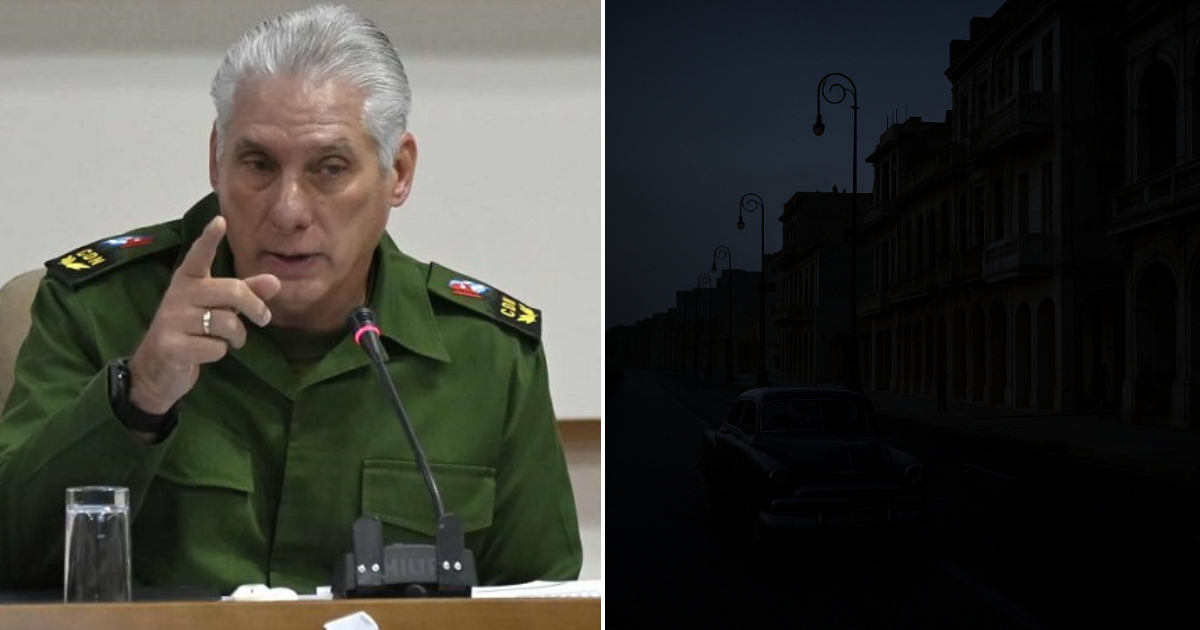
Miguel Díaz-Canel referred this Wednesday to the general blackout that left Havana and several provinces in the west without electricity, while reporting on the "disconnection of the National Electric System (SEN)" and mentioning the difficulties the country faces due to the "blockade" and the recovery from Hurricane Melissa. His message on social media sparked an avalanche of criticism and mockery from Cubans who expressed their fatigue over the energy crisis.
On his profiles on X and Facebook, Díaz-Canel stated that "the workers of Energy and Mines, who do not rest amid the daily complexities imposed by the blockade and the recovery from Hurricane Melissa, are already addressing the issue." He also added: "Once again, we trust them."
Her words sparked strong criticism and feelings of frustration on social media, where hundreds of users responded with reproaches, mockery, and complaints about the difficult living conditions amid prolonged blackouts, shortages, and the deterioration of essential services.
The comments predominantly expressed rejection of the use of the term "blockade" as a justification for the power outages. Several internet users pointed out that the true cause lies in the inefficiency of the system and the lack of maintenance of the thermoelectric plants. Others expressed indignation at the reiteration of the same official narrative, ironically referencing phrases like "the blockade and the power cut" or "Cuba has been disconnected since 1959."
Many deemed it insulting that the president once again resorted to blaming the external blockade while the population endures power outages of up to 30 hours. Some comments encapsulated the frustration with expressions like "you are disconnected from the reality of that people."
Claims have also multiplied from areas that have been without service for days. One citizen stated that “since the cyclone we have been disconnected; there are children and the elderly, mosquitoes and trash, and no one comes to see us,” while another pointed out that “it didn’t affect your house, of course, you never lose power.” Although a few users expressed support or gratitude to the workers in the electricity sector, the overall tone was one of indignation and mockery toward Díaz-Canel and his handling of the crisis.
During the early hours of this Wednesday, a power outage in the western region of Cuba occurred, affecting provinces from Cienfuegos to Pinar del Río, including the capital. According to official information, a failure in a transmission line between Santa Cruz del Norte and the Antonio Guiteras thermoelectric plant in Matanzas caused an overload in the grid, leading to the shutdown of several generating plants, including Mariel, Santa Cruz, Cienfuegos, and Felton.
Hours later, the Havana Electric Company announced that it had started the process of restoring service, prioritizing hospitals and water supply systems following the partial disconnection of the western system.
The blackout sparked a wave of outrage on social media, where Cubans expressed their frustration over the repeated failures and the deterioration of the energy system. The phrase "this is not just a blackout, it's a country in the dark" circulated widely in posts and comments, reflecting the accumulated discontent over the electric crisis.
According to previous reports, the event left millions of people without electricity since early morning and caused Havana to wake up completely in darkness. The outages, according to the Electric Union, were caused by an overload in the western part of the country and worsened a national generation deficit that already exceeds 2,000 megawatts.
In its evolution, the blackout adds to a long chain of failures that have exposed the deep fragility of the National Electric System, impacted by breakdowns, fuel shortages, and a lack of investment. In recent months, Cuba has recorded at least five national collapses and multiple regional blackouts that have paralyzed entire provinces.
While the authorities insist on referring to a "technical failure" and "complexities arising from the blockade," citizens are demanding transparency and solutions. For many, the darkness of this Wednesday was just another episode in a country that, as one user wrote on social media, "has been disconnected for far too long."
Filed under: