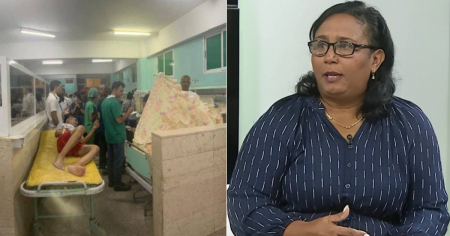
The Cuban government confirmed that respiratory viruses such as the pandemic H1N1 influenza, respiratory syncytial virus, which particularly affects young children and the elderly, and also COVID-19, are circulating in the country, although with low positivity according to official data.
The information emerged this Monday during a weekly exchange between the leader Miguel Díaz-Canel and scientists from the health sector, during which there was also a warning about a possible increase in cases in the coming weeks.
The epidemiological update arrives at a particularly critical moment for Cuba, marked by outbreaks of dengue and chikungunya that have resulted in 33 deaths, among them 21 minors, according to figures acknowledged by the Ministry of Public Health (Minsap) in recent days.
During the meeting, reported by the Canal Caribe, specialists from Minsap explained that between July and November, 1,423 samples from patients with Acute Respiratory Infections were studied. The highest circulation corresponds to respiratory syncytial virus and H1N1 influenza, two common pathogens during this time of year, but which can cause severe cases in vulnerable populations.
Regarding COVID-19, the experts themselves presented graphs showing "low" but persistent positivity peaks, as well as the presence of variants being monitored internationally. Although they insisted that there is no cause for alarm, they did acknowledge that the virus is "circulating" and that Cuba is keeping a watchful eye on new variants such as XFG, reported in other countries.
Nevertheless, no data was presented regarding hospitalizations, medication availability, or the system's capacity to cope with a rise in cases, which are particularly sensitive elements in the current context.
The mathematician and epidemiologist Raúl Guinovart presented predictive models indicating an increase in cases in the coming weeks, particularly in eastern Cuba and on the Isle of Youth. However, the official report did not clarify whether this increase refers to arboviruses, respiratory infections, or both.
Díaz-Canel urged health authorities to "provide timely and continuous information," despite the criticism that Minsap has faced for its lack of transparency in epidemiological reports.
Critical context: 33 deaths from arboviral diseases, 21 of them in minors
The confirmation of the circulation of H1N1 and COVID-19 comes just hours after the government acknowledged 33 deaths from dengue and chikungunya, 21 of which are among children and adolescents. This revelation has caused alarm both within and outside of Cuba.
For example, the Canadian press is already warning that the island is experiencing an epidemic outbreak with a “limited” healthcare system and hospitals in poor condition.
The situation is worsened by the shortage of insecticides, a lack of medications, power outages, and the state's inability to control infestation rates, which currently stand at 0.89%, with provinces like Camagüey, Santiago de Cuba, and Havana among the most affected.
"Laboratory" technologies versus the epidemic on the streets
At the meeting, scientists presented new technologies to "reduce or eliminate vectors," such as sterile insect techniques, transgenic mosquitoes, and intracellular bacteria capable of affecting Aedes aegypti.
These solutions, while promising, are still in the design or industrial scaling phase, while the Cuban population faces real outbreaks, overcrowded hospitals, and the uncertainty of lacking basic resources for protection.
Filed under: