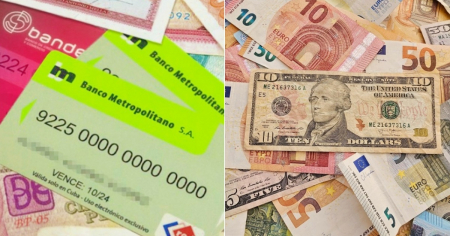
The freely convertible currency (MLC), which had seemed doomed to disappear for months, continues to show signs of movement in the informal Cuban market: today, it is down.
The MLC has entered a rollercoaster dynamic in recent days, with sudden drops or surges in its average selling value.
This Thursday, the Freely Convertible Currency drops from 285 to 280 CUP, which represents a decrease of five pesos compared to its selling value from the previous day.
The US dollar and the euro, for their part, have remained stable for several days.
Exchange Rate Evolution
Today the dollar remains pegged at 450 CUP for the fifth consecutive day, a value it reached last Sunday.
Also unchanged is the euro, which continues to be sold at 490 CUP, according to a report from the independent media on December 4 elTOQUE, which documents the price fluctuations of currencies in Cuba.
Exchange rate today 04/12/2025 - 6:39 a.m. in Cuba:
Dollar exchange rate USD to CUP according to elTOQUE: 450 CUP.
Exchange rate of the euro EUR to CUP according to elTOQUE: 490 CUP.
Exchange rate of MLC to CUP according to elTOQUE: 280 CUP.
The MLC refuses to die
During a good part of 2025, the informal exchange rate of the Freely Convertible Currency fell significantly against the Cuban peso, driven by the loss of public confidence, the increased use of cash dollars, and the reduction of products in state stores operating in MLC.
These elements fueled persistent rumors about its imminent disappearance as a relevant means of payment in the Cuban economy.
However, despite those warnings, the MLC has not disappeared; rather, it has shown remarkable resilience.
In recent days, its value in the informal market has risen again, despite some occasional dips. This surge is surprising in a context where the dollar and euro continue to dominate informal buying and selling transactions.
For months, elTOQUE has warned that this specific increase can be attributed to several factors: the limited availability of cash dollars, the need to access specific products that are only sold in MLC stores, and a seasonal or situational demand that has driven its use.
It is also influenced by the fact that, although in decline, the payment infrastructure in MLC remains active: many bank cards still have a balance in that currency, and there are still stores that accept it.
The MLC remains, therefore, an ambiguous monetary instrument: in decline, but still functional.
Its recent evolution reflects the complexity of the Cuban economy, where no currency seems stable, and where even a currency that many considered dead can unexpectedly resurge with strength.
Equivalence of United States Dollar (USD) to Cuban Peso (CUP), based on the exchange rates from December 4:
1 USD = 450 CUP.
5 USD = 2,250 CUP.
10 USD = 4,500 CUP.
20 USD = 9,000 CUP.
50 USD = 22,500 CUP.
100 USD = 45,000 CUP.
Equivalence of Euro (EUR) banknotes to Cuban Peso (CUP):
1 EUR = 490 CUP.
5 EUR = 2,450 CUP.
10 EUR = 4,900 CUP.
20 EUR = 9,800 CUP.
50 EUR = 24,500 CUP.
100 EUR = 49,000 CUP.
200 EUR = 98,000 CUP.
500 EUR = 245,000 CUP.
In recent weeks, the Cuban government has intensified its campaign against the informal currency market and against the reference rate published by the independent outlet elTOQUE.
This offensive includes criminal investigations, threats to currency operators, and a communication strategy focused on discrediting alternative sources for the prices of the dollar, euro, and other currencies.
Although the attack may seem like a distraction from the country's deep economic crisis, an article published last Monday by economist Pavel Vidal in elTOQUE suggests that the real objective is to pave the way for the implementation of a new floating official exchange rate, by first weakening the informal market and its key players.
This move aims to capture remittances through official channels and have greater control over the flow of foreign currency, but for this, the government is resorting to coercive mechanisms instead of competing with transparency and attractive rates.
Filed under: