
Related videos:
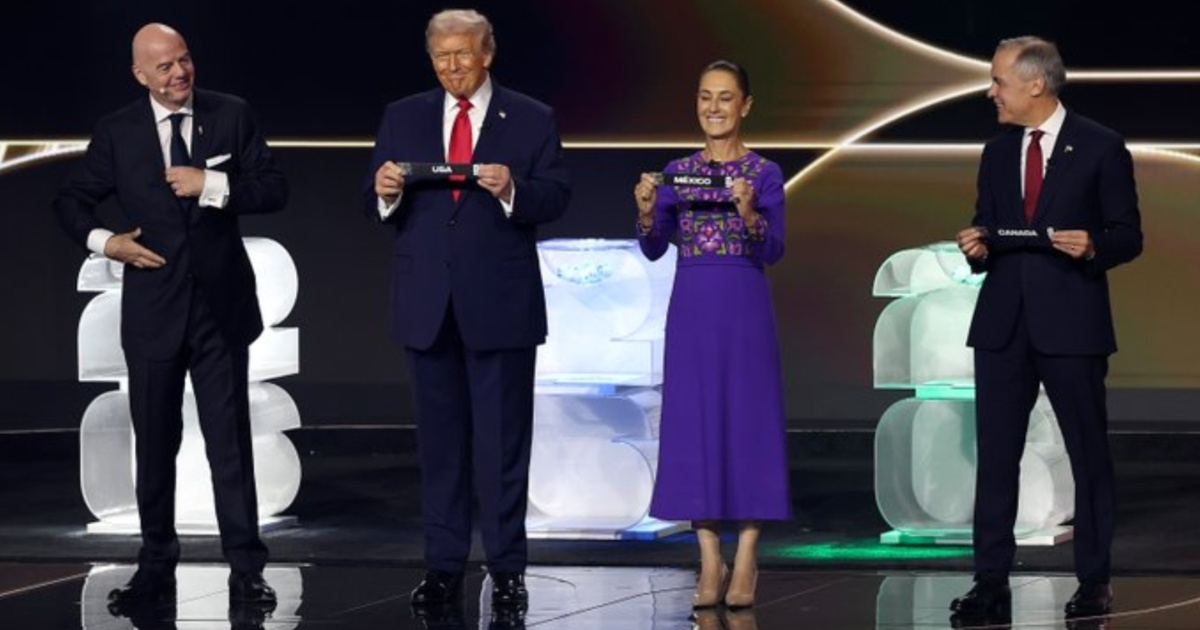
The path to the 2026 World Cup was marked this Friday following the group stage draw, held at the Kennedy Center in Washington D.C., which assigned the 48 participating teams into 12 groups for the first round of the World Cup to be held in the United States, Canada, and Mexico between June and July 2026.
The main novelty of the tournament is its expanded format to 48 teams, a change that extends the competition and adds an extra round of knockout: the round of 32, before the round of 16.
Out of the 48 participants, 42 are already qualified, while the remaining six spots will be determined in March 2026 through an international playoff and a UEFA playoff.
In terms of organization, the calendar already has key dates: the opening match will be held on June 11 at the Azteca Stadium in Mexico City, while the final is scheduled for Sunday, July 19 in New York, and the third-place match is set for July 18 in Miami.
Mexico, which is seeded as the host and appears in the text with its position of 15 in the FIFA ranking, has been placed in Group A, where it will debut against South Africa and will share the group with South Korea and an opponent to be determined from UEFA qualifying Playoff D (Denmark, North Macedonia, Ireland, or Czechia).
This group will play from June 11 to 24 and will be divided between Azteca (CDMX), Akron (Guadalajara), BBVA (Monterrey), and Mercedes-Benz (Atlanta).
Canada, the other North American host leads Group B alongside Qatar and Switzerland, as well as a team yet to be determined from the UEFA A playoff (Italy, Northern Ireland, Wales, or Bosnia and Herzegovina).
This area will be contested from June 12 to June 24 at venues such as BMO Field (Toronto), BC Place (Vancouver), Levi’s Stadium (San Francisco), SoFi Stadium (Los Angeles), and Lumen Field (Seattle).
In the rest of the draw, the lottery resulted in matchups with striking encounters from the initial phase.
Group C includes Brazil, Morocco, Haiti, and Scotland; Group D includes the United States, Paraguay, Australia, and a qualifier from the UEFA playoff (Türkiye, Romania, Slovakia, or Kosovo).
In Group E are Germany, Curacao, Ivory Coast, and Ecuador. Group F includes the Netherlands, Japan, Tunisia, and a yet-to-be-determined team from the UEFA B playoffs (Ukraine, Sweden, Poland, or Albania).
Later on in the group, Group G consists of Belgium, Egypt, Iran, and New Zealand; Group H includes Spain, Cape Verde, Saudi Arabia, and Uruguay; Group I features France, Senegal, Norway, and a qualifier from international playoff 2 (Bolivia, Suriname, or Iraq).
Group J was composed of Argentina, Algeria, Austria, and Jordan. Group K included Portugal, Uzbekistan, and Colombia, along with a team from international playoff 1 (Jamaica, Democratic Republic of the Congo, or New Caledonia). Finally, Group L brought together England, Croatia, Ghana, and Panama.
The organization of the World Cup will also be characterized by a "regionalized" dynamic to reduce travel and long transfers, due to the size of the tournament and the three host countries.
According to the published information, several cities and stadiums for some groups will remain to be confirmed with a schedule update set for Saturday, December 6.
Filed under: