
Related videos:
"We were thrown out of the house and the door was sealed." The scene remained etched forever in the memory of Ana Hebra Flaster, even though she was only five years old at the time.
That night, a guard appeared unexpectedly, handed over the exit visas, and forced his family to leave their home. Before leaving, he placed a sign on the door: "Property of the Revolution." Decades later, that phrase became the title of his memoirs.
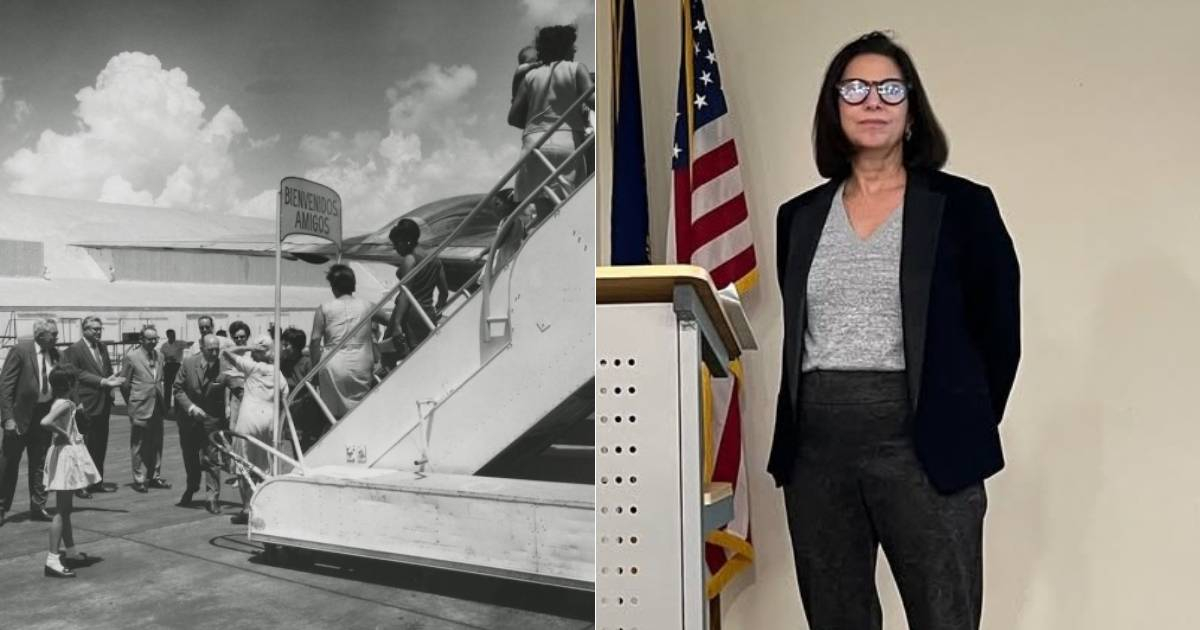
The Cuban-American writer, residing in New Hampshire, recalled her story in an interview with the public radio WBUR, marking the 60th anniversary of the beginning of the so-called Freedom Flights, the largest airlift of refugees in the history of the United States.
Between 1965 and 1973, approximately 300,000 Cubans escaped from the island through this means after negotiating their exit with Fidel Castro's regime.
Hebra Flaster recounted that his parents, who were workers and teachers, initially supported the Revolution. His mother even risked her life collecting money and medicine for the rebels. However, the promised project to restore democracy never materialized. Instead, the new government instituted repression, executions, and absolute control over everyday life.
When the family requested exit visas, a long ordeal began. For three years, they were expelled from their jobs, harassed, and labeled as “enemies of the Revolution.” Their home was vandalized, and they lived under the constant threat of arrest. “You were completely vulnerable,” the author recalled in WBUR.
The departure came suddenly and left no room for goodbyes. They could only take one suitcase with a change of clothes per person. They left behind their extended family, their memories, and everything they had built. Like thousands of other Cubans, they were labeled as "worms," the term used by the regime to dehumanize those who sought to leave.
Upon arriving in the United States, the first image that Ana holds onto is not one of abundance or comfort, but of human dignity.
In Miami, her mother tried to call a relative from a payphone and realized she didn't have any money. Leaning against the machine, she broke down in tears. A stranger approached, gave her a coin, and left silently. "That was our first act of kindness in this country," she recounted.
The writer emphasized that her story is defined by what she refers to as "incredible luck." Other members of her family did not share the same fortune.
He remembered a cousin who arrived during the Mariel exodus, stigmatized by the crisis and rejection, and another who was detained in Guantánamo after the Balseros Crisis of 1994 and returned to Cuba forever marked by his attempt to escape.
In her testimony, Hebra Flaster also offered a critical view of the present. She warned that many Cubans who were once beneficiaries of asylum policies now fear the deportation of relatives who arrived legally in recent years. For her, history shows that the treatment of migrants does not only depend on the repression in their countries of origin, but also on the political interests of the moment.
"The days of sending planes to rescue those fleeing from totalitarian regimes are behind us," he lamented. Nonetheless, he defended the American tradition of asylum and recalled the words of President Lyndon B. Johnson when he signed the Immigration Act of 1965, promising refuge to Cubans escaping the dictatorship.
From her experience as an exiled child and now as a writer, Ana Hebra Flaster concluded with a message that resonates today among thousands of Cubans both on the island and abroad: the hope that, despite everything, history will once again tilt in favor of those who only seek to live in freedom.
Filed under: