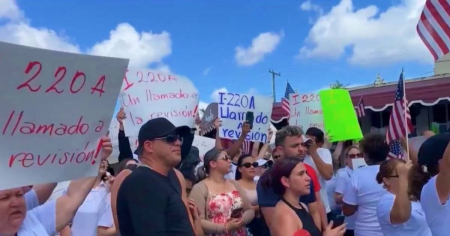
A Cuban with an immigration document I-220A shared on TikTok his experience after being sent from the United States to Mexico under a voluntary departure, describing step-by-step how his transfer went and the treatment he received until arriving in Cancun.
I am released on December 5 and taken by bus to the Hidalgo Bridge, which borders Reynosa. I walk across, and from there onwards, there is a checkpoint where they check your health status, recounted the migrant, who asserted that the process was monitored by the Mexican National Guard and was conducted “safely.”
According to the explanation, at each stop, the migrants received food and basic care. “They give us lunch, they treat us well, thank God the treatment is very good... Throughout the journey, they also provide us with food; we don't go hungry.” he shared.
The Cuban detailed that his journey covered several states in southern Mexico. “We passed through Mexico City until we reached Tabasco, specifically in Villahermosa,” he said, explaining that there they created an electronic safe conduct for them. Later, “they take us to the city of Palenque, which is about two hours from that location, and there they release us in a park, giving us our belongings.”
In his testimony, he stated that after purchasing a ticket to Cancun, the trip proceeded without any serious incidents: “We were stopped twice and were allowed to continue; they take a photo of any document we have, they treat us well, they never treat us poorly”.
The young man explained that with the conveyance pass he can travel through the south of the country, although he is not authorized to travel north, and he mentioned that he plans to share on social media what his process with COMAR, the Mexican Commission for Refugee Assistance, will be like.
The video, available on his TikTok account, has gained thousands of views and comments that reflect both support and curiosity about the immigration process.
The testimony generated hundreds of supportive messages and questions about the process of "voluntary departure." Many users expressed their gratitude to the Mexican people for the humanitarian treatment received by the young man, with comments such as: "Welcome, Mexico is a country that welcomes all migrants" or "Thank you for sharing your experience; it seems they treated you better than ICE. Thanks to Mexico for treating people like human beings."
Others expressed interest in understanding the process: "How did you initiate the voluntary departure?" and "Can one request to go to Mexico by their own decision?" Among the Cubans, several expressed understanding and solidarity: "Given what we Cubans have gone through, giving up is not an option, but I respect your decision. I wish you all the best."
Context: thousands of Cubans awaiting the decision on the I-220A
The situation of this migrant occurs amidst a growing expectation among the Cubans released under form I-220A in the United States, following a court hearing in Atlanta that could redefine the immigration status of thousands of them.
In that hearing, immigration attorneys argued that many were incorrectly processed and should have received a parole instead of an I-220A, which prevents them from benefiting from the Cuban Adjustment Act. The judges of the Eleventh Circuit questioned the Government's stance and left open the possibility that the court might consider those releases equivalent to a parole.
According to the arguments presented by attorney Mark Prada, migrants were given the wrong documentation. If the court accepts this interpretation, it would create a legal avenue for Cubans with I-220A to adjust their status in the United States.
The lawyer José Guerrero explained that a favorable ruling would directly benefit those residing in Florida, Georgia, and Alabama, although the precedent could be used as a persuasive argument in other states. He also warned that, even if the decision is positive, the Government could appeal and delay its implementation.
The audience, as reported in previous reports, left a feeling of hope among Cubans who are in a migratory limbo and who hope to benefit from the Cuban Adjustment Act after one year and one day of residence in the United States.
The story of this Cuban, now in Cancun, illustrates the journey of many migrants who leave the United States with a "voluntary departure" and end up in Mexico in search of a new opportunity. Meanwhile, the I-220A community remains divided between judicial hope in Atlanta and the reality for those, like him, who must rebuild their lives outside the country.
Filed under: