
Related videos:
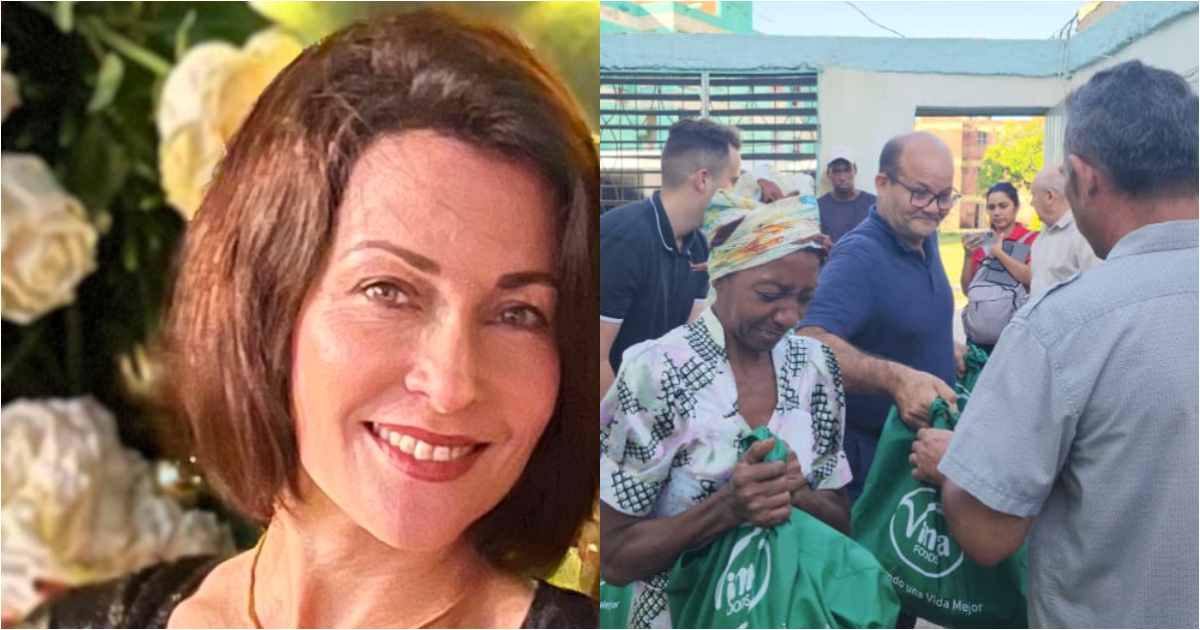
The Cuban actress Maikel Amelia Reyes posted a lengthy message on social media that, in less than a day, garnered tens of thousands of reactions as she called to "live with more love" amid the multiple crises that Cuba is currently experiencing.
In her post shared this Saturday on her Facebook profile, the actress acknowledges that Cuba is going through "incredibly difficult" times, marked by material shortages, blackouts, illnesses, and the family fragmentation caused by emigration. However, she insists that even in this context, each person retains the ability to choose how to face reality.
Reyes describes the pain of being away from his mother, his brother, and other family members, as well as the financial impossibility of meeting with them frequently.
Still, she claims that she chooses to embrace gratitude and fulfillment, believing that taking personal responsibility allows one to stop blaming others for their own misfortunes.
The text argues that material misery has been accompanied by a spiritual and emotional degradation, which —according to the actress— is evident in the rise of hatred, envy, and social aggression.
"It feels strange to see people being kind to one another, the scents of charcoal mingled with barbecues; I miss wishing each other well without the malice and the misery of spirit and mind that accompanies material hardship and the ignorance of believing we cannot choose," he wrote.
For that reason, he added, “if instead of hating, envying, and criticizing we were to bless more, support each other more, and take joy in the good fortune of our neighbors or colleagues, then we would be more abundant in every positive sense and resonate from love and gratitude.”
In one of the most discussed passages, Reyes stated that there is no equality in any country or social system, but there is the possibility of treating each other with respect, love, and kindness, because "the fact that you have a better economy than I do does not take away from me... the more those around you have, the more you will have."
On the occasion of the new year, he wished that 2026 "allows us to discern and understand that we have the power to change at least our square meter and that we have the ability to choose to live with more love amidst the chaos, thus bringing more miracles, more opportunities, and more abundance of goodness into our lives."
The message, concluded with religious references and a desire for mental and emotional renewal for the upcoming 12 months, has sparked mixed reactions.
Reactions
Hundreds of users expressed gratitude for the call to faith and resilience, while others recalled the political power's responsibility in a crisis marked by the collapse of basic services, a lack of prospects, and an increasingly uncertain future for millions of Cubans.
In this regard, they pointed out that as long as there is a system controlled by the Communist Party in Cuba, the Cuban citizen will not have the freedom to choose their own destiny.
In this regard, in the Facebook group Disproving the NTV of Cuba, the user Ghostman Barceló published an extensive text that directly questions the message's approach and associates it with the official discourse which, he claims, shifts political responsibility onto the individual.
Barceló came to identify the actress with her character Lucía from the crime series Tras la huella, suggesting that her reflection reproduces the moral logic of the repressive apparatus.
In his response, the user rejected the idea that the Cuban crisis could be resolved through a change in personal attitude or a "spiritual perspective" on reality.
He asserted that asking for gratitude, calm, or love in a context of scarcity, fear, and repression is equivalent to demanding resignation, and he claims that the ability to choose is not a mystical act but a material privilege that millions of Cubans lack.
In his view, presenting misery as an emotional issue or a matter of "vibration" is an elegant way of blaming the victims.
The text repeatedly uses quotes from José Martí to contrast the notion of justice with that of emotional charity, and it accuses this type of discourse of concealing structural inequality and the privilege associated with power.
Barceló concluded that indignation and criticism are not hatred or envy, but expressions of dignity, and that loving Cuba does not mean accepting the collapse with calmness, but rather pointing out those responsible and demanding real changes, even if it causes discomfort.
The popular actress is still recovering from chikungunya, but she assures that she has not stopped working despite the severe pain caused by the illness.
Filed under: