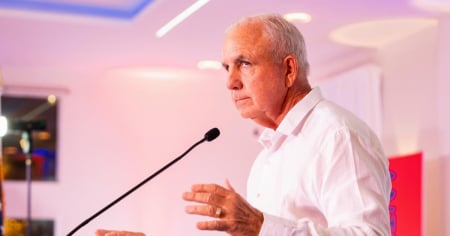
The CEO of Repsol, Josu Jon Imaz, announced this Tuesday at the White House the Spanish company's willingness to triple its oil production in Venezuela and to strengthen its presence in the United States.
The executive of the Spanish oil company celebrated before the American president Donald Trump the ambitious plan promoted by him to revitalize the energy industry of the Caribbean country following the capture of Nicolás Maduro.
"We are ready to invest more in Venezuela and triple production there in the next two to three years," stated Imaz during a meeting in Washington convened by Trump, which included top executives from Chevron, ExxonMobil, Shell, and Repsol, among other industry giants.
The aim of the meeting was to define the roadmap for the reconstruction of the Venezuelan energy system, which has been devastated after years of corruption, mismanagement, and international sanctions.
The U.S. president urged major oil companies to mobilize up to $100 billion in private investments to reactivate the extraction and refining of oil in Venezuela, without direct involvement of public funds, but with guarantees of legal security, political protection, and military backing from Washington.
“Venezuelan oil will not be in the hands of crime and tyranny again,” Trump said during his address, referring to the energy collapse under Chavismo, according to a report from El País.
In this context, Imaz highlighted Repsol's dual strategic commitment: to strengthen its presence in the United States and to increase its production in Venezuela.
"We are a Spanish company, but fully committed to the United States. In the last 15 years, we have invested 21 billion dollars in the oil and gas industry, from Texas to Alaska," he emphasized.
He also recalled that Repsol has been one of the key players in the discovery of the Pikka field in Alaska, which is considered crucial for reversing the historic decline in production in that state.
Regarding Venezuela, the executive noted that Repsol has a partnership with the Italian company Eni, through which it produces the gas that "ensures the stability of half of the Venezuelan electrical grid."
Currently, the Spanish company produces 45,000 gross barrels daily, but according to Imaz, "it is ready to triple that figure in the next two or three years, investing heavily in the country, following the recommendations of President Trump."
The announcement comes at a critical moment for the future of Venezuelan oil. Since Maduro's arrest on January 3 by a U.S. Delta Force operation, Washington has taken control of the transition process and has promoted an energy policy focused on attracting foreign capital to revitalize the sector.
Days earlier, Trump had ordered a total oil blockade against Maduro's regime and the seizure of ships and crude oil shipments destined for allies of Chavismo, such as China and Iran. He later revealed that some of the confiscated oil would be redirected to the strategic reserves of the U.S. or sold on the international market.
In parallel, the U.S. president announced that Venezuela will deliver between 30 and 50 million barrels of oil to the United States as part of the agreements with the new interim authorities led by Delcy Rodríguez, under direct supervision from Washington.
The measures have reshaped the global energy landscape and opened unprecedented opportunities for large Western oil companies. Venezuela, which holds the largest crude oil reserves in the world, is emerging once again as a high-potential scenario, albeit fraught with risks.
The country's infrastructure remains deteriorated after years of disinvestment and corruption, and the new legal framework proposed by the U.S. still creates uncertainty among investors.
Nonetheless, the commitment expressed by Repsol and other multinational companies reflects the new alignment of international energy capital with Trump's strategy, which aims not only to restore Venezuelan production but also to reinforce U.S. control over the flow and marketing of Latin American oil, directly impacting global prices and rival powers like China and Russia.
"Thank you, Mr. President, for opening the door to a better Venezuela," Imaz concluded, before a visibly satisfied Trump.
Filed under: