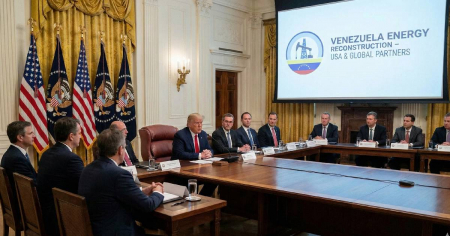
The CEO of Repsol, Josu Jon Imaz, stated this Friday to the President of the United States, Donald Trump, that the company is ready to "invest heavily in Venezuela" and to triple its oil production in the country to around 135,000 barrels per day.
During his statements at a meeting with American oil companies, Imaz thanked Trump "for opening the door to a better Venezuela" and emphasized that, although Repsol is a Spanish company, it is “fully committed” to investing in the United States.
He stated that in the last 15 years they have invested 21 billion dollars in the U.S. oil and gas industry, with a presence in Pennsylvania, the Gulf of Mexico, Texas, and Alaska.
About its operation in Venezuela, Imaz stated that Repsol is in the country "with our partners from Eni" and that it produces gas which —according to his claim— ensures "the stability of half of the electricity grid in Venezuela."
He added that the company has “personnel, facilities, and technical capabilities” on the ground and that, if permitted, it is ready to invest further within a “commercial and legal framework” that makes it possible.
Imaz detailed that Repsol currently produces 45,000 barrels of oil daily in Venezuela and is prepared to triple that figure “in the next 2 or 3 years,” “investing heavily in the country” and following the recommendation of the U.S. president.
The statements were made during a meeting at the White House with energy companies, where Trump, according to press reports, has urged major oil companies to invest billions in the reconstruction of the Venezuelan oil sector under a control and security scheme promoted by his administration.
Petróleos de Venezuela (PDVSA) confirmed this week that it is in negotiations with the U.S. government for the sale of crude oil volumes under schemes similar to those used with companies like Chevron, in a process it characterized as "legal and transparent."
Meanwhile, Venezuelan institutions continue to operate under the supervision of Washington, with Delcy Rodríguez as the interim president.
For international analysts, Trump's call to major oil companies solidifies energy control as a central axis of the strategy of the United States towards Venezuela and marks a shift from the isolation policy applied in previous years, opening a phase dominated by economic reconstruction under American oversight.
Filed under: