
Related videos:
While the Trump administration continues to warn about the possible expansion of its political pressure in the Caribbean following the capture of Nicolás Maduro, and Cuba faces a worsening of its energy and economic crisis, the regime has decided to respond with what it knows best: military propaganda and self-congratulatory ceremonies.
This Saturday marked the beginning of the National Defense Day, a series of exercises and official events aimed at demonstrating that the island is prepared to repel “any imperialist aggression.”
The Ministry of the Revolutionary Armed Forces (MINFAR) emphasizes in its doctrinal texts that defense is a "combat mission from the very first moments... with the entire people" under any circumstances.
In state publications, official networks and affiliated accounts, slogans reminiscent of the Cold War are being regurgitated: “Our defense is unbreakable,” “we are a brave people that knows no fear,” and that the trench is “in every neighborhood and every heart.”
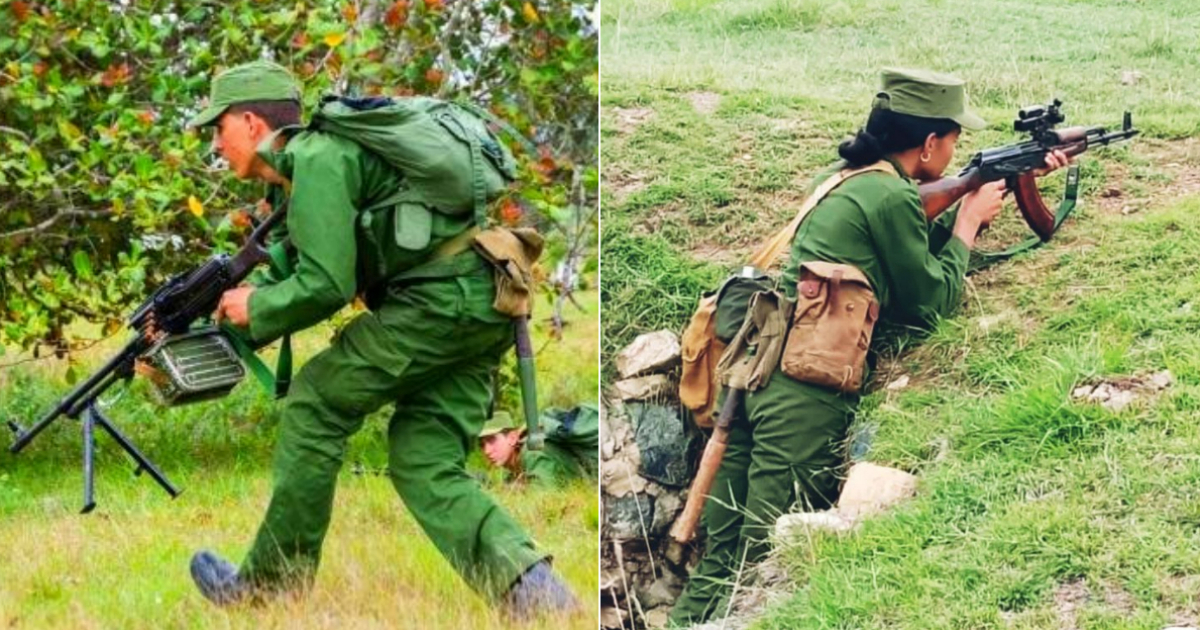
The words sound as anachronistic as one of those rusty AKM rifles, a larger caricature of the weapons that some militias display in promotional photos.
Images of uniformed soldiers inspecting old rifles, antique masks, and dusty machine guns blend with photographs of civilians posing with handguns in sandy fields, as if they were extras in a B-movie.
Far from the sophisticated modern weaponry, the military paraphernalia would seem more suited for a military history museum than for genuine preparation against real threats.
The reaffirmation of these positions occurs right when the operation to capture Nicolás Maduro, carried out by an elite group of the U.S. armed forces, left around 32 Cuban military personnel dead while protecting the Venezuelan dictator, a fact that has shaken the Armed Forces of the island and intensified official nervousness.
Moreover, the United States has stated that "no one can stop" its regional dominance after taking action in Venezuela, even mentioning Cuba, Colombia, and Iran as potential centers of its geostrategic influence.
In practice, the Defense Day exercise may reinforce the cohesion of the political apparatus, but it is unlikely to convince outside the confines of state propaganda. It's easy to declare that “fear is unknown” when training with museum weaponry while lacking the basics to keep the population supplied with electricity and medicines.
In the end, the defiant rhetoric of beret and rifle remains more a dramatization of resolve than a credible preparation to face a radically different geopolitical reality.
Filed under: