
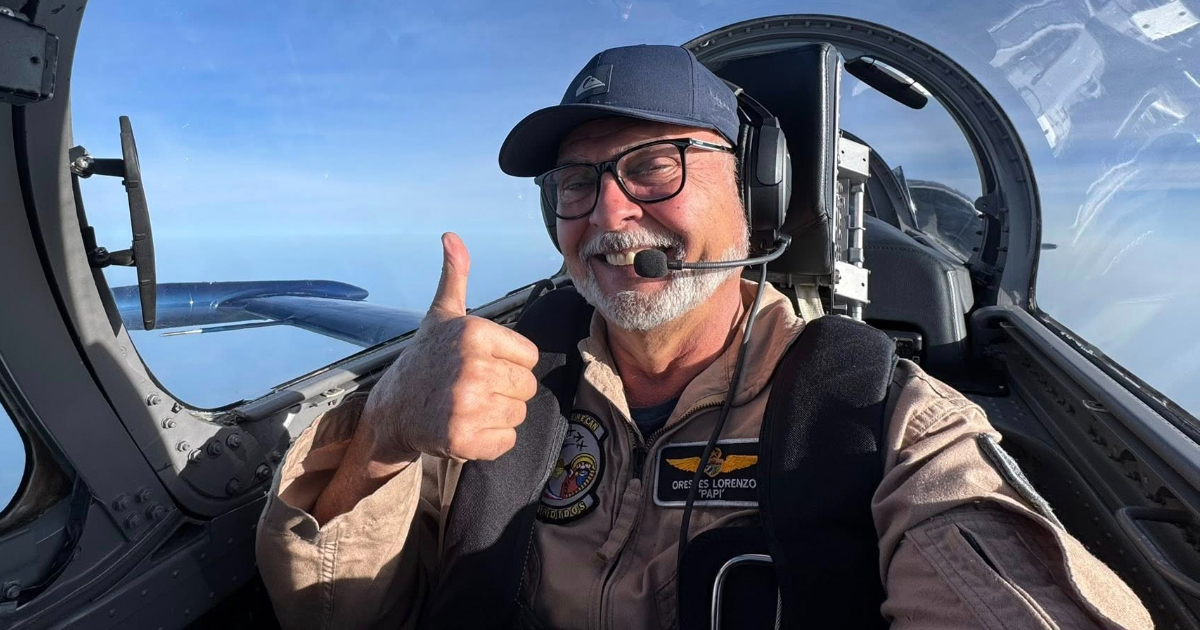
The Cuban pilot and former military personnel Orestes Lorenzo Pérez, known for his daring escape from Cuba and his return to rescue his family in the 1990s, issued a strong critique regarding the 32 Cuban military personnel who died in Venezuela during the U.S. operation that resulted in the capture of Nicolás Maduro.
From Miami, Lorenzo stated that the soldiers who died were not trained to face real combat, but rather to suppress and control unarmed civilians.
He stated that, although some analysts have suggested that the Cuban military was not prepared for an operation to remove Maduro from the country, that assessment is incomplete.
According to him, the U.S. military incursion "was an anticipated event" and did not surprise the soldiers protecting the dictator.
"They knew that it would happen at any moment. There was no strategic surprise," he emphasized on his Facebook wall.
In his opinion, although the Cuban and Venezuelan soldiers who died were expecting the attack, they were not properly prepared for that type of combat, which partly explains the magnitude of the losses.
The former official detailed that the training of the Cuban army focuses on repressing unarmed and disorganized enemies—such as citizens who protest or dissent—and on intimidating with displays of aggressive force when they appear in public.
"But facing a well-armed and organized enemy? Nah, they never learned that. And they paid with their lives for it," he concluded.
Lorenzo's criticism directly targets the inability of Cuban forces to conduct conventional military operations outside their own territory, and calls into question the real role of those military personnel sent to Venezuela: far from being trained combat troops, they were forces designed to support allied regimes and maintain internal order.
The death of so many Cuban soldiers in a military operation reveals the structural and doctrinal weakness of the Castro military system.
At the same time, Lorenzo's position resonates with the discontent of many critics of the regime who point out how he has allocated human resources—and the very lives of his soldiers—to support allied governments instead of addressing the internal needs of Cuba.
His analysis becomes particularly compelling considering his own experience with the dictatorship: Lorenzo defected from the Cuban Air Force in 1991 in a MiG-23BN and later returned clandestinely to Cuba to rescue his family in a high-risk operation that was successful.
The 32 Cuban military personnel who died have been officially recognized by Havana as members of the Revolutionary Armed Forces (FAR) and the Ministry of the Interior (MININT), who "were fulfilling missions at the request of their Venezuelan counterparts" during the U.S. operation in Caracas on January 3.
The publication of their names and photographs marked a drastic shift in the official narrative, which had denied the presence of Cuban forces in security operations abroad for years.
The list included high-ranking officers, captains, lieutenants, and soldiers aged between 26 and 67 years, including two colonels and three majors.
According to MININT, Cubans "fell in direct combat or as a result of bombings" and were presented as "heroes."
The leader Miguel Díaz-Canel declared two days of national mourning, suspending festive activities and ordering flags to be flown at half-mast in tribute to the deceased.
The criticism from Orestes Lorenzo highlights a profound contradiction: while the Cuban government glorifies the sacrifices of its military in another country, these troops lack the preparation for conventional armed conflicts, revealing the priorities of a system that sends its citizens to defend foreign dictators while the Cuban population faces shortages and repression at home.
Filed under: