
Related videos:
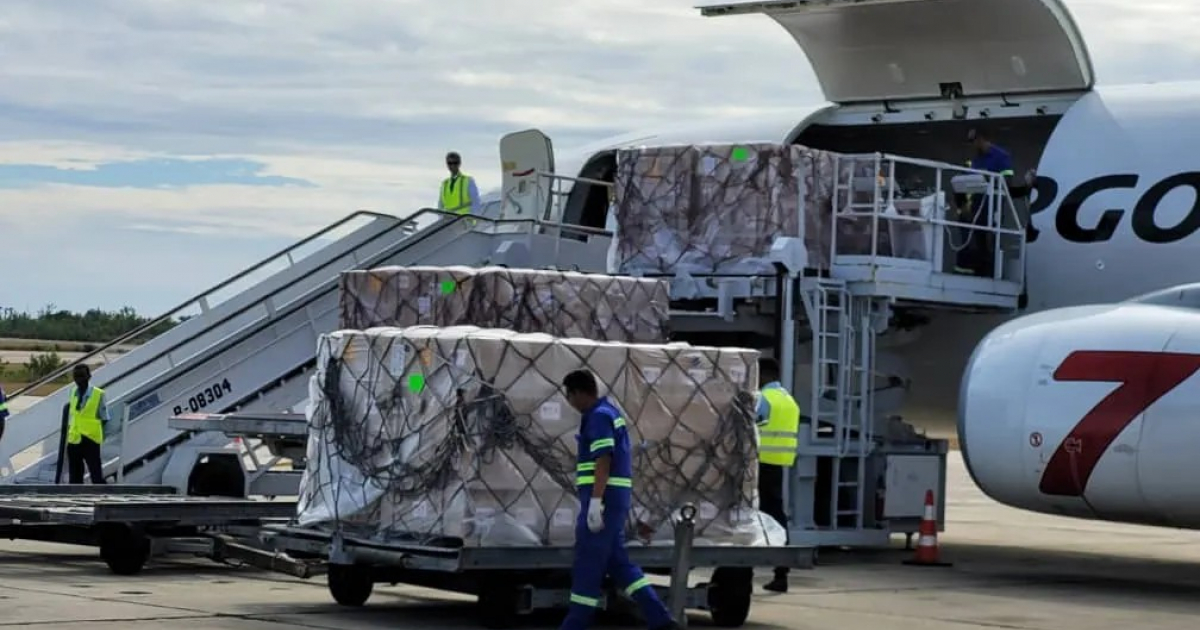
A second plane carrying humanitarian aid from the United States arrived this Friday at the Antonio Maceo International Airport in Santiago de Cuba, with supplies intended for thousands of families affected by Hurricane Melissa in the eastern region of the country.
The information was confirmed by Cáritas Cuba, which explained that the shipment is intended to support around 6,000 families across the four dioceses that make up the Eastern Region: Bayamo-Manzanillo, Holguín-Las Tunas, Santiago de Cuba, and Guantánamo-Baracoa.
According to the organization, the cargo was donated by the people of the United States and consists of 528 kits of non-perishable food and 660 hygiene kits, which will be distributed among communities that suffered the most damage during the weather event.
These are basic products for daily survival, in a context where many families have lost their homes, belongings, and regular access to essential resources.
Cáritas emphasized that this shipment "represents a gesture of charity and solidarity" from the people of the United States, aimed at alleviating some of the most urgent needs of those who found themselves in a state of greater vulnerability following the impact of the hurricane.
The delivery and distribution of assistance is being coordinated by the Catholic Church and Cáritas Cuba, who ensure they are acting guided by their commitment to the most affected sectors.
The organization emphasized that the process is conducted free of charge and with the support of volunteers from the Church in each diocese.
The donation will be transported to the community of El Cobre, from where the distribution of each module among the beneficiary families will be organized, with the support of the diocesan Caritas of Santiago de Cuba.
This second shipment adds to a first delivery received earlier, as part of the humanitarian assistance effort following Hurricane Melissa, which caused significant damage to homes, infrastructure, and livelihoods in several provinces of eastern Cuba.
Cáritas reiterated that the priority is to reach the most impacted communities, where many people still face difficulties in meeting basic needs such as food and hygiene.
The organization also highlighted the role of community work and local volunteers, which enable assistance to reach families directly without intermediaries, focusing on those in greatest need.
Three shipments of aid
The United States government announced a total of three aid shipments to victims of Hurricane Melissa in Cuba, with the first two sent by air and the last one by ship.
The first one arrived last Wednesday at Holguín International Airport and contained 528 food kits and 660 hygiene kits (including water treatment supplies).
Cáritas reported that this initial delivery would focus on Holguin communities such as Cacocum and nearby areas that suffered severe consequences from the storm.
According to a statement from the U.S. State Department, these shipments are part of a $3 million package pledged by the Trump Administration for disaster assistance following the passage of Melissa.
"In line with our longstanding policy, we have taken extraordinary measures to ensure that this assistance reaches the Cuban people directly, without interference or diversion by the illegitimate regime," the text specifies.
"We work closely with the Catholic Church in Cuba to provide assistance in a transparent and efficient manner," adds the text.
The organization estimated that aid could reach up to 24,000 people in the most affected provinces: Santiago de Cuba, Holguín, Granma, and Guantánamo.
In addition to basic food items (such as rice, beans, oil, and sugar), the Church will distribute supplies for purifying and storing water, as well as essential household items, including pots and cooking utensils, sheets and blankets, and solar lanterns to cope with power outages.
Cáritas Cuba indicated that the distribution will be carried out in accordance with its safeguarding principles, emphasizing dignified treatment of beneficiaries, protection, transparency, and a message of hope.
Protest of the regime
The Cuban regime has harshly criticized the humanitarian aid sent from the United States to the victims of Hurricane Melissa.
It is deemed an operation characterized by "political manipulation" and opportunism, despite the fact that the goods are received in the country and distributed in affected communities in the eastern part of the island.
In an official statement issued by the Ministry of Foreign Affairs (MINREX) on January 14, Cuban authorities accused Washington of using the tragedy caused by the hurricane as a tool to reinforce its political narrative and discredit the government of Havana.
"The U.S. government is taking advantage of what seems to be a humanitarian gesture for opportunistic and political manipulation," stated MINREX.
The document from Cuba emphasizes that, despite the public announcements from the State Department regarding the sending of aid, there was never an official communication channel between the governments to coordinate the operation.
Critics say that Cuban authorities learned about the initiative through the Cuban Catholic Church, which informed them that the U.S. Conference of Catholic Bishops would act as a channel to send material aid funded by the Trump Administration.
"As a principle, Cuba does not oppose assistance from governments or organizations, as long as it benefits the people and the needs of the affected individuals are not exploited for political gain under the guise of a humanitarian gesture," the statement emphasized.
The regime reiterated that all humanitarian contributions, regardless of their source, must go through the designated official channels for their reception, organization, and distribution.
Melissa struck eastern Cuba as a category 3 hurricane in October of last year, leaving thousands of people homeless and causing damage to crops, telecommunications, electricity, and water pumping infrastructure.
The aid is set against a backdrop of crisis on the island, with widespread shortages and only a few hours of electricity per day, as well as UN estimates regarding the extent of human and housing damage following the cyclone.
Filed under: