
Related videos:
Five months after the death of her son, Mercedes Roque continues to write from her pain. But also from her indignation.
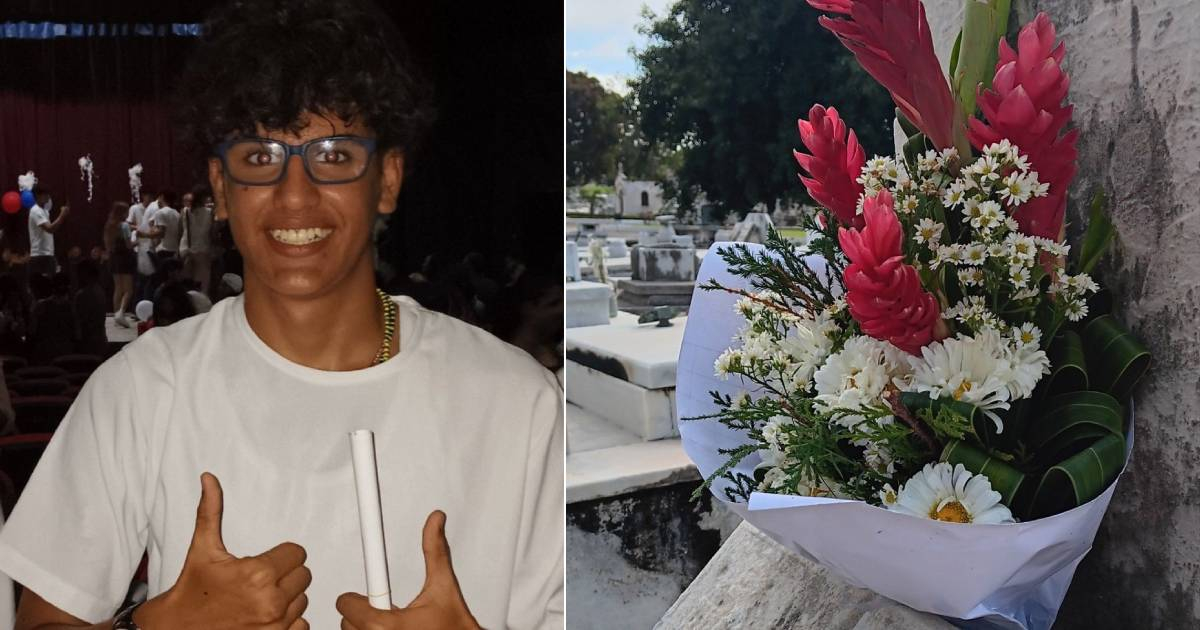
In a new post on Facebook, the Cuban mother once again demanded justice for Antonio Rassi Roque, the 18-year-old who lost his life while serving in the Mandatory Military Service (SMO) in Havana.
"Forgive me, son, for not being as strong as you might have believed," the woman wrote in a message filled with sadness and pent-up anger. "Living this life without you is becoming more difficult and painful every day," she confessed, while reiterating that she will not accept the silence or the cover-up regarding what happened in the military unit where her son was.
Mercedes not only remembers Antonio as a beloved and lively young man. She also refers to him as "another victim of the SMO in Cuba," a phrase that encapsulates her condemnation and links his case to that of dozens of families who have experienced similar tragedies.
In her most recent post, the mother directly pointed to officers from unit 5050, including First Lieutenant Aldo Fabregas Ardiles, whom she holds directly responsible for her son's death, and Captain Ricardo Martínez, the head of the unit.
"I will not tire of raising my voice for you, nor will those responsible for your death wear me down," he wrote, making it clear that his demand is neither fleeting nor impulsive, but rather a sustained fight against what he perceives as negligence, abuse of power, and a complete lack of humanity.
Days earlier, Mercedes had posted an even more striking message, denouncing the very structure of the Mandatory Military Service. "Cuba should be in eternal national mourning for so many young lives lost in the SMO," she wrote, questioning what she described as an outdated institution, lacking prompt answers for mothers and sustained, in her words, by silence and the embellishment of the truth.
The story of Antonio Rassi Roque is not new to the public eye. Since August 2025, his mother has reported irregularities, a lack of attention to her son's emotional state, and systemic obstacles in obtaining explanations. She has shared that she was never informed about the conditions in which her son was living, despite other recruits noticing his physical and mental decline. She has also reported that she was ignored for weeks when she attempted to approach the military unit following her son's death.
According to the official version, Antonio made the decision to take his own life. His mother, however, maintains that it was a reaction provoked by the hostile environment within the unit. “Something happened,” she insists, recalling the last phone call from her son before he went on duty, just hours before he died.
Antonio's case is part of a broader context of young deaths during Military Service in Cuba, a program that has been in place since 1963 and is increasingly questioned by families and independent organizations. Only between July and August 2025, at least seven recruits died while fulfilling their mandatory military service, according to testimonies gathered by independent media.
Despite the seriousness of the allegations, the Ministry of the Revolutionary Armed Forces has not issued a public statement regarding the case of Antonio Rassi Roque. Meanwhile, his mother continues to write, point out, and demand. Not as an activist or as an opponent, but as a Cuban mother who handed over her son alive and received him dead.
“ I love you, my beautiful Antonio,” wrote Mercedes. And alongside her love, she made something else clear: there will be no silence.
Filed under: