
Related videos:
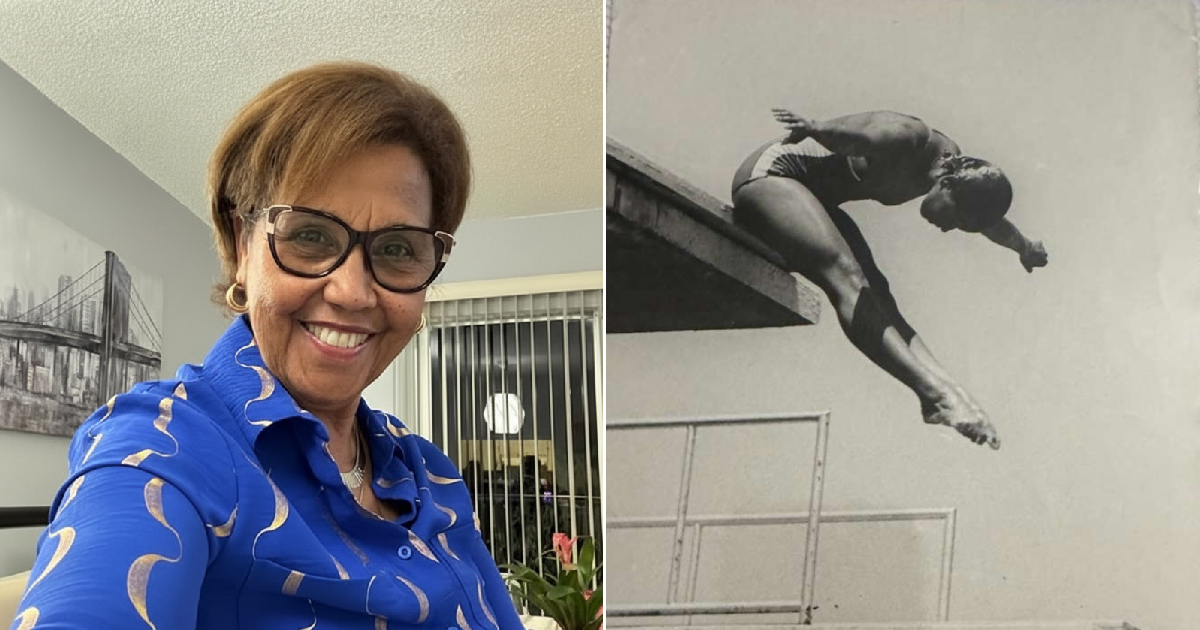
Cuban diving has had outstanding figures throughout history who have ascended to the podium or have been close to the top in many international events. One of the pioneers is our guest today, who lives in Miami, surrounded by the love of her daughter and her four grandchildren... the stellar Regina Lowry!
As kind and communicative as she was during her athletic days, Regina takes us by the hand to her origins, when she decided to become a diver.
It's a pleasure to talk with you, Julita. To remember is to live again, so let's reminisce about my early strolls through pools in Cuba and the world.
My first coach was the late Marcelino Quiñones and the Pontón, my first training center. I spent unforgettable moments there!
The first time I walked through the entrance of that cherished place was at the age of seven. Over time, I was trained by Raúl Pérez Ruiz, a figure who played a significant role in my development.
From the Pontón, I moved to the National School of Swimming "Marcelo Salado" at the age of nine, in the fourth grade. I joined the national diving team a few years later, at 13, in 1968. I was selected for my abilities and a talent that, according to my instructors, was innate. I had the ideal characteristics for practicing diving; moreover, I loved what I did.
Imagine what it meant for a 13-year-old girl to rub shoulders with the best, the cream of the crop in water sports in the country. I can assure you that it has been... and still is! one of the best experiences of my life: the "Marcelo Salado" Swimming School.
At the high-performance center, you were a student of Rubén Valdés (Chon)
Chon was a great mentor; he guided me to my first international event abroad. It was in 1967, at a competition in Mexico, and I was 12 years old. Overall, I was a national champion for 15 years and, at a time when sports were valued in Cuba, I won the National School Games from the 11-12 age category all the way up to the youth category.
First multiple games?
Look, that was something big, because at just 14 years old, I attended the Central American and Caribbean Games held in Panama in 1970. And who would have thought that, despite my young age, I won a silver medal on the 10-meter platform and a bronze in the 3-meter springboard.
It was an indescribable happiness, a joy that I still remember to this day! It was spectacular. Everyone was congratulating me, everyone was praising me. And then, when I returned, my mom, my dad, the neighbors... what a huge party!
The Central American and Caribbean Games brought me great satisfaction, as I reached the top of the podium in the Dominican Republic in '74, Medellín in '78, and Havana in '82.
You also participated in four Pan American Games: Cali '71, Mexico '75, San Juan '79, and Caracas '83, competitions that showcased the continent's best. What was your best result?
The fifth place in the San Juan Games and those in Cali. For me, it was a significant position considering the level of competition that existed at that time on the continent.
A moment you might not want to remember happened after the San Juan Games in Puerto Rico, when your then-coach Francisco Ferrer urged you to retire, something you felt was unfair.
Indeed, I found it unjust; the reason they gave was that I was 24 years old, but I felt complete, whole. I didn’t give up and continued my studies in Physical Culture and Sports, from which I graduated in 1979 with an excellent evaluation.
As I never lost hope, I was able to return to athletic activity as an athlete after a year and a half, under the guidance of coaches Fernando Guerra and the late Russian Leonti.
For that reason, I lost the opportunity to go to the Moscow 80 Olympics, something I will never forget. I was in my prime, as we athletes say, and they took that possibility away from me.
However, I managed to rejoin the national team for the Central American Games in Havana '82 and set the record for winning three consecutive regional games: Dominican Republic '74, Medellín '78, and Havana '82, something I will always carry in my heart. In that competition, I outperformed Mexican divers who had participated in Moscow, so I am quite pleased with that.
That's a difficult question: if you had to choose the greats of diving, both Cuban and universal, what would you say?
I must mention several athletes from my time whom I admired for their sporting achievements, as well as other teammates who helped me win for many years due to their brilliant talents and athletic abilities: Milagros González, Clara Elena Bello, Josefina González, María Caridad Miguel Bueno, María Elena Carmuza, Carmen Anido, Mercedes Gavilán, Leonor Ponce Carratalá, and Maite Garbey, the latter being a Pan American bronze medalist. All of them have been important to me, because if they didn't possess quality as athletes, I wouldn't have succeeded.
Regarding the men, I must mention Alberto Moreno (may he rest in peace), José Luis Ponce Carratalá, Raúl Pérez Ruiz, Rolando Prieto, my idol and brother Rolando Ruiz Pedreguera, Enrique Cortina, Juan Carlos Ramírez, Abel Ramírez, and Roberto Hung.
I want to make two special mentions to those I admired and continue to admire today: the Pan American champion Rioger Ramírez, for whom I feel respect and admiration, and José Antonio Guerra, whom I had the honor of seeing compete in Mexico against Chinese athletes and who left me in awe.
You didn't leave anyone out... haha! And internationally, who are the biggest, in your opinion?
For the boys, Klaus Dibiasi, an Italian platform diver who won three gold medals in four Olympic Games; the late Mexican Carlos Girón, who placed second in the three-meter springboard in Moscow and won bronze at the Cali 75 World Championships; and the extraordinary American Greg Louganis, a member of the Aquatic Sports Hall of Fame with his five medals—four gold and one silver at the Olympic Games—and five titles at World Championships.
For the women, another Mexican, Berta Baraldi, and the Swedish athlete Ulrika Knape, Olympic champion in Munich '72 and second place in Montreal '76. Of course, currently the Chinese are the dominant winners in pools around the world, but I choose to lean towards the ones I mentioned.
Regina, you said a definitive goodbye to platforms and trampolines in 1983, but four years earlier, in 1979, you graduated with a degree in Physical Culture and Sports, which served you well. What did you do then?
I began working as a coach at the "Marcelo Salado" National School in 1984, guiding my students to win medals in the Central American Youth Games. Later, I was selected to work in Mexico, where I had a wonderful career spanning 20 years.
In Mexico, what were your best results?
I started my work in La Paz, Baja California Sur, training children with excellent athletic abilities; I worked with them for two years. Due to my dedication and organization of the training, I was selected to work at CONADE, to coordinate the efforts in youth sports development.
Can you tell me about the international results of your athletes?
Three-time Central American champion in Medellín, Colombia, in 1999, at the Central American Children's and Youth Championships; gold, silver, and bronze medals in consecutive years at National Championships in Mexico; seventh and eleventh places at Youth World Championships in Canada and Brazil.
Additionally, for eight years, I held the position of sports talent coordinator at the National Autonomous University of Mexico (UNAM).
But it didn't stop there. The Mexicans were thrilled with your work.
Well, yes, something that makes me proud. I was chosen as a coach by the multiple Olympic medalist Jorge Rueda, who has since passed away, to work with six university athletes at the Olympic Committee; I'm very grateful because he helped me grow as a trainer and achieve my best athletic results in that position.
The work I carried out at UNAM, one of the most prestigious universities in the country, involved selecting talented young people who reached elite positions at the national level, in a country known for its excellent divers.
I can't help but mention how grateful I am to that wonderful country, Mexico, where I had the opportunity to grow as a coach, as a person, and to meet such beautiful and amazing people.
Regina Lowry's family
My family... my family means everything to me! My daughter Giselle, her four children - my grandchildren - Giovanny, Lucas, Kyle, and Melanie. My daughter has a degree in Law and holds a Master's in Corporate Law.
I have been blessed with the joy of four wonderful grandchildren, of whom I feel proud. By the way, Kyle is a soccer player and Melanie practices synchronized swimming.
Currently, despite my 70 years, I am studying for a Master's in Special Education along with my daughter, and I live in the city of Miami. I am grateful to you and CiberCuba for this interview, because for many, the "old" no longer exist, and what we have done, some more than others, is unknown to the current generations. It is always good to remember, don’t you think? Because to remember... is to live again!
Filed under: