
Related videos:
Life is a tapestry of sensations and experiences, and day by day, we encounter events, scenes, and people that maintain a heterogeneity that brings joy and adornment to it.
I had the opportunity to meet a wonderful human being: Piter Ortega Núñez, born in Los Palos, a small rural town in the municipality of Nueva Paz, within the current province of Mayabeque, who on October 9th will fulfill another dream: to present his new book How to Interpret a Work of Art?, published by the Art-Sôlido publishing house in the capital of the world, New York.
It is a pleasure to be interviewed by you, so I am doubly satisfied. This work aims to bring art closer to the general public, especially the Latino community, using accessible yet profound language. The book is launched during the activities of the Hispanic Heritage Month.
What inspired you to write it?
It arises from something very simple yet very ambitious: the desire to share with people what it truly means to look at a work of art. I have always believed that art is a tool for healing the soul. We live in a world saturated with images, but we do not always know how to read them. I felt the need to provide a simple, poetic map that would help anyone, especially Latinos, to find not only beauty but also strength and comfort in art.
You have published other books. Does this one have something particular about it?
Yes, unlike my other books, this one has a more educational and broad intention. My previous texts were more specialized, closer to critical essays.
Here I decided to lower the register, to speak in a clearer and more approachable language. I believe my training as a journalist helped me a lot: journalism teaches you to be direct, to communicate without beating around the bush.
I wanted it to be a book that anyone—regardless of their academic background—could feel accompanied by and not intimidated by.
Why publish this book during Hispanic Heritage Month?
I felt it was the perfect time. Hispanic heritage is not just music, food, or family traditions: it is also art, sensitivity, and the ability to see the world through different eyes.
In a time when our community faces so many challenges, I thought a book like this could serve as a gesture of affirmation and hope. Art belongs to all of us, and I want Latinos in the United States to feel that they also have the right to interpret it and make it their own.
Is there a piece of art mentioned in the book that particularly “speaks” to you?
Yes, “With the Power of Example” by Lázaro Saavedra. It's a painting featuring the Virgin of Charity rowing in a boat alongside three Cuban rafters. I lived in Cuba during the 90s, the Special Period, and that image resonates deeply with me.
The virgin is not in her altar; she is in the shipwreck, rowing with her people. For me, it was impossible not to write from a personal perspective: from the memory of what it meant to see so many Cubans plunge into the sea. That work encapsulates faith, pain, and resilience, and it reminded me that art can be a collective mirror of our history.
And indeed, a work of art is also about interpreting oneself. What we see in a painting or a sculpture depends on what we carry inside. In times of such violence, anxiety, and confusion, pausing in front of an image and allowing it to speak to us is a profoundly human act. It can remind us who we are, where we come from, and provide us with a bit of calm. Art does not cure us of diseases, but it does heal us from meaninglessness.
Let's take a step back. You were born in Los Palos, what has your journey been like?
From Los Palos, I moved to San Nicolás de Bari, and then I relocated to Havana in 2001 to study History of Art at the bicentennial university. I graduated with a Gold Degree, as the top of my class, and was chosen as the most well-rounded graduate in my cohort.
In 2008, I received the National Art Criticism Award of Cuba "Guy Pérez Cisneros," awarded by the National Council for Plastic Arts, and in 2011 I published my first book, Against the Toxin, with the Cuban Institute of Cultural Research Juan Marinello.
Indeed, in addition to the National Art Criticism Award, you have won an Emmy as a journalist. How do these two paths interact?
I believe both gave me a distinct voice. In Cuba, I learned rigor, critical tradition, and a passion for art. In New York, journalism taught me to speak clearly, to communicate with direct images and words.
This blend of roots has left a mark on me. I am not just interested in writing for specialists: I want to speak to the neighbor, to the migrant, to the woman who has never entered a museum.
And what did you do in Cuba after you graduated as a professional?
In Cuba, I worked as a critic and curator, organizing controversial and impactful exhibitions, such as “Sex in the City” at Galería La Acacia —a provocative show about homoerotic themes— or “Bomba” at the Wifredo Lam Contemporary Art Center, primarily dedicated to young painters.
Tell us how you made the “jump” from Havana to Miami, was it by raft, through “the volcanoes”, did you claim asylum, did you come and stay...?
Hahaha, you love gossip, Julita, as any good Cuban would. And I know that our readers do too. I came to Miami in 2013 through an art gallery that invited me to give a talk about contemporary Cuban art. At that time, I had a tourist or cultural exchange visa; I don’t remember the name of those visas. Back then, Obama was in office, and there was a lot of cultural exchange. It was a good opportunity to travel. I came with that visa, waited a year and a day, applied for the Cuban Adjustment Act, and then obtained my permanent residency.
Piter, how does that expressive-eyed boy with dreams of creation arrive in New York? I imagine your journey has not been easy.
No, it certainly hasn’t been easy. As I told you, I arrived in Miami in 2013, where I lived until 2017. There, I worked as a waiter in Peruvian restaurants, a country in the Andes that I love. In fact, my boyfriend is Peruvian, and my next book will be about shamanic experiences in the Amazon jungle in Peru.
After my work as a waiter, I ventured into art galleries in Wynwood, collaborated with El Nuevo Herald writing about exhibitions, and participated in programs on América TeVé as an analyst of Cuban issues. I also published my books The Weight of an Island in the Love of a People and The Millennium Generation: Cuban Art 2001–2016.
In 2017, I arrived in New York to pursue my Master's in Journalism at the CUNY Graduate School of Journalism, from which I graduated in 2018.
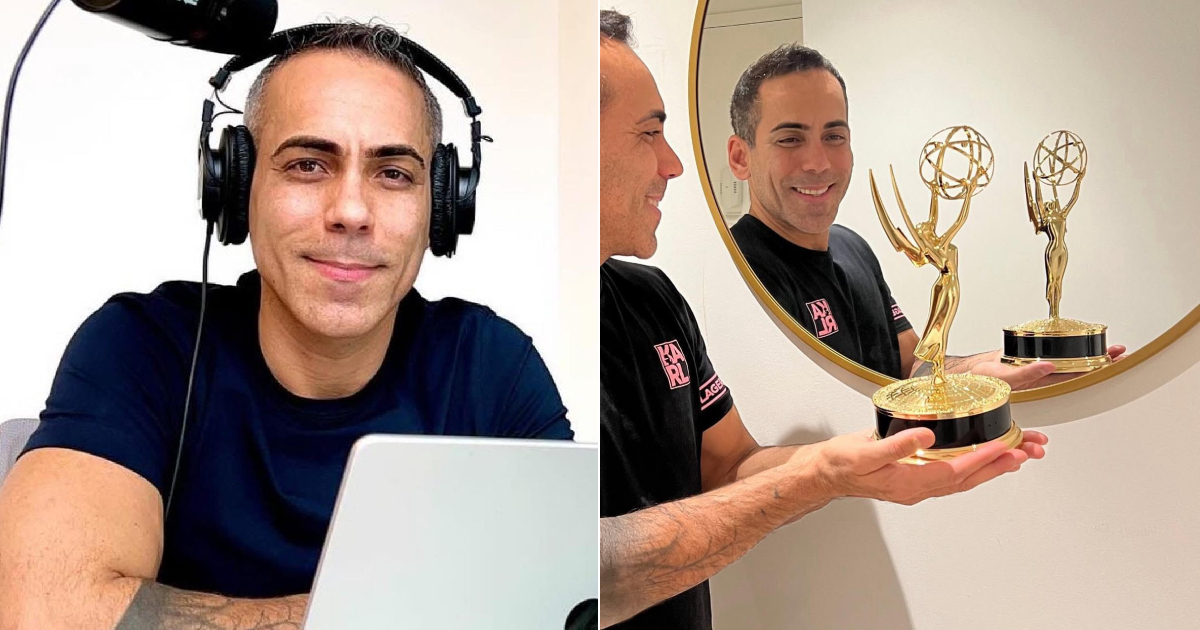
Since then, I have worked as a reporter for channels such as NY1 Noticias, Univisión 41 Nueva York, and Telemundo 39 in Dallas, in addition to writing for Telemundo 47. In 2022, I received an Emmy Award for my work as a journalist. As you can see, I have covered “all the bases,” baseball-wise.
In addition to your most recent book, you have audiovisual projects. Do they connect with this work?
Absolutely. My YouTube channels —“TV Mi Gente” and “TVG Arte”— are extensions of the same idea: democratizing access to art and knowledge. In one, I talk about physical, mental, and spiritual health; in the other, I interpret works of art in museums and galleries. They use different languages, but all respond to the same vocation: to share and to accompany.
What comes after this launch in New York?
Next year, I want to present the book in Miami and also in Havana. At the same time, I am writing another very different book, which I mentioned earlier: a testimony of my experiences in the Amazon with ancestral medicines and shamanism. It was a few intense months of spiritual learning, and I want to share it. And, of course, I will continue to work hard on my channels, which are lifelong projects.
If you had to summarize in a few words why someone should read your book, what would you say?
I would say: to interpret art is to learn to look at ourselves, and in that gaze, we can find a bit of beauty, a bit of truth, and, above all, a bit of healing. That is my book.
With How to Interpret a Work of Art? Piter Ortega Núñez offers more than a manual: he provides an invitation to see differently. His book is a reminder that art is not the property of experts, but a right and a possibility for all. And that perhaps, taking a moment in front of an image with open eyes and a willing heart is one of the most necessary acts today.
I take this opportunity given to me by CiberCuba to inform that the presentation of my book will take place at Saphira & Ventura Gallery, located at 4 W 43rd St, Unit 416, New York, on Thursday, October 9th, at six in the evening. After the event, the book will be available on Amazon.
In the family sphere, how is life treating you?
On a personal note, I am at a very happy moment in my life: I have a stable partner, I have been with my boyfriend for a year and two months, and we are planning to get married next year. I am in love, and I feel that my life is aligned in body, mind, and spirit.
Cuba is going through its worst moment in the last 66 years. You mentioned the so-called Special Period, and the current situation makes that time seem minor. What do you think?
What can I tell you that readers of CiberCuba don't already know? I visit Cuba frequently because my mother, my brother, and many family members I love are there. Each time I go, what I see is increasingly sad: not only the physical deprivation but also the spiritual, civic, human, and moral degradation. It is painful to witness the suffering of our people. It's not just about food but also electricity, infrastructure, and the absence of everything. And yes, I can say that it is even worse than during the Special Period in the 90s.
The hardest part is witnessing the disillusionment, the disappointment, the loss of hope. The distress that the people live in. All we can do is ask God to support our people, so they can have the future they deserve. Because the people of Cuba are wonderful: beautiful people, fighters, good friends, good family; human, enterprising, and joyful people. But those who live on the island have their dreams shattered today. And that is very sad.
Filed under: