
Related videos:
In recent days, the Cuban regime presented Agreement 10199/2025 as “a new decision of the Council of Ministers,” a measure that had already been officially published six months earlier in Extraordinary Official Gazette No. 45 on August 11, 2025.
The regulation, which authorizes state entities to redistribute unspent salary funds as work incentives, was redistributed this week on its social media by state journalist Lázaro Manuel Alonso as if it were a recent approval, creating confusion and highlighting the maneuvers of the regime's propaganda apparatus to simulate economic dynamism where there is only bureaucratic recycling.
The truth is that the document does not contain any new measures; rather, it formalizes a temporary mechanism for "additional payments" using savings from the wage fund in the so-called budgeted units—ministries, schools, hospitals, administrative offices, or cultural centers—with the supposed purpose of "curbing labor instability."
In other words, the State does not inject more money or increase salaries; it only authorizes the distribution of surplus funds among a few when there are shortages of workers.
An old law presented as new
The temporal contradiction is evident. Agreement 10199 was approved on August 2, 2025, and published in the Official Gazette nine days later, but it did not receive coverage in the Cuban press.
Neither Granma, nor Cubadebate, nor the Cuban News Agency reported on it. However, unusually, it was the Argentine Club of Journalist Friends of Cuba (CAPAC), a pro-socialist advocacy portal based in Buenos Aires, that published the full text on August 21, 2025, citing sources from the Gazette and from TeleSur.
It is striking that a foreign media outlet was the first to disclose an internal regulation affecting labor in Cuba, while official channels remained silent.
Only now, in January 2026, as attempts to implement the mechanism in ministries and local governments begin, Cuban television "resurrects" the agreement and presents it as a "new decision" from the Council of Ministers.
The change in tone is not due to confusion; it is part of a planned communication operation aimed at demonstrating government action in response to a citizenry increasingly desperate about the loss of purchasing power.
What does Agreement 10199 really say?
The text authorizes state entities to use unspent salary funds —due to vacancies, unpaid leave, subsidies, or maternity leave— to pay additional bonuses or incentives to their active employees.
These payments are considered salary "for all legal purposes," but they do not constitute a permanent system, nor can they be applied on a large scale.
Each institution must approve an internal regulation with the participation of the union, which defines: (1) the performance or responsibility criteria, (2) the amounts to be redistributed, and (3) the frequency (single or temporary).
Redistribution should be selective, based on merit or workload, and supported by verified savings from the wage fund.
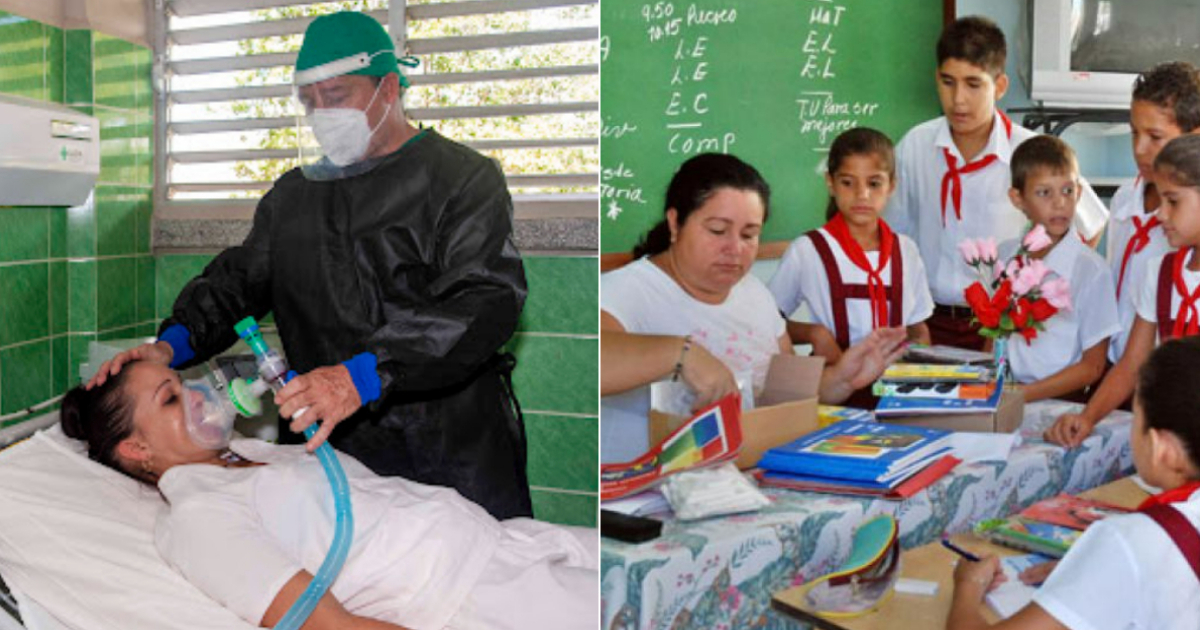
The agreement explicitly excludes the health and education sectors, on the grounds that their professionals already receive special benefits for "maximum effort" and "educational overload," stemming from the salary measures announced in mid-January 2024 on the television program Mesa Redonda.
However, those measures, which were also partial, were absorbed by inflation in less than six months and today have no real effect on the purchasing power of doctors and teachers.
Nominal increases vs. real inflation
According to official data from the Mesa Redonda, salary increases for health and education ranged from 10% to 25% nominal, depending on the position.
A general doctor increased their earnings from about 5,000 CUP to approximately 6,200 CUP per month, while an average teacher barely rose from 4,100 to 4,700 CUP.
However, during the same period, the annual accumulated inflation in Cuba exceeded 200%, with an informal dollar that jumped from 250 to nearly 490 CUP between January 2024 and January 2026.
That means that the salary of a doctor or a teacher today is worth less than a third of what it represented two years ago.
Even workers who can access the incentives of Agreement 10199 —ranging from 500 to 1,000 CUP extra per month— would still be losing more than 60% of their real purchasing power.
The numbers of the salary mirage
- Estimated basic basket (January 2026, two people): 25,000–27,000 CUP/month
- Average state salary: 5,400 CUP
- Coverage of the basket: *only 20–22% of the cost of living.
In summary: neither the increases in January 2024 for health and education nor the temporary bonuses from Agreement 10199/2025 for the rest of the state sector will restore the collapse of purchasing power.
Both mechanisms are nominal and temporary, while the deterioration of the national currency advances faster than any wage adjustment.
Doctors and teachers: The great forgotten ones
The exclusion of doctors and teachers from the new incentive is not technical, but political.
The regime needs to show quick results in areas of public administration where employee turnover has caused a collapse of services, while the health and education sectors are used as a propaganda banner for "revolutionary humanism."
Even so, it is precisely those workers who support the country under the most precarious conditions.
A Cuban doctor continues to earn the equivalent of 12 dollars a month, a teacher just over 10, while the government spends billions subsidizing military companies or on foreign propaganda.
Agreement 10199 consolidates that inequality: it rewards bureaucrats and administrators while excluding those who truly sustain the public system.
An old norm, an exhausted economy
In essence, the reappearance of Agreement 10199/2025 is not a calendar error, but a reflection of the exhaustion of the Cuban economic model.
The State no longer has the resources to increase real wages, so it repeats the same decrees under a different guise, recycling savings from the salary fund as if they were a new achievement.
But the reality is clear: with inflation that obliterates any increase and a peso that is increasingly depreciated, there is no incentive that can stop job desertion or mass migration.
In summary, the Cuban regime is trying to present an old agreement as a "new achievement" that does not increase real wages or improve the lives of workers.
Doctors and teachers, once again excluded, remain the most visible face of institutional disdain towards those who uphold the pillars of the public system.
The media reactivation of a regulation that was dead six months ago is not an economic measure; it is a symptom of the power and idea vacuum at the very heart of the Cuban model.
Filed under: