
Related videos:
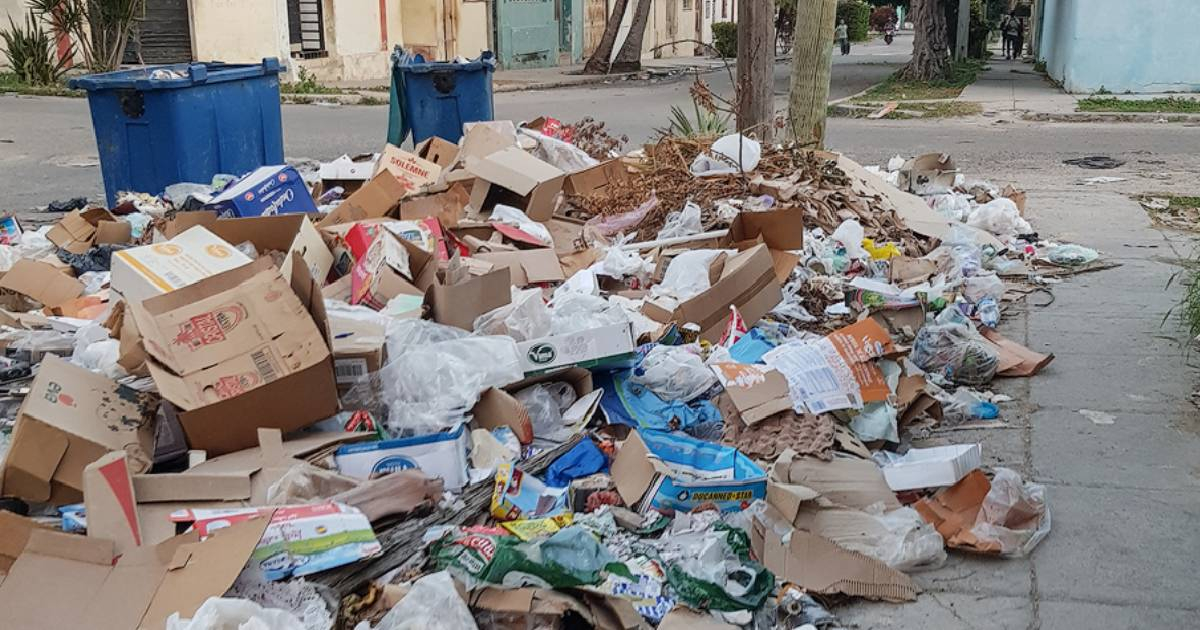
Mountains of trash overflowed onto the streets and sidewalks of Havana due to a lack of fuel for the garbage trucks, exacerbating a health crisis amid blackouts, shortages, and a collapse of public services, according to testimonials collected by the news agency EFE published this Friday.
In Centro Habana, waste spills over the sidewalks and reaches halfway into the streets, while the smell and worms invade the homes.
“Nobody is taking care of this. Every day it gets worse. They say there’s no gasoline,” lamented Javier, a 55-year-old resident, describing a situation that is repeating itself in numerous neighborhoods of the capital.
Three months ago, the Government announced a campaign against litter and promised "a before and an after," even featuring images of President Miguel Díaz-Canel picking up waste from the street.
However, today, micro-dumps are proliferating on almost every corner, due to broken trucks and, above all, the lack of fuel, exacerbated by the cessation of supply from Venezuela following the capture of Nicolás Maduro.
The fear of reprisals stifles complaints. “If I said what I think, I would end up in jail,” confessed a neighbor whose window overlooks a huge pile of waste.
In the parish of the Spanish priest Alberto Sola, the demand has been constant to Epidemiology, Health, and the People's Power. "They know it, but they tell you that there's no fuel or trucks. I don’t see this in any Party houses," he stated, denouncing the indifference of the authorities.
The accumulation of garbage adds to the overall economic deterioration. Cuba lost 15% of its gross domestic product in six years, while inflation, massive migration, and daily blackouts lasting more than 20 hours have become commonplace.
The problem goes beyond aesthetics and becomes a public health threat, as overflowing landfills promote the proliferation of mosquitoes that transmit dengue and chikungunya.
In 2025, the country acknowledged an epidemic of these diseases, although it later stopped disseminating figures.
The Pan American Health Organization reported 81,909 infections and 65 deaths, with more than half being minors.
"There are many children and elderly people sick due to all the filth here," warned Estrella Ramos, a neighbor who suffered from chikungunya for months.
In the absence of personnel and resources, the State is turning to inmates with lesser sentences to collect waste without tools or protection. Despite this, Prime Minister Manuel Marrero acknowledged that, after months of campaigning, “the results are not evident.”
The picture described by residents and confirmed by recent reports portrays a capital flooded with garbage and sewage, with a collapsed public services system.
For many residents of Havana, the dirt in the streets is no longer a temporary issue, but rather a structural indication of the deterioration the country is experiencing.
The extent of urban deterioration was also reflected in the recent testimony of Dánica Coto, Caribbean correspondent for Associated Press, who returned to Cuba at the end of January after more than three years without visiting the island.
The journalist described a country marked by extreme poverty, darkness, and piles of garbage, and recounted scenes that, in her opinion, encapsulate the daily collapse, from people rummaging through waste to salvage plastic to historic buildings crumbling and a capital immersed in almost permanent blackouts.
That portrait aligns with other recent complaints shared on social media from various neighborhoods in Havana, where residents document streets flooded with sewage, piles of garbage left uncollected for days, and significant sanitary deterioration.
Videos recorded in areas such as Jesús María, in Old Havana, and Centro Habana show accumulated waste alongside dilapidated houses, overflowing pits, and pedestrians forced to navigate between refuse and contaminated waters, in a context that residents and experts link to increasing public health risks and the structural collapse of community services.
Filed under: