
Related videos:
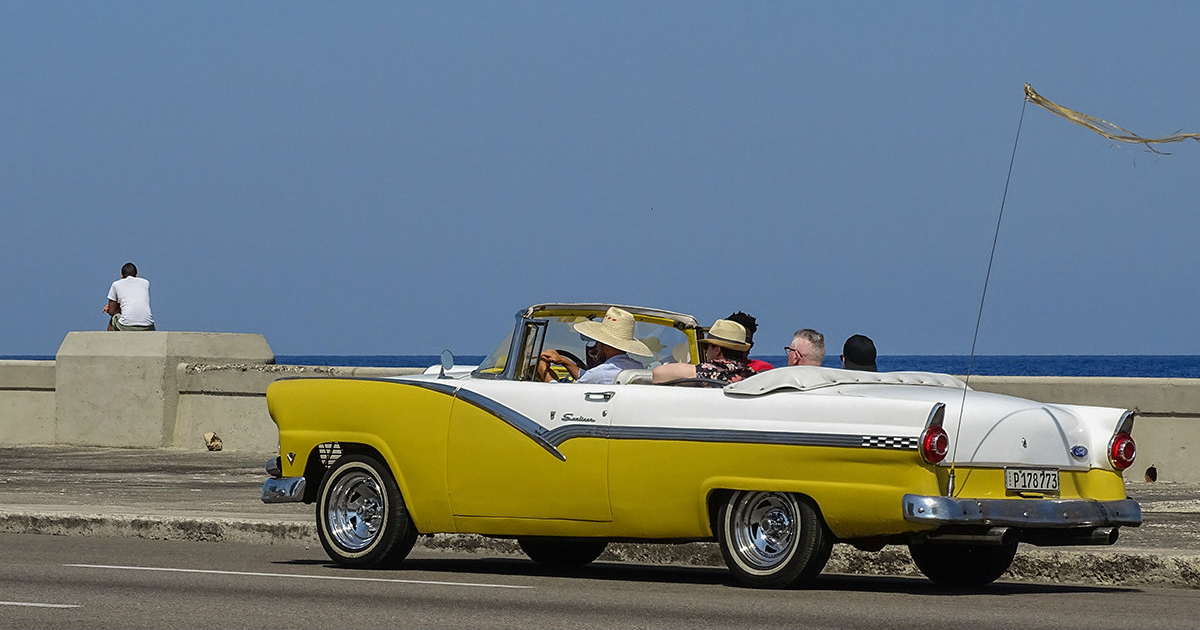
Around noon, a group of tourists gets off a small yellow bus in front of Havana's Malecón and rushes toward a row of shiny classic cars to take pictures.
The drivers, who were waiting for their first ride of the day, rise with hope, but quickly lose it: the visitors take a couple of selfies and leave without getting on.
According to a report by the Associated Press (AP), the scene is repeated daily in the Cuban capital, where tourism has dropped by more than half since 2018 and threatens to leave thousands of Cubans who depend on this industry without a livelihood.
The crisis, exacerbated by power outages, fuel shortages, and the reduced supply of oil from Venezuela following the U.S. military operation that overthrew Nicolás Maduro, has nearly emptied Havana of visitors.
“This is very bad, we are waiting for them to come so we can work,” laments Reymundo Aldama, driver of a pink 1957 Ford Fairlane.
He explains that he used to work until nine at night, but now he spends the whole day without clients.
Demand has fallen so much that the prices of tours have dropped from 50 to 25 dollars, and even to 20 if the tourist insists on haggling.
The collapse of tourism has also impacted street vendors like Rosbel Figueredo, 30, who survives by selling fried dough with sugar.
Before, I could sell 150 bags a day; today I barely manage to sell 50, and often I come home without having sold them all.
"I am an industrial technician, but now I sell sweets to be able to eat," he says, worried about supporting his partner and their three children.
Official data confirms the extent of the decline. Between January and November 2025, only 2.3 million tourists visited Cuba, compared to 4.8 million in 2018, AP recalled.
The restrictions imposed by President Donald Trump on travel and cruises to the island, along with the tightening of sanctions that cost the Cuban regime nearly $8 billion between March 2024 and February 2025, have shut the door on one of the few sources of foreign currency that kept the economy alive.
Gaspar Biart, a driver of a tourist bus, recalls that a few years ago, eight double-decker buses used to travel through the city filled with passengers three times a day.
Now only four are barely running, nearly empty: “What we lack are customers. Tourism drives the economy, and without tourism, there is no country,” he summarizes.
The view at the Malecón reflects decay. The restaurants are empty, the tables covered with tablecloths that flutter in the wind, and the employees gaze at the horizon without hope.
In the more touristy neighborhoods, trash accumulates, water is scarce, and power outages are becoming increasingly frequent.
Some visitors, however, still arrive driven by curiosity. The Russian Vincent Seigi, sitting in front of the Morro Castle, says he came prepared for chaos but was surprised by the lack of connectivity and the atmosphere that feels frozen in time.
"It seems that time has stopped here," he/she comments.
With the Venezuelan crisis and the fall of its main ally, many in Cuba are wondering if Russia or China will take on the role of economic support.
For now, support is limited to political statements, while tourism—once the driving force of the Cuban economy for decades—plummets amid scarcity, sanctions, and a lack of prospects.
In a quiet Havana, the colorful almendrones remain parked, waiting for customers who do not arrive.
And with fuel becoming increasingly scarce, many drivers know that soon they won't even be able to start their engines.
Filed under: