
Related videos:
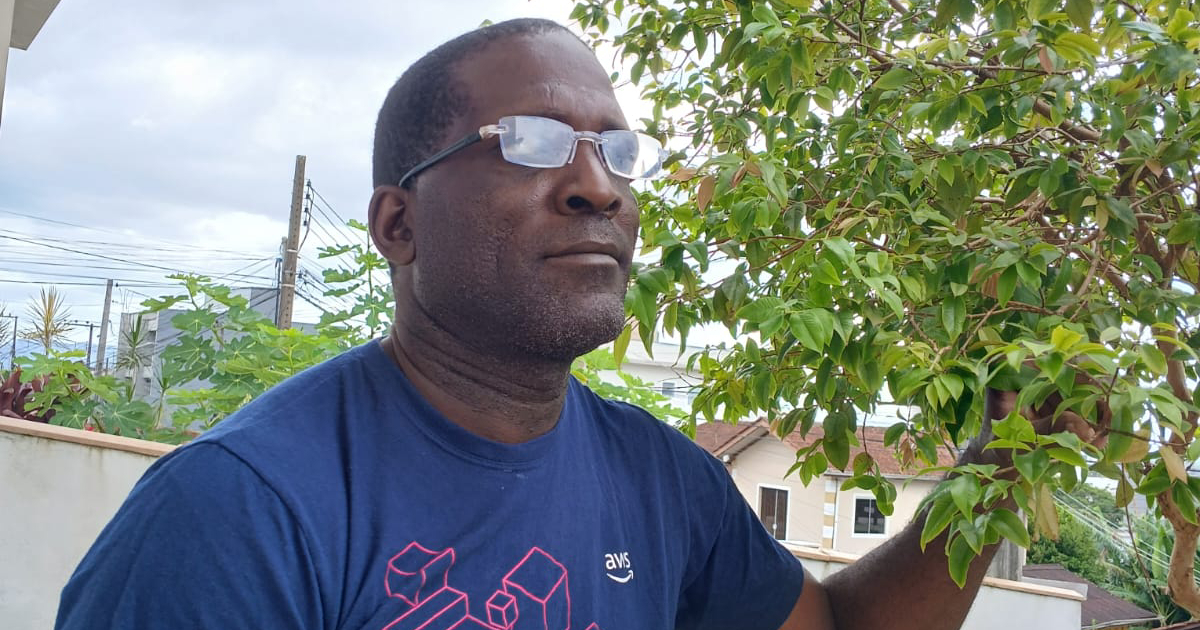
Since you saw him burst onto the scene, you knew a great one was coming. I often said that the Paralympic world was too small for him. And that’s because Arián Iznaga possesses incredible willpower and charisma. Today, CiberCuba takes pride in the presence of this remarkable visually impaired athlete.
I know you weren’t born blind. What was the process of adapting to total darkness like?
Well, I am one of those people who acknowledges that sight is necessary, that it’s essential… one hundred percent, you see! But when you achieve many things, as I have, it becomes more manageable.
I haven't seen since I was 17. It was a tough blow, you can imagine; but right now I can assure you that, with everything I've learned, I no longer need vision as much. Yes, don’t make that surprised face; I can’t see it, but I know you made one... hahaha.
Life has taught me to rely on myself, and I believe that not being able to see is not an insurmountable obstacle, as I do everything I need to do. That is the reality. I can't say it doesn't matter, because, on the contrary, how wonderful it would be to see the beauty of my daughters! But I feel capable of doing anything, equipped for everything in this life.
Arián Iznaga is a double Paralympic medalist: he won silver in Athens 2004 as part of the 4x100 relay team in the T11-13 U category (totally blind), and bronze in Beijing 2008 in the 200 meters T11. Additionally, he is a five-time champion at the Paralympic Athletics World Championships and has eight medals, three of which are gold from the Parapan American Games.
Although I didn’t have the opportunity to cover the Paralympic movement, I watched this young man run along the track flawlessly, unafraid to take a misstep, determined, quick, even racing alongside his guide Yaseen Pérez Gómez. They say Arián ran among the rocky outcrops surrounding the stadium, next to the sea.
It's true that you couldn't interview us; you journalists are like doctors and their specialties. You focused on athletics, but the conventional kind; however, you always had a smile, a strong hug, a kiss for us, and in my case, a bit of fun... hahaha... Do you remember when I used to say, “Here comes the white one!” because of your smell?
Well, yes, I was always a confident athlete; I would run with a mask on even though I was blind, honing my hearing. I ran through my ears, and you can define so many things that sight, as I told you, is unnecessary, you understand?
And not only in sports, because many know me as an athlete, but they are not familiar with the other side of me.
Hey, what phase is that?
Girrrrl… I am a mechanic! I work on trucks, buses, cars... all kinds of vehicles. I get underneath the trucks, use the jack, lift the car. I do everything without sight; for many it seems impossible, but that's how it is—it's incredible! There are so many things I master without seeing.
How independent are you?
I am a completely independent person. I go out alone, I walk alone. I handle everything; well, about 95% of what needs to be done, I do by myself. Look, Julita, I've faced life alone. Since I became blind, I've had to do so. Life has forced me to.
You can see how much I've done that I am the father of four kids... hahaha. The youngest is 10 years old. I have two other daughters who are 19 and 22 years old, and a single son who is also 22.
I am a very good father; it's wrong to say it, but, well, I’m the one being interviewed. I’ve raised them and guided them in life without sight. I have four stars.
The ability to listen has been very beneficial to me. There are people who look at you and can tell who you are just by your face, but I can do the same by listening to them; their tone of voice, their inflections, the way they speak, whether they talk loudly or softly. This allows me to create a portrait that almost never fails, what do you think? That’s how I know you, my friend. I’ve known you since the first time I heard you. I define a person by their voice; I can give you an approximate idea of their physical appearance and character with up to 90 percent accuracy. I have that gift.
Right now, anyone with a clear vision sometimes has to rely on sound and noise. For example, you might be at home, asleep, and your eyes won’t transmit anything because they can’t see through the walls… Ah! But if there’s a noise, even if many might not detect it, I do. I can tell if it’s a car outside or someone arriving, a dog that’s wandering around; I perceive the street through sound. I notice when it’s a car, if the neighbor's dog is anxious, if there’s an unfamiliar person in the building… Can you understand that with sight?
I would like to see it, no doubt, but I have overcome it and I am capable of identifying with my ears what a person with sight cannot do. And that has been proven. It has been more than proven with people who have had "20-20" vision and who have been by my side and have not perceived what I have. For example, those next to me do not see a helicopter approaching, and I say, "Here comes a helicopter," and, astonished, they all tell me, "I take my hat off to you, you’re incredible." I have to thank God after all.
You have already stated that sight is not so essential, but if you had a moment of vision, what would you like to see?
To my four children! Knowing how they are, so precious; because I know they are lovely... Oh, how I wish I could confirm it! That is a pain I will always carry with me, it has always been with me.
The only thing I wish I could see right now is my four children and also, believe it or not, to see the faces of the many false people around us.
But I know that when you don’t understand something, you say it to their face.
Of course, I’m able to tell people what I think directly. That’s very much a part of who I am. When something bothers me, when I want to say things to people, I tell them directly, even if I can’t see their faces. It’s at that moment that I wish a star would shine on me so I could see their faces.
Many people avoid your gaze and look the other way, laughing in your face. They turn their backs on you. And for those people, I wish I could see clearly in that moment and tell them things directly.
Arián Iznaga currently lives in Brazil and, as he himself says, is a “stay-at-home dad,” missing Cuba but experiencing a new phase in which his daughters are heading towards a better future.
Yes, that’s true. I’m proud of my wife and my two daughters. Hahaha. I’m a stay-at-home dad. I haven’t had the opportunity to work, unfortunately, but I’m very happy to give my girls a better life, even if it’s away from my homeland.
What has sports for the disabled given you in Cuba?
20 years! It sounds easy, but it hasn't been easy, Julita. Truly, it hasn't been easy. Twenty-something years of commitment, twenty-something years of sacrifice, doing something I enjoyed, dedicating myself, being disciplined in my work. For what? At this point, they haven't had the decency to provide me with a dignified retirement that would make my children proud. Not even that!
It's one of the most negative memories I have; one of the reasons why I've been in Brazil for a year and a half and haven't even visited Cuba, my homeland that I miss and where I wish to return every day of my life: to my same old routine. But the sad thing is that things will remain the same, and I want my daughters to have a better future.
I could tell you many more things, none of them good, but I prefer to focus on the beautiful part. It's better to remember the achievements, my medals, the fans cheering in the stands, my teammates encouraging me to be better in training... Those, my wonderful days!
Precisely, tell me about your colleagues, about your precious time with so many stars, from Enrique Cepeda to Omara Durand, who arrived as a child at the tracks of the Pan American Stadium.
Girl, I remember Omarita and Yunidis Castillo, who were always by my side when they started and from whom I have pleasant memories. They were great, thank God. I helped a lot the guide of Omara, Yuniol Kindelán, who benefited greatly in life. Look, I don’t want to come off as self-sufficient, but the guide training school is this Cuban speaking to you: I trained Joel, I trained Vázquez, I trained Noel, Elíades, Alaín, Campanioni, and Yaseen himself, who, although he didn’t achieve results as an athlete, has indeed succeeded as a coach, as you know, he has led the Dominican Marileidy Paulino to Olympic and World Championship titles.
What qualifications should the guide have?
Imagine that in the case of the 400 meters, you had to be a runner under 50 seconds; Yaseen was around 47 seconds and some. Who better than the blind athlete himself to teach the guide?
Can I tell you something? Many foreign guides would run inside, and for a conference I gave in Brazil, I did a study on why running inside wasn't allowed. The guide is the person who leads, and the blind person has to go inside. And from there, wow, they ran better than I did! Hahaha...
Other companions who will be unforgettable for you.
Look, I was part of three generations of Cuban Paralympic sport. In the first generation, Enrique Cepeda and Omar Turro stood out; we were like brothers, the victories of some were victories for all. By the second generation, things began to change: there were interests, money started to take hold of people, and there was—one could say—little sense of camaraderie.
And why talk about my third stage, in which camaraderie was "absent from the scene," there was no unity, and everyone was pursuing their own interests. There was no communication between the athletes.
The values that marked our sport at its inception were lost, but I lived in my own world.
Yaseen helped me a lot; he came to me at a crucial moment. In less than a year, we achieved what I needed so desperately: I reduced my time by 23 seconds in the 200 meters, including a world record. With him, I truly exploded.
You were fine when you left. What happened?
Girl, it was a sad hour. It turns out that during a medical check-up, they found an enlargement of the aorta in one of the echocardiograms they did on my heart. I had to say goodbye automatically to the tracks due to an aneurysm behind my heart, which, by the way, is what has been affecting me lately and has caused issues and instability in my blood pressure.
What do you think about wrapping up your interview?
Hey, “blanca,” I want you to allow me to conclude my interview (because you told me it’s mine) by thanking you for remembering me; for CiberCuba remembering me. And it's just that wherever you are, I will always be grateful to you for keeping the sport alive in your time. For never forgetting those stars who shone brightly in their moment and who today no one or almost no one remembers. I, in my modesty, consider myself one of them.
And I will always carry that with me, always!, wherever I am. If I feel sad, if I’m not feeling well, I can't deny it, because I have never been a hypocrite. Being far from my Cuba kills me. My four beautiful boys bring me comfort.
I have a family. I have my accomplishments there. And I have a massive flag with five stripes and a star that always shines, which I have represented with honor for more than two decades.
Filed under: