
Related videos:
The United States is set to tighten measures against Cuban citizens identified as participants in acts of repudiation and organized demonstrations against American diplomats in Havana.
According to sources within the administration who spoke on the condition of anonymity, as reported by Martí Noticias, the State Department is seeking to prevent the entry into U.S. territory of individuals linked to actions directed against the Chargé d'Affaires, Mike Hammer, as well as those participating in hostile acts outside the United States Embassy.
According to these sources, the measures under evaluation include a permanent inadmissibility to enter the United States, the cancellation of existing visas – if any – and the revocation of ongoing immigration processes.
In addition, authorities would be visually documenting those who participate in these types of demonstrations as part of verification mechanisms.
"We will not allow under any circumstances for our diplomats to be harassed, and those who participate in such actions will not be able to enter the U.S. with impunity," they stated.
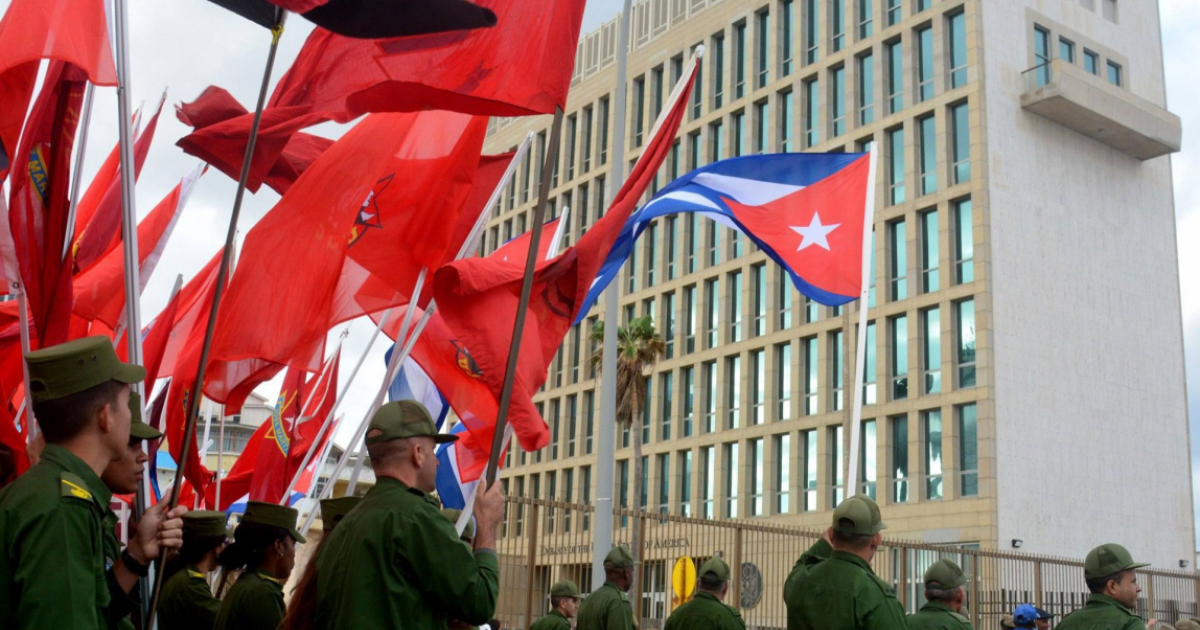
The State Department would be identifying not only those who interact aggressively with U.S. officials during Hammer's visits to the provinces but also the participants in hostile acts in front of the diplomatic mission on the Havana waterfront.
Sources indicated that evidence is being gathered regarding those behaviors to support future immigration decisions.
Although there is no official announcement detailing each of these actions so far, the decision falls within the United States' policy of responding to harassment against its diplomatic staff.
For years, the area in front of the U.S. Embassy has been used by the dictatorship for political rallies and acts of repudiation, a practice that Washington deems incompatible with the Cuban state's international obligations to ensure the protection of accredited personnel.
In that context, the project Cuban Repressors -driven by the Foundation for Human Rights in Cuba (FDHC)- reported the addition of political leaders from Camagüey linked to the organization of recent actions against Hammer to its database.
The inclusion of these names in the database aims to document responsibilities and facilitate future accountability actions.
The escalation occurs following a series of episodes of diplomatic tension.
Last week, Republican Congressman Mario Díaz-Balart warned that anyone or any regime that threatens U.S. officials, whether in Cuba, Venezuela, or other countries, will face consequences.
"Anyone who threatens U.S. officials in Venezuela, Cuba, or elsewhere will face consequences. The United States will not appease or allow impunity for the thugs who endanger American lives," he wrote on X.
His statements came after Mike Hammer became the target of a series of repudiation acts organized by regime structures during his visits to various provinces of the Island.
Government-affiliated groups carried out hostile actions against him, prompting Washington to demand that the Cuban regime immediately halt such acts of aggression.
The Office of Western Hemisphere Affairs then emphasized that "the illegitimate Cuban regime must immediately cease its repressive acts of sending individuals to interfere with the diplomatic work of Chargé d'Affaires Hammer and the members of the Embassy team."
The institution also emphasized that U.S. diplomats will continue to meet with the Cuban people "despite the regime's failed intimidation tactics."
The current tightening is supported by a policy applied more rigorously since last October.
The U.S. has started to deny visas to Cubans linked to the Communist Party or those who have participated in anti-American demonstrations promoted by the regime.
Journalist Mario J. Pentón then revealed that the embassy had revoked the visa of a Cuban citizen after receiving "new information" that made him "ineligible" to enter the country.
A State Department official, quoted by Pentón, confirmed that "participating in the demonstrations organized by the regime in front of the U.S. Embassy in Cuba, sharing anti-American propaganda on social media, and displaying hatred towards democratic values" are sufficient reasons for the immediate revocation of a valid visa.
He added: "Having a visa to enter the United States is not a right, it is a privilege. If you wish to come to the United States, you must respect our country."
These decisions are based on Section 221(i) of the Immigration and Nationality Act (INA), which allows for the revocation of an already issued visa if new information arises that questions the holder's eligibility, ranging from suspicions of fraud to indications of a threat to public or national security.
Months ago, the Embassy in Havana has applied these regulations more rigorously, with particular attention to applicants with labor or ideological ties to the Cuban state apparatus.
In May, Hammer himself indicated that the regulations prohibiting visas for individuals with recent ties to the PCC or state institutions were being enforced more strictly.
"We want to avoid having the repressive forces in the streets of South Beach, sipping on a mojito. That cannot happen, it's not fair," he stated at a press conference in Miami.
As a result, there have been dozens of visa rejections for Cubans who, without being communist militants, worked in state entities or in companies controlled by the regime.
Filed under: