
Related videos:
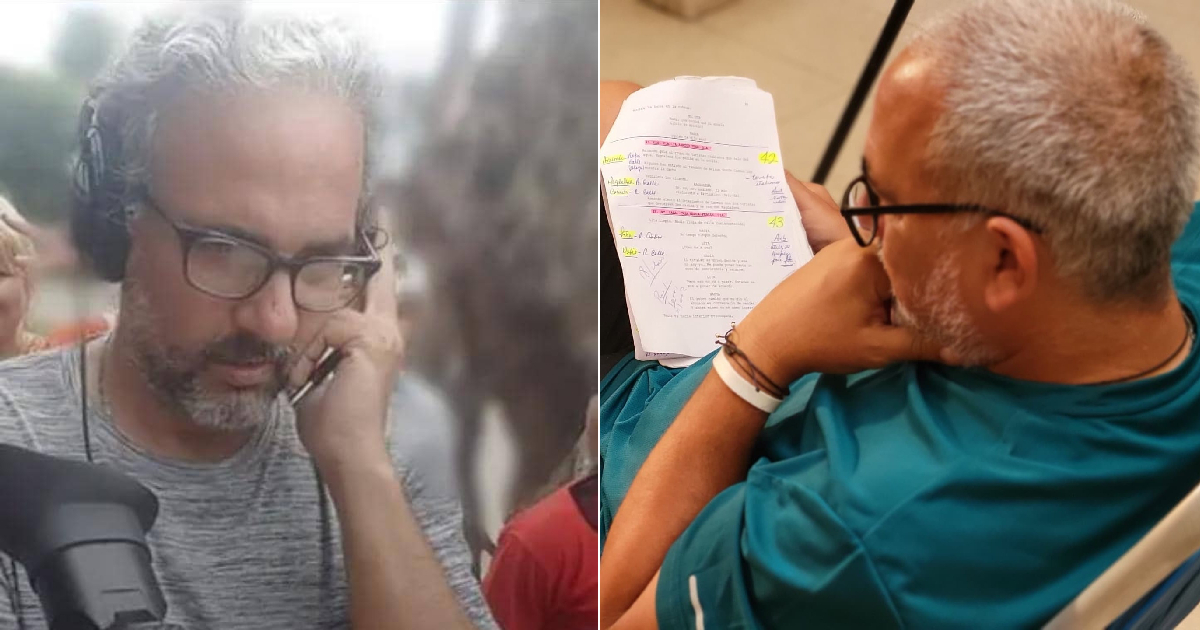
The director and screenwriter from Cuba, Albertico Luberta Martínez, is on the quest for another television success following the airing of his new soap opera Ojo de Agua, which consists of 80 episodes.
What can you tell us about Ojo de Agua?
Well, Ojo de Agua is a fictional locality located in the south of the Artemisa province, although there are several places in Cuba that share that name. The one I'm most familiar with is located at the entrance to San Antonio de los Baños, but I've also heard that there are others in Holguín, Sancti Spíritus, Pinar del Río, and other provinces.
This locality owes its name to the telenovela, which is an original idea by Eurídice Charadán, who received support from María Eugenia Liñero and Yahima Sotolongo, and co-wrote the script with Lil Romero Domínguez.
In the general direction, I am joined by José Víctor Herrera, and the co-direction is led by Humberto Hernández Massia; both of them have been my friends and collaborators for many years, which makes the work process more comfortable.
Under any circumstances, the production of a soap opera is a very complex endeavor, even more so under current conditions, so beyond the script and direction, I am always grateful to each and every person who made the realization of Ojo de Agua. possible.
Particularly to Adriana Paris, who "took on the fight" with us, as we say in good Cuban fashion, from the production direction of the novel. I also thank the Telenovela Production House for their trust, and the advisors Eunice Peña, Beatriz Roussó, and Vanessa Márquez, with whom we maintain regular communication in order to successfully complete the project.
Nevertheless, beyond those specifics, I want to express my gratitude to the team, to those who have been with us for many years in these twists and turns of the audiovisual field, and to those who have recently joined and made the telenovela their own as well. That is always my aspiration, for no one to say, "This is Luberta's or José Víctor's telenovela," but rather for each of them to say, "This is also my telenovela."
Given the significant number of actresses and actors who are no longer in the country, I imagine it has been challenging for you to create a lineup that satisfies you as a director.
Putting together a "line up" (to stick with the baseball term) is always complicated, because they are rarely independent characters; in most cases, they form families and start to play together. Therefore, in addition to the actor's skills, physical characteristics come into play.
There, it is advisable not to rush into making decisions, but rather to allow things to flow and to try different variants, often seeking a mix of established faces with new talent. Additionally, many times you have an actor selected, but then they can't take on the role for some reason, and you have to start rearranging the pieces in search of a new combination of roles.
Decisions are never made by just one person; instead, all three directors and the acting director are involved, in this case, Yailín Coppola.
In Ojo de Agua, for example, the children's characters were very important due to the weight they held in the story. We found two of them quite quickly, but in our search for the other character, we had lengthy casting sessions, tried out many boys, until we found the one who, in our opinion, was the right fit, and we are very pleased with him.
Regarding the casting, I want to first mention Raúl Enríquez, who passed away two days before the show went on air, which was very shocking and painful for everyone.
The protagonists are Yura López, Yeney Bejerano, Alberto Corona, Carlos Migueles, and Denis Ramos. I feel very satisfied to have worked for the first time with Yordanka Ariosa, Luis Ángel Batista, José Luis Hidalgo, Susel Benavides, and Hamlet Paredes, as well as to reunite with Mayra Mazorra, Jorgito Martínez, and Faustino Pérez, among others who would make the list quite extensive. Among the younger ones are Sindy Rosario, Camila Montes de Oca, and Yojan Ramos.
Considering the growing production needs, I imagine that this proposal was not easy to put together.
The novel required very specific locations, and that was the first thing we did when we began pre-production. We searched for those locations to ensure that the novel could move forward.
Fortunately, those locations appeared quite quickly, and then we set the rest of the process in motion.
They were distant and complicated locations, such as the ancient Sepen of the Navy, which is near Playa Salado; the Bajos of Santa Ana, at the border with Playa Baracoa; the town of Peñalver (which belongs to Guanabacoa); Guanabito, which is closer to Campo Florido than to Guanabo, and a farm in La Lisa, located one kilometer off the Pinar del Río highway. That kilometer had to be traversed on foot, and of course, you also had to walk back in the afternoon after long hours of filming. As you can see, there is a significant percentage of peripheral locations.
In Havana, the University, a house on 13 and 8, and the La Covadonga Hospital.
What was your previous work on Cuban television, and what has Albertico Luberta done between that and this one?
My most recent work broadcast on television, before Ojo de Agua, was the telefilm El reverso de la moneda, which aired on August 30, 2025, but I recorded it after finishing the filming of the novela.
In other words, we just finished filming the novela on May 22, and while José Víctor was moving forward with the post-production process, I went to shoot the telefilm, which aired in the segment "Una calle, mil caminos."
It is a television film about a girl who wants to be a boxer, in which I worked again with some of the actors who were part of the cast for the telenovela and also with much of the crew that always accompanies me.
I imagine that the loss of Cary (Caridad Martínez, an iconic figure in Cuban radio) has been a significant blow, even more so because she was both your mother and an artist.
That's right, my mother passed away during the filming of the telenovela. It was a tough blow, and the support from my colleagues was essential. She passed away on a Sunday, and although many suggested that I take more time off, I returned to work on Tuesday.
Why? First, because being cooped up at home wouldn't solve his death; but also, because from my mother and my father I learned dedication to work. It was the first thing they taught me in life, and they did it in the best way… through their example!
Could Delivery and Fight Against Bandits: The Other War be considered your peak television works so far? And in the same vein, what are your expectations for the current Ojo de Agua?
I don't like to talk about peak works. I believe my peak work is still to be created (if I ever create it); on the other hand, each project always contributes something to my career, both personally and professionally. I learn with each day of filming, and that learning is what stays with me always.
In the second question I outlined the topic for you, and although the answer is obvious, I would like to hear your opinion: what do you think is causing the stampede of artists?
I believe it's obvious; you said it yourself. Still, everyone sets their own priorities, as each person knows their own realities and is free to make their own decisions. That deserves respect.
Future plans? Do you have anything new in mind?
There are always future plans, one way or another. Among the most immediate ones, I’ve started writing scripts again for “Tras la huella,” and a youth series is taking its first steps, which I am very excited about, due to the character development and a number of interesting angles that can be explored.
It is an original script by Olga Montes that I hope we can bring to fruition in 2026. There are also a couple of things that can't be discussed yet and a documentary that I have been working on for over three years, which I hope to finish this year as well. I owe it to the protagonists and to myself.
The family?
My family? My family, paraphrasing Sabina, is “my hideaway, my treble clef, my wristwatch.” My wife, with whom I have spent more than half my life, and my two children, the older one following in my footsteps and the younger one sharing my passion for sports, even though he is studying Telecommunications Engineering.
There's also my mother-in-law, who if I don’t mention her, won’t bring me coffee while I’m writing. My brother, who lives in the United States, with whom I’ve always had a friendly relationship. And I can’t forget my friends. Those friends who are also family, both here and there, from the neighborhood, lifelong friends, and those who have gifted me a radio and a television. They are always there, in many ways, in good times and bad, in beer and in sweetened water.
Talking with Albertico Luberta is always a pleasure. I remember when he used to run as a child through the hallways and studios of Radio Progreso, having fun with "Alegrías de sobremesa," and as an adult, loving what he does on television.
Creator of beautiful projects that reach viewers, we cannot expect less from Ojo de Agua, which so far generates diverse opinions among the audience. Some find it entertaining, with good performances and impeccable cinematography, while others point out weaknesses in narrative and technical flaws in the script.
Time will tell. For now, keep watching Ojo de Agua, which, given the country's electrical situation, can be viewed on YouTube, in addition to being rebroadcast on television at 5:30 and 11 in the morning the following day.
Filed under: