
Related videos:
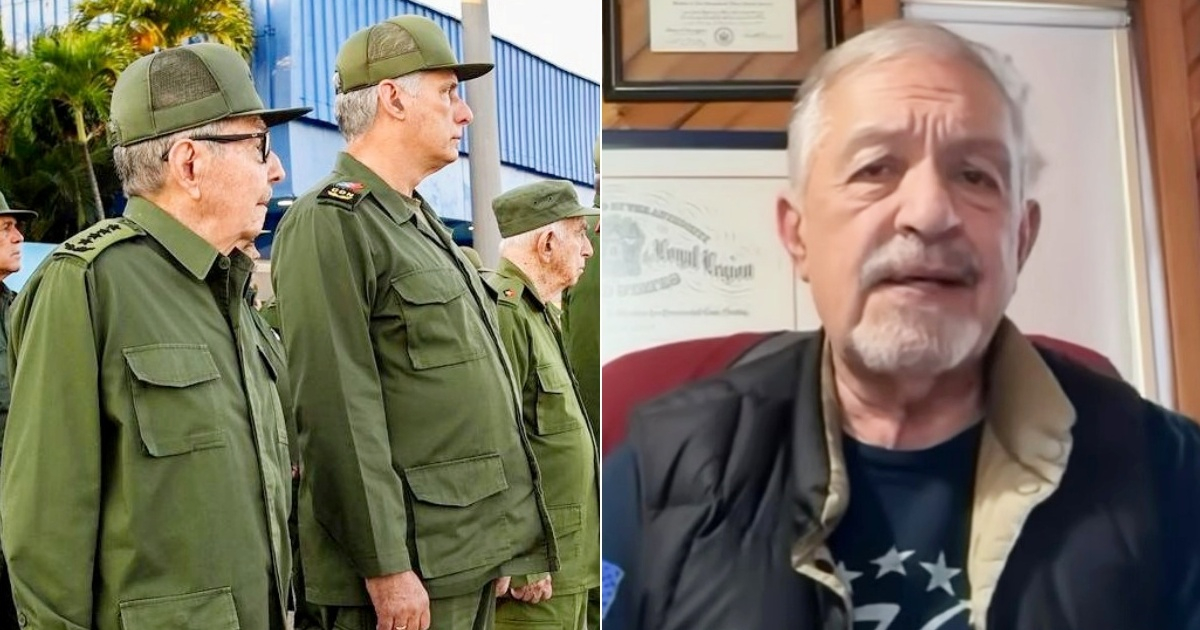
In an interview with journalist Javier Díaz from Univision, retired U.S. Army Colonel and military analyst Eric Rojo shared his insights on the possible scenarios in Cuba amidst the ongoing political and social tension affecting the island.
From his experience, Rojo suggested that any break within an authoritarian system typically does not originate from the military leadership, but rather from the mid-level ranks.
When asked whether the military should side with the people, he honestly replied: "Typically, in dictatorships, high-ranking military officials are completely sold out to the leaders of the government, whether they are presidents or whatever name they may use."
In his opinion, if any kind of internal uprising were to occur, it would come from mid-level officers.
“If there is going to be any revolt from the military, it usually happens at the level of commander, major, or captain, who are people that are not particularly happy with the regime and who would be willing to assume the situation,” he explained.
In contrast, he almost entirely dismissed an initiative from the military leadership.
"The generals and others are completely compromised. It is rare for any of them to take matters into their own hands and lead a revolution, even a non-violent one, but to remove control of the country," he declared.
Russia, China, and the Limits of External Intervention
Regarding the possibility that a military action in Cuba could lead to intervention by powers like Russia or China, the analyst was unequivocal.
It is considered that, beyond speeches or political positions, the logistical and geographical limitations make a real involvement against the U.S. presence in the Caribbean unfeasible.
"We are very far from Russia or China. This is the area of interest for the U.S. We have the Monroe Doctrine, we have history... The geographical distances to do more than just make statements are quite significant. They do not have the capacity to confront the fleets of the U.S.," he stated.
And he concluded: “From a practical standpoint, they lack the capacity to do anything other than give speeches.”
What is the actual military capacity of the Cuban regime?
Regarding the military capabilities of the Cuban regime, Rojo denied that the island possesses sufficient technology or infrastructure to become a regional power.
He recalled that in previous years, Cuba deployed forces in Venezuela, but emphasized that this does not equate to having the capacity for confrontation against the United States.
“No one can confront the U.S. If such a situation were to arise, it would truly be a disaster for the Cuban military, but again, it would be an unnecessary tragedy,” he warned.
Is a regime change imminent?
The retired colonel finally expressed his opinion on the possibility of a regime change in the short term.
He arrived in the United States at the age of 13 and recalled a saying he often heard during his childhood, frequently mentioned in his family: "No pain lasts a hundred years nor can a body endure it."
Rojo lamented that although it has not yet reached a hundred years, several generations have already suffered and continue to suffer under the Cuban regime.
“At some point, with the communications that exist today, the Cuban people must get tired of being dominated… In some way, I hope they understand that there is a way of living different from what they are used to”, he concluded.
Eric Rojo's analysis does not foresee an external military intervention or an immediate uprising from the military leadership.
Rather, it suggests that any transformation in Cuba would depend on internal dynamics, the accumulated wear in society, and eventually, fractures at the intermediate levels of the military apparatus.
Filed under: