
Related videos:
The fines imposed following several inspections in Plaza de la Revolución in Havana sparked a wave of reactions on social media, where much of the commentary questioned the actual impact of the measures.
According to the report published on Facebook by the Municipal Administration Council, 11 non-state management entities were visited in one week, including nine self-employed workers, three small and medium-sized enterprises (mipymes), and one state management entity. A total of 12 fines were imposed for various violations.
Among the highlighted cases is a self-employed worker from the establishment "El Divino," who was fined 5,000 CUP and 8,000 CUP for not having the price visible on a leather package and a candy, and for violating the price according to the whisky invoice. Another self-employed worker from "Donatello" was fined 5,000 CUP for not having the price list visible.
Sanctions were also imposed on SMEs such as "Prado Montero," fined 1,500 CUP for lack of hygiene at the business entrance, and "El Recanto," with two fines of 8,000 CUP for price violations on the product "chupa chupa" according to the Municipal Administration Council's agreement. In the case of the SME "Célebre," a fine of 5,000 CUP was imposed for having outdated prices on the display board.
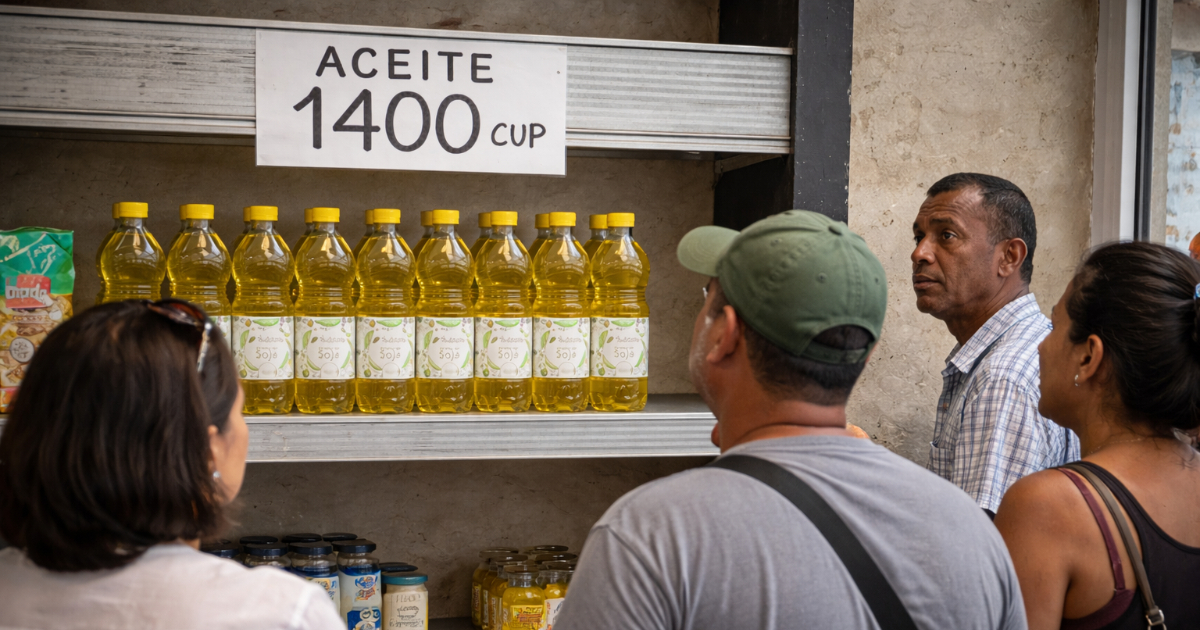
At the National Bus Terminal, a self-employed worker from "Esencia de Café" was sanctioned for the forced sale of oil —which he did not have in the one-liter bottle at 1,500 CUP and in the 900 ml bottle at 1,400 CUP— and for violations related to products such as milk and confections, according to the official publication.
The images shared by the authorities showed, among other examples, bottles of oil priced at up to 1,400 CUP.
However, many users shifted the focus to the stores that operate in foreign currency. “Go to the dollar stores where it costs you $2.60, multiply it to see who is violating the law,” wrote one internet user. Another commented: “You also have to visit the dollar stores; the prices are really high and, of course, inaccessible.” Similar questions were repeated, such as: “When are they going to do the same with the dollar stores?” and “Lower the prices in the dollar stores, that’s what they need to do.”
Some conducted public calculations. "In the USD store, the oil costs 2.40, and for the exchange rate of CAD, it’s 1099. Go check it out and look at the milk too," noted one user. Another asked, "And who fines the state for selling oil in dollar stores above that price, according to the exchange rate? Scam."
The effectiveness of fines was another of the most discussed points. “Fines in small and medium-sized enterprises are not significant because they can earn that in a day,” commented one user. In a similar vein, another remarked: “It’s a game between the one imposing the fine, the one paying it, and the one authorizing it. The fine doesn’t solve anything, nor does it enforce discipline." And, “A fine for selling chupa chupa, what a ridiculous feat.”
The issue of electronic transfers also came up frequently. "No place is accepting transfers anymore," wrote one user. Another pointed out, "It's the duty of micro, small, and medium enterprises to accept transfers, and that is not being fulfilled." Several people reported limits on the amounts or outright refusals to accept digital payments.
At the same time, there were voices that supported the inspections. "Tough measures against illegalities," commented one user. Another expressed, "Relentless war against price violators; where they are selling oil, they are violating the rules by selling it for 1500 or 1400." There were also calls to expand the operations to other municipalities and to carry them out more systematically.
Among the most extensive comments, some attempted to explain the current economic dynamics, highlighting the purchase of dollars in the informal market, the difficulties in withdrawing cash from banks, and the impact of the exchange rate on price formation. Others summarized the discontent in phrases like: “The issue isn't the prices; the issue is that there is nothing.”
The debate in Havana takes place just days after it was officially reported in Guantanamo about more than 2,600 inspections, 1,538 fines, and 162 forced sales in the early days of February, with an infringement rate exceeding 58%, according to state media in a report on the scope of these measures. In that case, there were also numerous questions raised on social media regarding prices in shops selling in foreign currency and the effectiveness of the sanctions.
In Plaza, as in Guantánamo, the public debate reflects a situation marked by inflation, scarcity, and tension between price ceilings and the actual market. While the authorities maintain their price control policy, part of the population demands that these measures also apply to stores in dollars and questions why many basic products are sold in foreign currency while salaries are paid in Cuban pesos.
Filed under: