
Related videos:
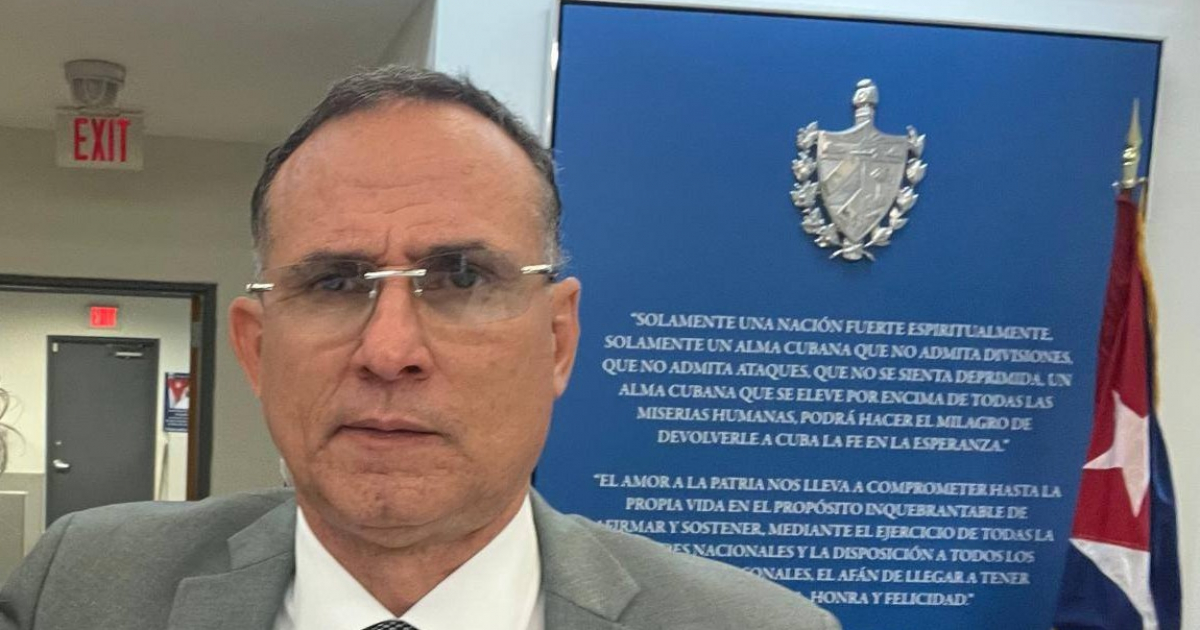
The opponent and former political prisoner from Cuba, José Daniel Ferrer, stated that a strong action by the United States against the regime, similar to the operation in January that resulted in the capture of Nicolás Maduro in Venezuela, should "remove from power" the leader Miguel Díaz-Canel and Colonel Alejandro Castro Espín, the eldest son of Raúl Castro.
In an interview granted to the agency EFE in Miami, where he has been living as a political refugee since October, Ferrer stated that both leaders are directly responsible for the situation facing the Island.
"They are responsible for many crimes and even much death, and therefore, the solution is to remove them from power," he stated.
Although he expressed support for “serious conversations to initiate the transition” immediately, he warned that if the “Cuban drama continues to escalate,” he would back a more drastic solution, even “in the style of Maduro.”
When asked who could assume a role similar to that of Delcy Rodríguez in Venezuela, Ferrer responded that there is speculation on social media about Ana María Mari Machado, the vice president of the National Assembly of People's Power.
He described her as a "figure perhaps less hated by the people," in contrast to others who are constantly seen on television, such as Díaz-Canel, Raúl Castro, or Manuel Marrero.
However, he insisted that his preference is for a transition driven by the Cubans themselves. "I have always been an advocate for Cubans to achieve freedom and democracy through our own efforts."
However, he made it clear that if the regime closes any avenue for change, "what is needed is action."
"A people with less fear every day"
The leader of the Patriotic Union of Cuba (UNPACU) expressed that for the first time in decades, conditions are converging that could lead to a transition. "I would start with a Cuba that is increasingly discontented and rebellious, with less fear each time," he stated. He noted that protests are no longer held in secret, but are becoming more open.
He also highlighted the "awakening of youth" and mentioned the digital project El4tico, whose members have received "incredible solidarity from young people within Cuba, like never seen before," which in his opinion reflects a profound change in Cuban society.
To these internal factors, external elements are added: the blow suffered by the Venezuelan government, which left the Cuban regime without a key ally; the "maximum pressure on tyranny" policy implemented by Washington; and the distancing from other strategic partners.
"The regime's allies (China, Russia) are distancing themselves because they know that this very bad company is not in their best interest," he stated, referring to the potential tariffs for those supplying fuel to Havana.
He also recalled that Russia is facing its own crisis due to the war against Ukraine and that Brazilian President Luiz Inácio Lula da Silva is being "quite discreet."
"For many years it has been said 'this time for sure', but never have so many factors converged that allow us to claim that this year the Castro-communist regime will not survive. But yes, now we are indeed very close," he emphasized.
International pressure and fuel
Regarding the policy the United States should follow, Ferrer was explicit: "continue to apply pressure," including enforcing the tariffs announced by Donald Trump on anyone who sends oil to the regime.
He stated that the Cuban government is maintaining reserves of fuel stored in the eastern part of the country.
And regarding Mexico, she said that "the oil she wants to send to the Cuban regime is not for ambulances; it is for the vehicles of high-ranking officials and primarily for the repressive force."
He added that if there is a true desire to support the people, the aid should consist of "food, medicines, and basic necessities" sent directly to the population, "through the Church or any other actor."
Ferrer’s statements reflect a direct stance against the Castro regime, responsible for the repression and deterioration of living conditions on the Island.
His call combines the push for a negotiated transition with the warning that, if there is no openness, a more forceful solution could be imposed.
Filed under: