
Related videos:
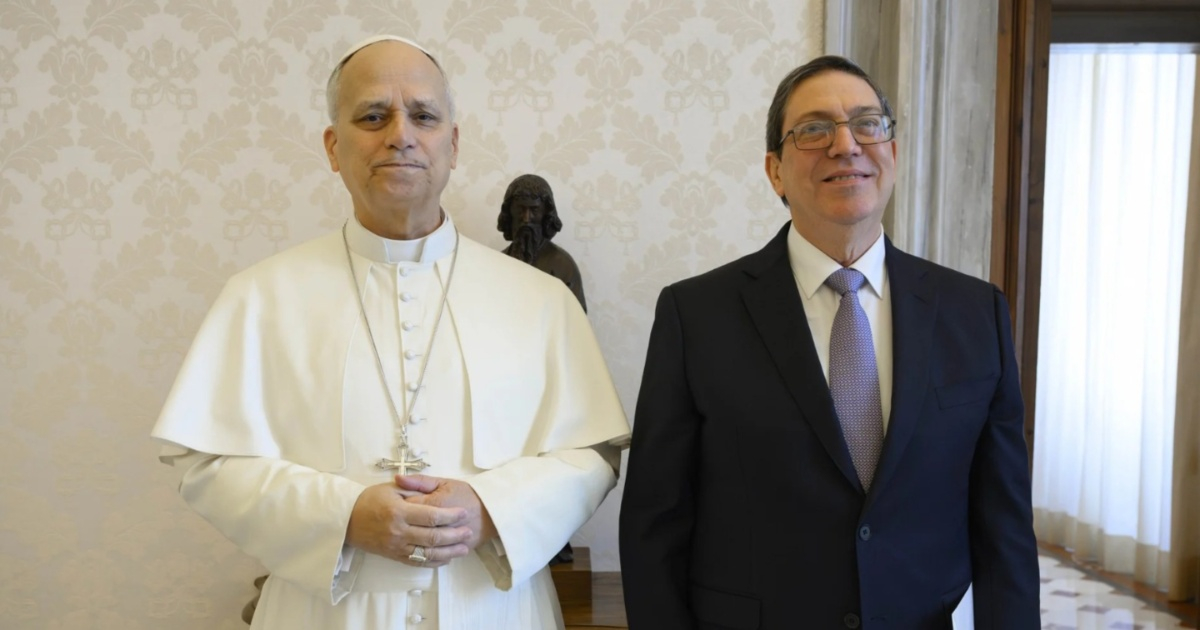
The Holy See is reportedly undertaking a diplomatic mediation between the United States and Cuba, although sources close to the Vatican's Secretary of State warn that the situation is “neither rosy nor easy," due to both the complexity of the bilateral relationship and the distance between Pope Leo XIV and U.S. President Donald Trump, as reported by Agenzia Nova from Rome.
The agency cited a source close to Cardinal Pietro Parolin —Vatican Secretary of State— when asked about ongoing conversations with the Cuban Foreign Minister Bruno Rodríguez Parrilla and the Chargé d'Affaires of the U.S. in Havana, Mike Hammer, who, according to the report, are currently in Rome.
The note states that Rome has become the center of intense diplomatic activity regarding Cuba.
According to the report, Rodríguez Parrilla arrived in the Italian capital on February 25 and would seek to discuss the situation on the island with the Holy See, amid what the text describes as a U.S. policy of "maximum economic pressure."
The same report adds that the discussions may also involve Mike Hammer, who—according to "other diplomatic sources" cited—was in Rome following recent efforts in Italy related to the recruitment of Cuban doctors, and after meetings in various sectors.
The coldness towards the White House complicates mediation, according to the source
One of the elements that, according to the source cited by Agenzia Nova, complicates the mediation is the state of relations between the Vatican and the White House.
As a sign of that coldness, the report states that the Pope decided to visit Lampedusa on July 4 and declined an invitation to Washington for the celebrations of the 250th anniversary of the independence of the U.S., an invitation that —according to the text— was said to have been delivered personally by Vice President JD Vance, according to a disclosure from Time mentioned by the agency.
In that context, the source indicates that the Vatican's "preferred interlocutor" would continue to be Secretary of State Marco Rubio.
The report links mediation with signs of ecclesiastical concern regarding the crisis in Cuba. On February 1st, at the end of the Angelus prayer, Pope Leo XIV expressed concern for the "suffering of the beloved Cuban people."
It also mentions that on January 31, Cuban bishops released a message expressing "deep concern" over the social and economic deterioration, warning of the "real risk" of a greater social collapse, especially following recent decisions attributed to President Trump aimed at blocking the island's energy supply, with the subsequent danger of chaos and violence.
According to the document, the Cuban bishops had planned a visit to the Vatican from February 16 to 20, but they postponed it due to the worsening socioeconomic situation in the country.
Hammer meetings at the Vatican and contacts with the Cuban Church
Agenzia Nova reported that Hammer discussed the situation in Cuba with the Vatican Secretary for Relations with States, Paul Richard Gallagher, in a meeting that also included the U.S. Ambassador to the Holy See, Brian Burch, where the role of the Catholic Church on the island was emphasized.
The report adds that Hammer met in Rome with the bishop of Guantánamo-Baracoa, Silvano Pedroso Montalvo, who had been received in audience by the Pope and was staying in Rome due to gastritis, according to a statement cited from the Conference of Catholic Bishops of Cuba.
Furthermore, the text states that Hammer met with Cuban exiles in Italy and urged them to support a "peaceful and swift" transition, citing statements attributed to him in EFE about the need to unite efforts—including the Vatican and the Italian government—to support a transition "soon and peacefully."
The Background of Venezuela: Failed Mediation before a Military Operation
The piece from Agenzia Nova recalls that the Holy See had previously attempted—unsuccessfully—to mediate between the U.S. and Venezuela prior to a U.S. military operation in Caracas on January 3, in which Nicolás Maduro was removed from his residence, according to the report itself.
According to that version, Parolin allegedly asked Ambassador Brian Burch on December 24 to offer an exit for Maduro and also tried to contact Rubio to prevent a bloodbath, although the White House decided to go ahead with the operation.
The report presents the Vatican mediation as active, but emphasizes that the context is difficult and that it is not a “simple” process nor one with guarantees of success.
Filed under: