
Related videos:
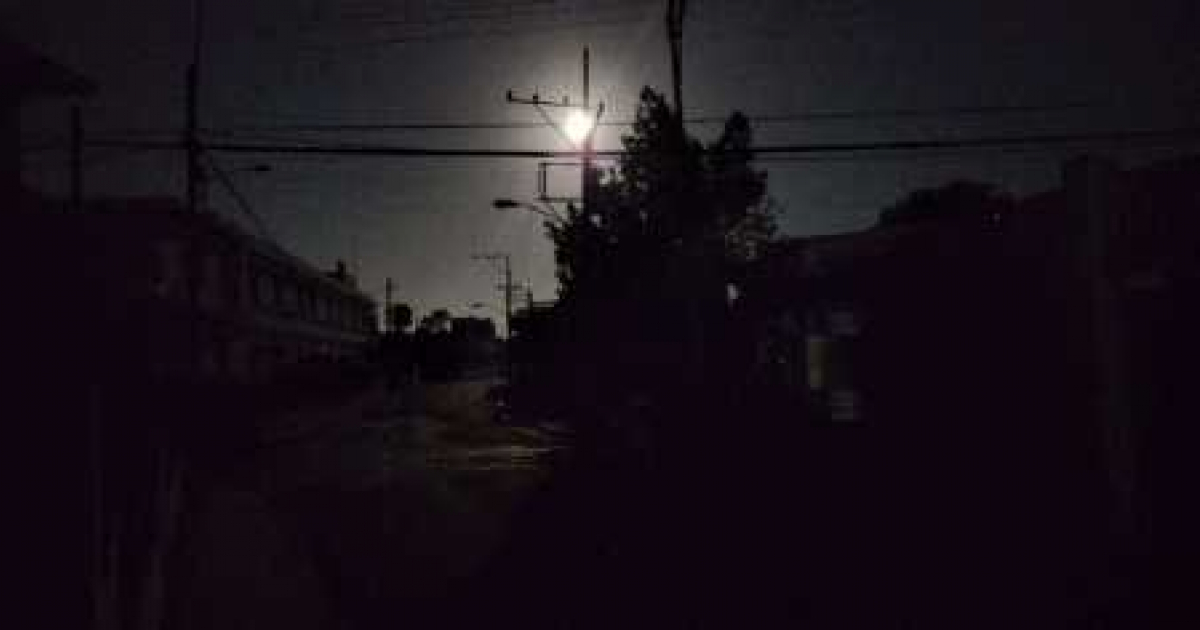
Blackouts continue to hit millions of Cubans hard as the country's energy crisis remains unresolved.
The report from the Electric Union (UNE) this Monday confirms that the National Electric System (SEN) is once again operating with a significant generation deficit, amidst a backdrop characterized by breakdowns, maintenance issues, and limitations in thermal generation.
The service was disrupted for 24 hours on Sunday, and the blackouts continued into the early hours of today.
The highest recorded impact reached 1804 megawatts (MW) at 7:40 PM, one of the highest levels of deficit in recent months.
An electrical system unable to meet the demand
At 6:00 am this Monday, the SEN had a capacity of 1150 MW against a demand of 2290 MW, resulting in an impact of 1140 MW at that moment.
For the midday forecast, the company anticipates that the power outages will remain significant, with an estimated impact of 1100 MW.
Breakdowns and maintenance continue to impact generation
The official report details that five generating units are out of service due to malfunctions, distributed across the thermoelectric plants Mariel, Diez de Octubre, Felton, and Antonio Maceo.
These failures are compounded by three units undergoing scheduled maintenance at the Mariel, Nuevitas, and Carlos Manuel de Céspedes plants.
Additionally, the UNE reports 416 MW out of service due to limitations in thermal generation, another factor that exacerbates the capacity deficit.
Equally critical forecast for the night
For peak consumption hours, the agency anticipates the addition of two generating units: one at the Antonio Maceo thermoelectric plant with 70 MW, and another at Energás Jaruco with 30 MW.
Even with these additions, the system would only reach 1250 MW of availability against an estimated demand of 3080 MW.
This would result in a deficit of 1830 MW, which would translate to an estimated impact of 1850 MW during the nighttime peak, one of the most severe levels of blackouts.
Havana also experienced long power outages
The energy crisis has not spared the capital either. The Electric Company of Havana reported that on Sunday, the power service in the city was interrupted for 17 hours and 13 minutes.
The largest recorded impact was 189 MW at 7:10 PM.
In addition, the authorities had to implement 40 MW of emergency load shedding, and even so, it was not possible to fully restore the service due to the generation deficit.
At the close of the official report, six blocks remained without electricity, amounting to an impact of 206 MW, with a forecast for restoration during the morning.
The company also warned that blackouts due to the so-called "energy contingency" will continue without a fixed schedule, as they depend on the actual availability of the national electric system.
Insufficient solar energy
Amid this crisis, the UNE reported that the 51 new photovoltaic solar parks generated 3,234 megawatt-hours (MWh) during the day, reaching a peak power of 585 MW at noon.
Although this generation constitutes an additional contribution to the system, it remains insufficient to compensate for the enormous deficit in electricity production that the country faces.
La Guiteras has resumed operations, but the power outages persist
The energy crisis occurs just a day after the largest thermoelectric power plant in the country, the Antonio Guiteras thermoelectric plant successfully re-synchronized with the grid on Sunday.
The plant had suffered a breakdown the previous Wednesday, causing a massive blackout that left much of the country without electricity, from Las Tunas to Pinar del Río.
Although the unit was able to reconnect to the system, the restoration has not provided any real relief for the population. On Sunday, power outages lasted for long hours across the country, and this Monday, the situation remains the same.
For millions of Cubans, the return of the country's main thermoelectric plant has not changed the situation: power outages continue to dominate daily life.
The situation reflects the fragility of an aging and poorly maintained electrical system over the years.
The country's thermoelectric plants have suffered from decades of intensive exploitation, a lack of investment, and makeshift repairs, which have ultimately turned electricity generation into a permanent source of crisis.
Meanwhile, the population continues to endure increasingly prolonged blackouts, in a scenario that reflects the consequences of years of lack of investment, poor management, and the deterioration of the national energy infrastructure.
Filed under: