
Related videos:
The message of Miguel Díaz-Canel for International Women's Day, shared on the official profiles of the Presidency and the leader himself, sparked a wave of reactions on social media this March 8.
With the country undergoing an unprecedented systemic crisis, users' reactions were primarily characterized by critical, ironic comments, and outright rejection of the contrast between the official discourse and the reality faced by millions of Cubans.
In one of the messages, the ruler stated that engaging in dialogue with Cuban women "always uplifts, emancipates" and defended the "achievements" they have made in the so-called "revolution."
In another post, he stated that “the light of our days has much to do with women: sensitivity, talent, and commitment to the country's fate,” accompanying the text with the promotion of an interview with a scientist linked to the photovoltaic field.
However, the official emphasis on “light,” “sensitivity,” and “achievements” immediately clashed with the dark humor and outrage expressed in dozens of comments, many of which focused on the daily drama of blackouts, food shortages, lack of water, and the precariousness that particularly affects women.
The most repeated phrase, in various forms, was a question as simple as it was devastating: “Which light?”.
The expression became a focal point of popular criticism. A commentator captured the sentiment of many with a line laden with sarcasm: “Good day, but please don’t talk to me about electricity until the service is restored”.
Another was even more piercing in describing electricity in Cuba as “an unfaithful mistress, who leaves when she wants and returns whenever she pleases”.
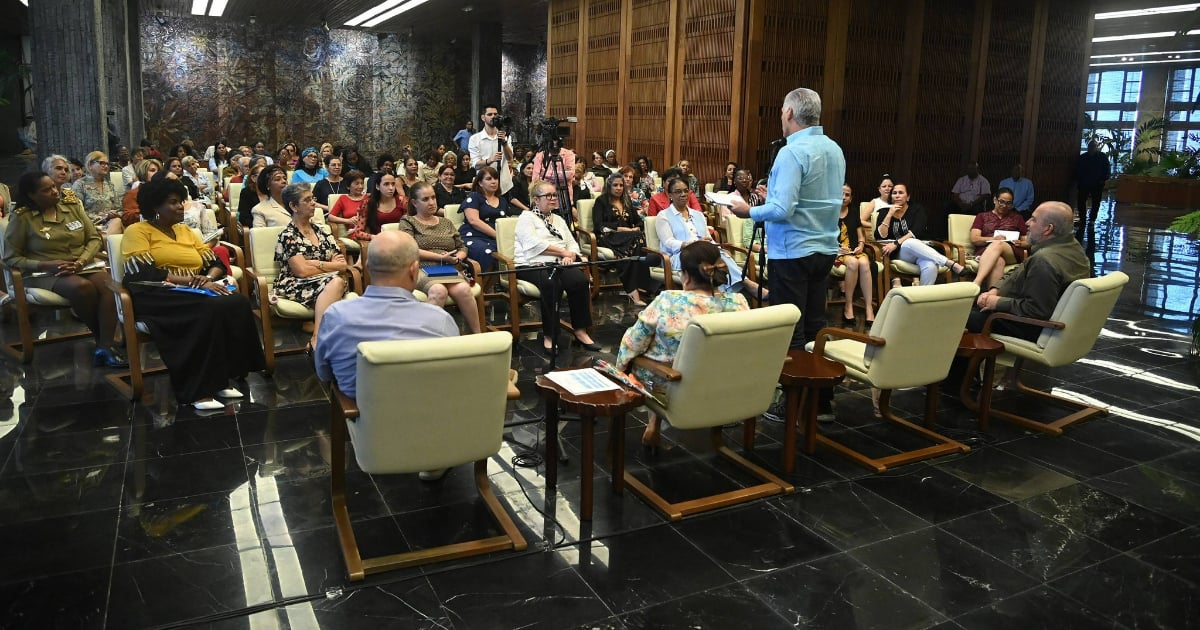
The popular wit also emerged in observations that blended irony and critique. “There was indeed electricity there”, several users pointed out while commenting on the images of the official meeting of the “appointed” with the Cuban Federation of Women (FMC) in the air-conditioned halls of the Palace.
The idea was echoed in more than one publication and highlighted the disconnect between the scenery of power and the darkness in which much of the country survives.
Other comments were less humorous and more raw. Several women and family members described a March 8th without any possibility of celebration, marked by the anguish of not knowing what to feed their children, what to cook, or how to cope with the lack of electricity.
A user wrote that Cuban women "have nothing to celebrate today"; another lamented that "we are no longer happy, we do not have a day of happiness".
There were also messages that portrayed the Cuban woman as someone who wakes up each morning thinking about food, water, electricity, and how to endure another day.
That tone of exhaustion emerged repeatedly. Some spoke of women “finding ways to ensure their families do not go to bed hungry,” and others recalled the mothers and grandmothers who today cook “with charcoal and firewood,” an image that undermines any attempts to gloss over the crisis with the worn slogans of the official FMC.
Several commentators also highlighted the lack of representation at the official event. They questioned why the dialogue announced by Díaz-Canel did not include the Cuban women protesting against power outages, those waiting in endless lines, those unable to find medicine for their children, or the mothers of political prisoners.
“They didn't talk to Cuban women, they talked to the women who will tell them what they want to hear”, came to say one of the most accurate comments.
Messages were also highlighted that called for visibility for political prisoners, the Ladies in White, and the mothers of young people imprisoned for protesting.
In that group of reactions, one idea resonated strongly: the best gift for the Cuban woman would not be an official greeting or a slogan, but rather "freedom" and "a dignified life."
Among the sharpest comments were those that dismantled the grandiose tone of the presidential message with a single phrase. “It is cynical to offer congratulations and even more so to talk about light.”, wrote one person.
Another one concluded: “What light are you talking about, if we live in eternal darkness?”. There were even some who pointed out that using that word amid power outages lasting 20, 30 hours or more was a mockery.
Irony also arrived through the political route. Some users recalled that Cuban women are now, more than official symbols of heroism, the primary managers of domestic survival in a country in ruins.
Instead of "conquests," they spoke of hunger, misery, stress, desperation, and emotional exhaustion. A commentator summarized that sentiment with a phrase as bitter as it is eloquent: "Life hurts us".
Every solemn phrase from the government was met with a reminder of reality. While Díaz-Canel's message spoke of a "commitment to the country's fate," many responded with the prices of rice, oil, or the accumulated hours without electricity.
If he appealed to revolutionary epic, the responses returned scenes of exhausted women cooking with coal, without medications, and trying to calm heated children in the midst of the blackout.
More than a celebration, what these reactions revealed was a deep social discomfort. And something more: that in today's Cuba, humor, irony, and brief commentary have become tools for venting against the official rhetoric of the regime, which is increasingly disconnected from real life.
This March 8th, while the authorities tried to wrap Cuban women in words like "emancipation," "achievements," and "light," a significant portion of the comments offered a much more down-to-earth response: hunger, blackouts, and frustration.
And amid that critical chorus, the question that was asked most frequently turned out to be the most devastating: "Which light?”.
Filed under: